
Quantum Computer Stores Data in Vibrations Like Notes on a Guitar
Understand this faster with AI


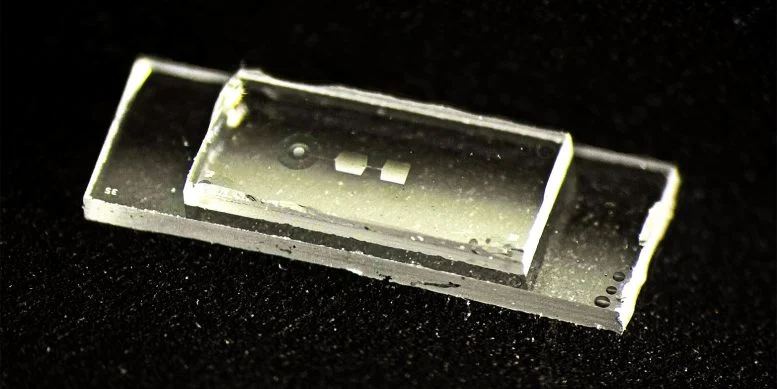
The new quantum chip developed by ETH Zurich physicist Yiwen Chu contains so-called mechanical resonators, tiny components that begin to vibrate when storing information. The chip is approximately 7.5 millimeters long, 2.5 millimeters wide, and 1 millimeter high. This makes it roughly as wide as a small fingernail. Credit: Hybrid Quantum Systems Group / ETH ZurichInside a chip no wider than a fingernail, a quantum computer is storing information as tiny vibrations, a breakthrough that could reshape how these machines are built.A quantum computer does not usually bring musical instruments to mind. Yet inside a chip developed at ETH Zurich, information is stored in vibrations that behave somewhat like notes resonating through a guitar.These movements cannot be heard. They occur at extremely high frequencies inside microscopic mechanical resonators, where packets of vibrational energy called phonons carry quantum information. The entire experimental chip measures about 7.5 millimeters long, 2.5 millimeters wide, and 1 millimeter thick (0.30 inches long, 0.10 inches wide, and 0.04 inches thick), making it roughly as wide as a small fingernail.Led by quantum physicist Yiwen Chu, the team used these tiny resonators as a working memory connected to a superconducting quantum processor. Their results, published in Science, demonstrate a different way to organize a quantum computer, one that more closely resembles the basic structure of the classical computers used today.“The interaction between the quantum processor and the quantum memory provides a crucial foundation with a view to establishing quantum computers as a powerful and reliable way to perform computations that are not feasible with conventional computers,” says Yiwen Chu.Borrowing the CPU and RAM ModelMost quantum systems do not clearly separate calculation from memory. Processing and information storage are often closely integrated into the same hardware, which can make it difficult to expand the machine without adding more bulky components.Chu’s team instead borrowed a familiar idea from conventional computing. In a digital computer, a central processing unit (CPU) performs calculations while data is temporarily held in random access memory (RAM). Separating those jobs allows the processor to retrieve information when needed rather than forcing every part of the system to perform every task.The experimental quantum architecture follows a similar principle. A superconducting qubit serves as the processor and control unit, while mechanical resonators hold quantum information during the calculation.“In our quantum working memory, however, information is not stored electromagnetically, as is usually the case today, but rather in the form of mechanical vibrations,” explains Chu.How Vibrational Quantum Memory WorksA qubit differs fundamentally from a classical bit, which represents either 0 or 1. Quantum states can exist in combinations known as superpositions and can become entangled with one another. These properties could eventually allow quantum computers to solve certain problems more efficiently than conventional machines, although building hardware that can preserve and control such delicate states remains a major challenge.The ETH Zurich system stores information in specific vibrational modes inside the resonators. When the processor needs that information, the superconducting qubit interacts with the selected mode, modifies its quantum state, and returns it to memory.This creates a division of labor between two technologies with different strengths. Superconducting qubits can perform fast operations and provide the nonlinear behavior needed for quantum logic. Mechanical resonators are compact, support many separate vibrational modes, and can preserve quantum states for relatively long periods.Many existing designs use electromagnetic resonators as memory because they can be controlled with exceptional precision and already work well with superconducting circuits. Their size, however, becomes a problem as engineers attempt to fit increasing numbers of memory elements and qubits onto a chip.Smaller Memory With Greater CapacityMechanical resonators can pack many modes into a much smaller space. Each mode can act as a separate place to store information, giving a single component access to multiple memory locations rather than requiring an individual electromagnetic device for each one.The researchers have now experimentally shown that these mechanical modes can do more than passively preserve quantum information. When coupled to a superconducting qubit, they can participate in a programmable architecture capable of carrying out quantum calculations. The study provides a proof of principle, not a finished commercial computer, but it shows that vibration-based memory can function as a practical computational resource.To test the design, the researchers implemented two important procedures: the quantum Fourier transform and quantum period finding.“The Quantum Fourier Transform is a fundamental computational procedure required for many quantum algorithms. The period-finding algorithm we implemented served as a demonstration of how this procedure can be used,” explains Igor Kladaric, a doctoral student in Chu’s team and co-author of the publication.Testing a Programmable Quantum ArchitectureThe quantum Fourier transform helps reveal patterns hidden in quantum data and appears as a building block in several major algorithms. Period finding applies that procedure to identify repeating mathematical structures. It is closely associated with some of the most widely discussed potential uses of quantum computation.Both tests required the system to prepare, store, connect, and precisely manipulate several quantum states. The architecture also had to move information between the processor and different mechanical memory modes without destroying the coherence needed for the calculation. The successful demonstrations showed that the system could perform controlled phase operations and connect stored states across its available memory.In principle, the architecture includes the essential operations needed for general-purpose quantum computation. That does not mean the chip can already outperform conventional computers. Its importance lies in showing that a processor can control a compact collection of mechanical memory modes and use them to run programmable algorithms.The next obstacle is scale. A useful quantum computer would need far more memory, greater processing power, low error rates, and reliable control over a much larger collection of quantum states. Researchers must now determine whether mechanical resonators can retain their advantages as the architecture expands.Reference: “Mechanical resonator–based quantum computing” by Yu Yang, Igor Kladarić, Martynas Skrabulis, Michael Eichenberger, Stefano Marti, Simon Storz, Jonathan Esche, Raquel García Bellés, Max-Emanuel Kern, Andraz Omahen, Arianne Brooks, Marius Bild, Matteo Fadel and Yiwen Chu, 28 May 2026, Science. DOI: 10.1126/science.aef4139Never miss a breakthrough: Join the SciTechDaily newsletter.Follow us on Google and Google News.