
Photonic CMOS Chip Shows Superior Noise Tolerance to Superconducting Qubits
Understand this faster with AI


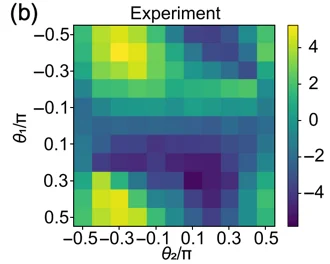
Researchers have designed and benchmarked RP000, a three-qubit photonic quantum processor built using standard CMOS-compatible manufacturing and operating at room temperature, a significant departure from the cryogenic cooling typically required for many quantum systems. The work details a chip capable of encoding quantum information in single photons, then tests its performance against machine learning tasks using three quantum-classical architectures. Experimental results and simulations demonstrate the chip achieves higher accuracy than classical networks of comparable size in multiple applications and exhibits superior noise tolerance when compared to a superconducting quantum processor. These findings, the authors state, “validate our steps toward a feasible, scalable route to efficient quantum applications and chip design.” This advance offers a promising pathway toward practical quantum computing by addressing key challenges in scalability and operating conditions. RP000 Chip: Three-Qubit Design and Telecom C-Band Operation This departure from the cryogenic requirements of many quantum systems, including superconducting architectures, represents a significant engineering step toward wider accessibility and reduced operational costs. The chip encodes quantum information within the properties of single photons, a method that inherently offers superior noise tolerance when contrasted with superconducting qubits. This CMOS-based approach leverages a graded algebraic structure, where a single photon embodies multiple logical degrees of freedom, enabling compact multi-qubit operations and mode-preserving linear-optical transformations. The design utilizes a minimal (Z_2)^3-graded Lie algebra to model and implement quantum photonic operations, providing a consistent language for describing optical mode coupling. Researchers benchmarked RP000 against machine learning tasks, evaluating three quantum-classical architectures of increasing complexity to assess performance. The chip’s operation within the telecom C-band is particularly noteworthy because it aligns with existing telecommunications infrastructure, simplifying integration and potentially accelerating scalability for real-world applications. The authors detail that the chip is realized using standard CMOS-compatible manufacturing processes, highlighting the use of established fabrication techniques. The processor operates entirely at room temperature, eliminating the need for complex and expensive cooling systems.
The team emphasizes that the primary barriers to building larger systems are engineering challenges, integrating detectors and single photon sources, increasing control electronics density, and actively stabilizing larger reconfigurable circuits, rather than fundamental physical limitations of the photonic platform. Attention is focusing on silicon photonics as a viable platform for quantum computation, and a team including Alessandro Luongo is demonstrating a functional three-qubit processor built using standard manufacturing techniques. Their work details RP000, a chip designed for operation in the telecom C-band, a wavelength range crucial for compatibility with existing fiber optic networks. This focus on established CMOS processes represents a departure from the complex and costly fabrication required for many superconducting quantum systems, potentially accelerating scalability. Central to the RP000 processor is an innovative approach to encoding quantum information. The researchers implemented a minimal (Z_2)^3-graded Lie algebra, a mathematical framework allowing a single photon to embody multiple logical degrees of freedom, streamlining qubit operations. They explain that this graded algebraic structure provides a natural language for describing the coupling between optical modes while maintaining algebraic consistency. This co-design approach is critical for validating the entire quantum hardware and software stack, from calibrating on-chip unitaries to executing multilayer quantum circuits. Their work focuses on identifying design methodologies and production pipelines, rather than immediate architectural scalability, establishing a foundation for future expansion. The development of practical quantum computers hinges not only on increasing qubit counts but also on establishing reliable manufacturing processes and demonstrating performance advantages over classical systems. Recent work details RP000, a three-qubit photonic quantum processor designed to address these challenges, and its implementation of a specific quantum circuit known as an Ansatz.
The team focused on building a functional processor and validating the entire hardware-software stack, rather than immediately pursuing architectural scalability. Central to RP000’s operation is a carefully chosen circuit structure. The researchers implemented a layered architecture consisting of alternating R_y and R_z rotations coupled with CNOT gates, a configuration known as an Ansatz. This specific arrangement allows for the creation of entanglement between qubits and the exploration of quantum algorithms. They explain that this graded algebraic structure ensures algebraic consistency across different parity sectors within the system.
The team evaluated three quantum-classical architectures of increasing complexity, assessing the chip’s accuracy against classical networks of comparable size. Conventional wisdom suggests quantum processor evaluation focuses solely on qubit fidelity and gate accuracy. However, a newly detailed photonic chip, RP000, demonstrates that meaningful benchmarking demands a holistic assessment spanning the entire hardware-software stack, from fabrication to application performance. This three-qubit processor, operating in the telecom C-band at room temperature and built using standard CMOS processes, isn’t merely a demonstration of quantum mechanics; it’s a testbed for streamlining the development pipeline. This isn’t merely theoretical elegance; it’s a practical method for managing the complex interactions within the photonic circuit. This noise resilience is a significant advantage, as it suggests photonic systems may be less susceptible to environmental disturbances that plague other quantum platforms. A key benchmark for any emerging quantum technology lies in demonstrable performance advantages over existing classical and competing quantum approaches, and the newly detailed RP000 photonic processor delivers compelling results in this regard. The design team deliberately chose operation in the telecom C-band, a decision that eases integration with existing telecommunications infrastructure and simplifies scaling for future applications. This focus on compatibility is crucial, as it lowers the barrier to entry for incorporating photonic quantum processors into existing networks.
The team’s benchmarking extends beyond basic gate fidelity measurements, encompassing supervised machine-learning tasks to evaluate end-to-end performance. This holistic approach, as the authors emphasize, demands a comprehensive assessment of the entire hardware-software stack. They state, “We remark that the goal of this work is to identify design methodologies for photonic processors and production pipelines,” signaling a continued focus on refining the manufacturing and control aspects of the technology. Source: https://arxiv.org/abs/2607.06488 Stay currentSee today’s quantum computing news on Quantum Zeitgeist for the latest breakthroughs in qubits, hardware, algorithms, and industry deals. Tags:
Tags
Source Information
Discussion
0 professional contributions
Sign in to join this professional discussion.
Be the first to add a constructive contribution.