
New protocol makes an elusive superconducting signature measurable
Understand this faster with AI


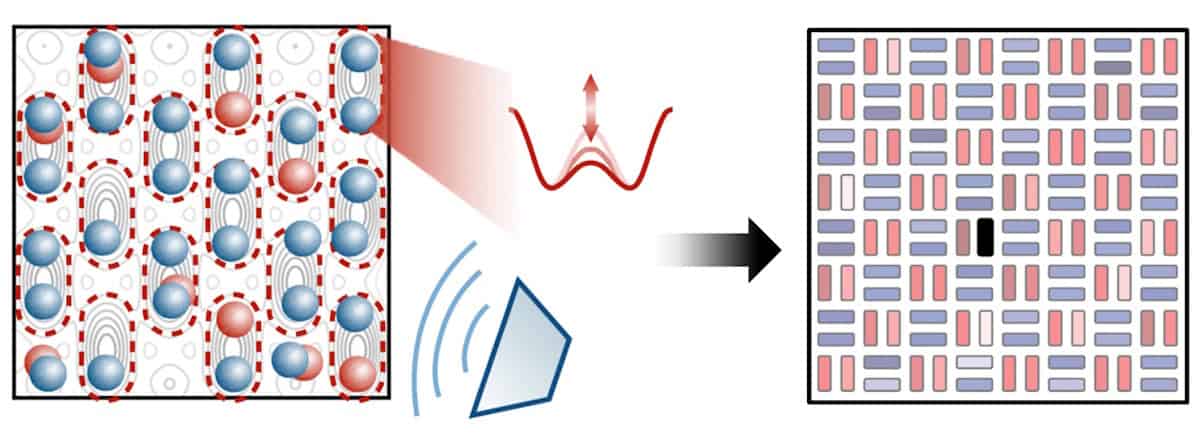
From immeasurable to measurable Microwave pulses and lattice depth control manipulate fermions on a lattice (left), converting a hard-to-detect signal into a brickwork pattern (right) that reveals d-wave pairing, a key signature of high-temperature superconductors. (Courtesy: Adapted from D K Mark et al. Phys. Rev. Lett. 135 123402 (2025)) Understanding the mechanism of high-temperature superconductivity could unlock powerful technologies, from efficient energy transmission to medical imaging, supercomputing and more. Researchers at Harvard University and the Massachusetts Institute of Technology have designed a new protocol to study a candidate model for high-temperature superconductivity (HTS), described in Physical Review Letters. The model, known as the Fermi-Hubbard model, is believed to capture the essential physics of cuprate high-temperature superconductors, materials composed of copper and oxygen. The model describes fermions, such as electrons, moving on a lattice. The fermions experience two competing effects: tunnelling and on-site interaction. Imagine students in a classroom: they may expend energy to switch seats (tunnelling), avoid a crowded desk (repulsive on-site interaction) or share desks with friends (attractive on-site interaction). Such behaviour mirrors that of electrons moving between lattice sites. Daniel Mark, first author of the study, notes that: “After nearly four decades of research, there are many detailed numerical studies and theoretical models on how superconductivity can emerge from the Fermi-Hubbard model, but there is no clear consensus [on exactly how it emerges].” A precursor to understanding the underlying mechanism is testing whether the Fermi-Hubbard model gives rise to an important signature of cuprate HTS: d-wave pairing. This is a special type of electron pairing where the strength and sign of the pairing depend on the direction of electron motion. It contrasts with conventional low-temperature superconductors that exhibit s-wave pairing, in which the pairing strength is uniform in all directions. Although physicists have developed robust methods for simulating the Fermi-Hubbard model with ultracold atoms, measuring d-wave pairing has been notoriously difficult. The new protocol aims to change that. A change of perspective A key ingredient in the protocol is the team’s use of “repulsive-to-attractive mapping”. The physics of HTS is often described by the repulsive Fermi-Hubbard model, in which electrons pay an energetic penalty for occupying the same lattice site, like disagreeing students sharing a desk. In this model, detecting d-wave pairing requires fermions to maintain a fragile quantum state as they move over large distances, which necessitates carefully fine-tuned experimental parameters. To make the measurement more robust to experimental imperfection, the authors use a clever mathematical trick: they map from the repulsive model to the attractive one. In the attractive model, electrons receive an energetic benefit from being close together, like two friends in a classroom. The mapping is achieved by a particle–hole transformation, wherein spin-down electrons are reinterpreted as holes and vice versa. After mapping, the d-wave pairing signal becomes an observable that conserves local fermion number, thereby circumventing the challenge of long-range motion. Pulse sequence Carefully timed pulses, including microwave, hopping and idling pulses transform the state of the system for easier readout. (Courtesy: D K Mark et al. Phys. Rev. Lett. 135 123402 (2025)) In its initial form, the d-wave pairing signal is difficult to measure. Drawing inspiration from digital quantum gates, the researchers divide their complex system into subsystems composed of pairs of lattice sites or dimers. Then, they apply a pulse sequence to make the observable measurable by simply counting fermions – a standard technique in the lab. The pulse sequence begins with a global microwave pulse to manipulate the spin of the fermions, followed by a series of “hopping” and “idling” steps. The hopping step involves lowering the barrier between lattice sites, thereby increasing tunnelling. The idling step involves raising the barrier, allowing the system to evolve without tunnelling. Every step is carefully timed to reveal the d-wave pairing information at the end of the sequence. Read more Quantum microscopy sheds light on high-temperature superconductivity The researchers report that their protocol is sample-efficient, experimentally viable, and generalizable to other observables that conserve local fermion number and act on dimers. This work adds to a growing field that combines components of analogue quantum systems with digital gates to deeply study complex quantum phenomena. “All the experimental ingredients in our protocol have been demonstrated in existing experiments, and we are in discussion with several groups on possible use cases,” Mark tells Physics World. Want to read more? Registration is free, quick and easy Note: The verification e-mail to complete your account registration should arrive immediately. However, in some cases it takes longer. Don't forget to check your spam folder. If you haven't received the e-mail in 24 hours, please contact customerservices@ioppublishing.org. E-mail Address Register
Tags
Source Information
Discussion
0 professional contributions
Sign in to join this professional discussion.
Be the first to add a constructive contribution.