
Long Live Ytterbium! Long-lived States Found in Trapped Ions Open New Doors For Quantum Computing And Atomic Clocks
Understand this faster with AI


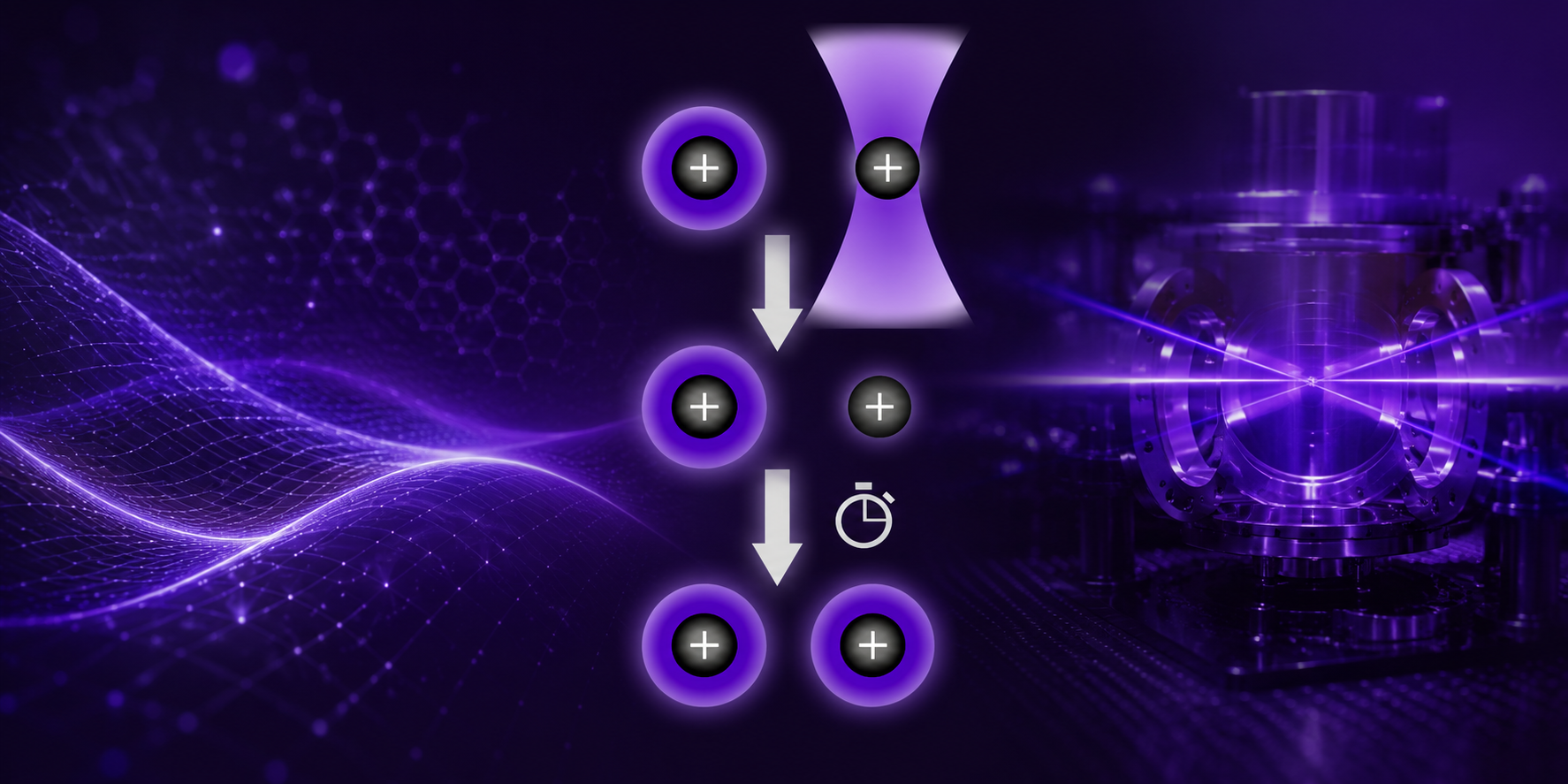
Insider BriefPRESS RELEASE — Researchers from the Universities of Amsterdam and New South Wales have answered a question that has been around for decades: whether ions of the metal ytterbium can enter certain long-lived and nearly stable states, and if so, for how long. The measured long-lived states may find applications in quantum computers and atomic clocks.Many modern atomic clocks and quantum computers have so-called trapped ions at their core. Ions, electrically charged atoms, can be in many different states, all with different amounts of energy. Because of their charge, these ions can be suspended in empty space and kept in place using electromagnetic fields. The working of the clock or the computer then relies on precisely controlling which energy state such an ion occupies.Researchers from the Universities of Amsterdam and New South Wales have now discovered that the ytterbium ion (Yb⁺), a leading candidate for both technologies, can remain in previously unexplored states for surprisingly long times. In the lab of Rene Gerritsma at the UvA-Institute of Physics, the team pumped a single Yb⁺ ion into a variety of so-called metastable (that is, nearly stable) states, by laser-exciting it to a high energy level. From there, the ion decayed to lower-lying states, some of which turned out to be metastable as well, such that it would take a long time for the ion to return to its ground state. In this way, the team clocked decay signals corresponding to lifetimes of about 1 second and 10 seconds and even found evidence for a state with a lifetime of more than 30 seconds. The results were recently published in the journal Physical Review A.PhD student Zeger Ackerman, first author of the publication, explains: “To make the measurements possible, we did not just trap one single ion, but in fact we trapped two ions together. One of these was for spectroscopy measurements, and the other to continuously cool and stabilize the system without disturbing the metastable state being studied. This allowed us to watch the ion remain in a metastable state and precisely time its decay. Detailed atomic structure calculations then confirmed the results from the measurements.”The newly characterized states may find applications in quantum computing and atomic clocks. The researchers are particularly excited about the state with a 1-second lifetime. Calculations show that it may be reached from the ground state relatively easily, using just a single laser pulse. The lifetime of 1 second and the predicted strength of the transition suggest that it could be used for significantly improving the detection of states of quantum bits (qubits) and their generalized analogues (so-called qudits) in ytterbium ions.When it comes to this particular state, the research answers a thirty-five-year-old question by theoretical physicists Fawcett and Wilson, who predicted a lifetime of 5.2 seconds for the same state and asked for experimental confirmation. Given how complicated the energy level structure of Yb⁺ is, their prediction turned out to be pretty close!TopicsShare Get the latest research, company news, and market intelligence every week. MENTIONED IN THE ARTICLEThe University of Amsterdam (UvA) is a key player in quantum research, focusing on areas like quantum matter, quantum information, and quantum computing through initiatives such as the Quantum Matter & Quantum Information research area and the QuSoft research center. UvA also emphasizes quantum computing education, practical applications in collaboration with industry, and the legal implications of quantum technologies through its Institute for Information Law.The University of New South Wales, often referred to as UNSW Sydney, is a public research university situated in Sydney, New South Wales, Australia. It was established on July 1, 1949. It stands as one of the original members of the Group of Eight, a consortium of research-focused Australian universities. UNSW, founded in 1949, holds the status of a research-focused university.More in Research The Quantum Insider (TQI) is the leading source for the latest quantum technology news, market intelligence, industry analysis, and data covering the global quantum ecosystem.NEWSROOMPLATFORMSERVICESCOMPANY© 2026 Resonance Alliance Inc. All rights reserved.A RESONANCE NETWORK PROPERTYOne of our team will be in touch to learn more about your requirements, and provide pricing and access options.Subscribe to our industry leading leading newsletter for the latest in quantum news and insights. Necessary cookies are always on to ensure the website works. Optional cookies help us understand how the site is used. Privacy Policy
Tags
Source Information
Discussion
0 professional contributions
Sign in to join this professional discussion.
Be the first to add a constructive contribution.