
Logical Qubit Technology Launches Quantum Cloud Platform at Quantum Day 2026
Logical Qubit Technology’s launch matters because it combines physical-qubit access, logical-qubit experiments and pulse-level control on one cloud platform. This lowers the cost and infrastructure barrier for universities, researchers and companies that cannot operate their own superconducting quantum systems. Users can test algorithms, study quantum error correction and customise hardware-level controls remotely. The inclusion of repetition and surface codes also makes the platform valuable for advancing research toward practical, fault-tolerant quantum computing.
Understand this faster with AI


On July 9, 2026, Logical Qubit Technology Co., Ltd hosted its Quantum Day 2026 event, officially unveiling its superconducting quantum computing cloud platform. The platform delivers high-performance quantum computing cloud services to universities, research institutions, and potential application sectors including biomedicine, chemistry, materials, energy, AI, finance, and logistics.
A Quantum Cloud Platform for Practical Quantum Computing
Quantum computing development currently faces two core challenges. The first is technological breakthroughs and enhanced engineering capabilities, primarily reflected in increasing qubit counts, extending coherence times, and improving two-qubit gate fidelities. The second is the high barrier to user adoption, including the steep cost of full quantum computer systems and the scarcity of practically useful quantum cloud computing power. How can we lower the barrier for users and accelerate the deep integration of quantum computing with industry for widespread application? The quantum cloud platform is Logical Qubit Technology's answer.
At Quantum Day 2026, Zhen Wang, founder and CEO of Logical Qubit Technology, introduced the platform's core technical capabilities across three levels: physical qubit, logical qubit, and pulse-level control.
Physical Qubit Level:
The execution of quantum circuits on the cloud platform relies on high-performance underlying quantum hardware support. The superconducting-qubit-based cloud platform combines fast operation speeds with high fidelity: users can perform arbitrary single-qubit gates in just 20 nanoseconds, achieving a maximum single-qubit gate fidelity of 99.97%; two-qubit gates can be executed in 40 nanoseconds with a maximum fidelity of 99.8%. Operation time does not increase with the number of qubits—parallel control of over 100 qubits also takes only tens of nanoseconds.
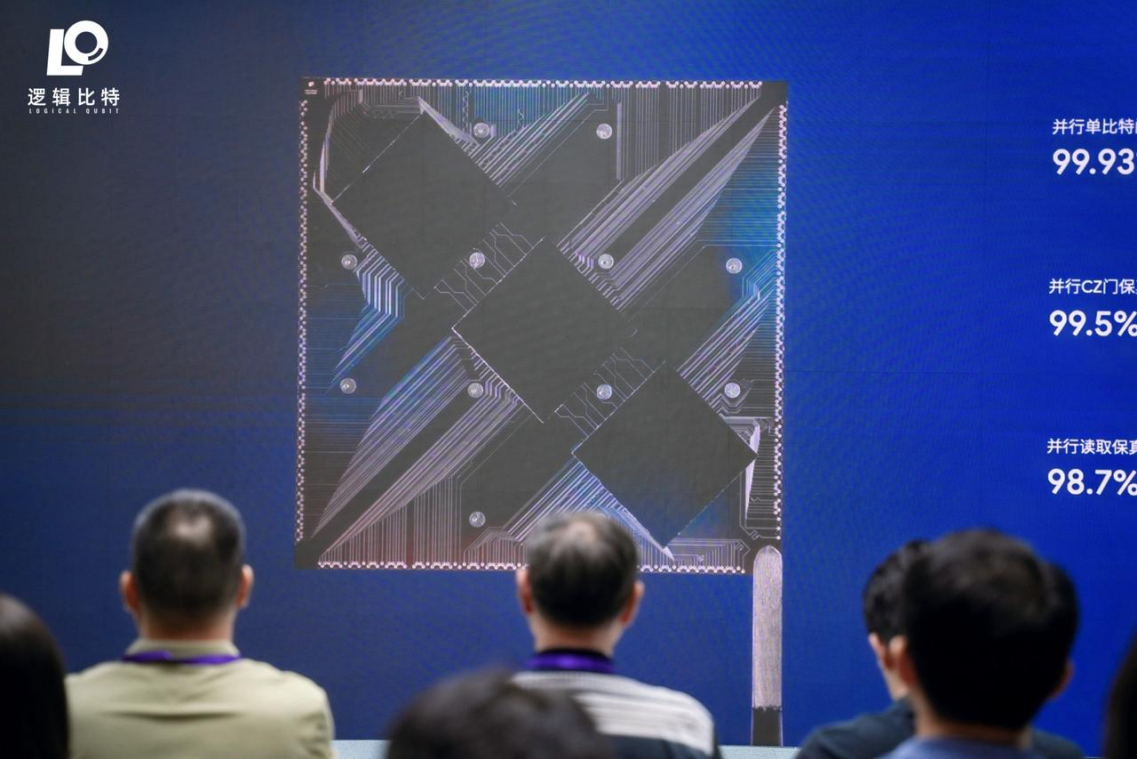
Logical Qubit Technology provides quantum circuit execution support based on its 30-qubit and 100-qubit AGate series chips. Taking the AGate-100 chip available on the newly launched cloud platform as an example, its basic building blocks are frequency-tunable physical qubits, with neighboring qubits connected via tunable couplers. The chip achieves parallel single-qubit gate fidelity of 99.93% (median), parallel two-qubit gate fidelity of 99.5% (median), and parallel readout fidelity of 98.6% (median)—key metrics that meet or exceed those of leading international quantum cloud platforms.
For researchers at universities, research institutions, and industrial R&D departments, a cloud platform with over 100 physical qubits will greatly meet their daily needs for quantum computing and quantum algorithm research. Users simply submit their algorithms as code to the cloud platform, which translates them into quantum circuits and returns execution results. The entire process is straightforward and easy to use, significantly lowering the adoption barrier.
Logical Qubit Level:
Logical qubits are the fundamental building blocks for universal quantum computing, composed of multiple physical qubits. Once the quantum gate fidelity of physical qubits exceeds a certain threshold, the error rate of logical qubits decreases exponentially as the scale of physical qubits increases. To achieve fault-tolerant goals, fast qubit readout is essential for error detection during quantum circuit execution. To this end, Logical Qubit Technology has developed the AGate-165 superconducting quantum chip, reducing readout time from 2 microseconds to approximately 600 nanoseconds, with reset time after each readout shortened to 400 nanoseconds. Additionally, the Logical Qubit Technology quantum cloud platform now offers distance-9 repetition code and distance-3 surface code algorithms, with parallel single-qubit gate fidelity of 99.93% (median), parallel two-qubit gate fidelity of 99.5% (median), and parallel readout fidelity of 98.7% (median). All quantum algorithm researchers can run and verify theoretical effects such as error correction and decoding algorithms on the platform.
Pulse-level Control Level:
Quantum circuits serve as the "common programming language" for quantum computers—based on single-qubit gates, two-qubit gates, and readout operations, most customers can implement arbitrary quantum algorithms on any quantum computing platform. However, the actual execution on superconducting qubit platforms relies on a "machine language" composed of physical waveforms including square waves, Gaussian pulses, and continuous sine waves. For more demanding customers, direct manipulation of the physical waveforms applied to each qubit and coupler is of great value for achieving higher fidelity and more efficient control.
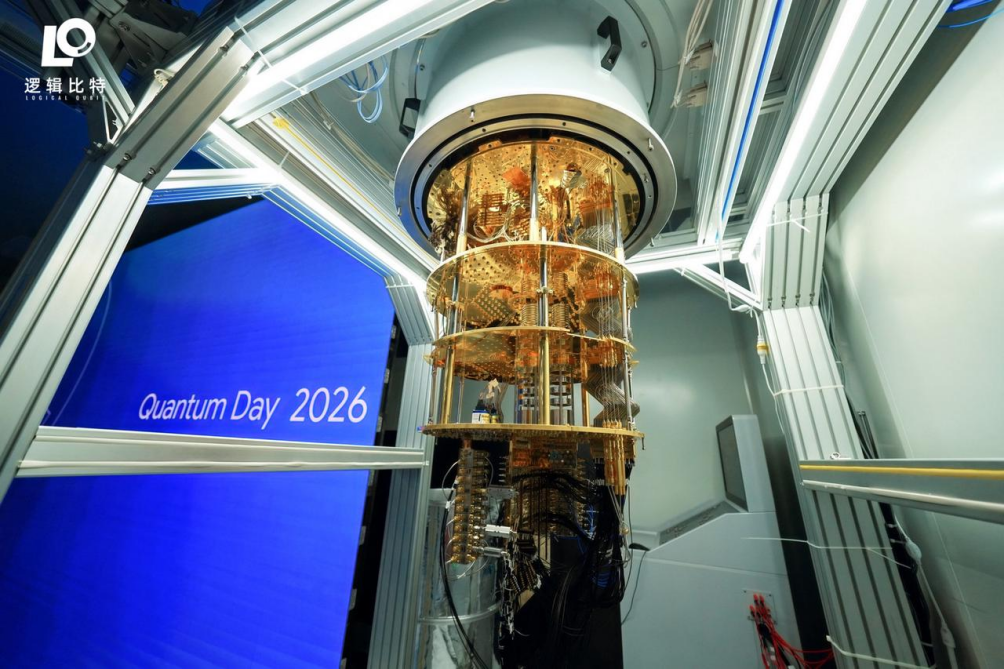
The Logical Qubit Technology quantum cloud platform now provides access to quantum computers with Pulse-level control, supporting users to directly modify arbitrary waveforms with timing precision down to 1 nanosecond. By customizing complex pulse-level control, users can achieve optimized and more sophisticated quantum manipulations. These features give users laboratory-level underlying control through online access, allowing them to run a "quantum computing lab" without maintaining the hardware themselves.
Fostering Quantum Computing Ecosystem Collaboration Around the Cloud Platform
2025 is widely regarded as the breakout year for quantum computing. 2026 can be seen as the year when the quantum computing ecosystem begins to flourish. On one hand, industries such as pharmaceuticals, chemicals, materials, energy, AI, and finance are starting to explore the integration of quantum computing with their businesses. On the other hand, numerous software and algorithm companies have emerged this year, greatly enriching the quantum computing ecosystem.
At the event, Zhen Wang highlighted progress made by partners on the Logical Qubit Technology cloud platform, including pharmaceutical representative Pharmaron, and software algorithm companies Liangguan Zhiyuan, Quantum Emergence, Tongyuan Liangzhi, and UnitaryForge. Notably, Logical Qubit Technology has entered into a strategic cooperation agreement with Pharmaron to explore collaborative models between quantum cloud platforms and pharmaceutical companies through joint laboratories and other initiatives, driving the pharmaceutical industry's R&D systems, technical standards, and data frameworks toward a "Quantum-ready" state and leading industry innovation.
"Although quantum computing is still in its early stages, we hope to work with these partners and many more in the future to foster a thriving quantum computing ecosystem, enabling quantum computing to truly deliver value and create social impact," said Zhen Wang.
At this stage, technology remains the top priority for quantum computing development, and coherence time is one of the most critical technical metrics for superconducting quantum chips. At the conclusion of the event, Zhen Wang reviewed the nearly two decades of superconducting quantum computing development—coherence time has improved by three orders of magnitude, from 1 microsecond to the millisecond range.
Logical Qubit Technology has been continuously working to extend coherence time, recently achieving over 890 microseconds on a small-scale chip. The company's next step is to transfer this technology to hundred-qubit quantum chips, further improving physical qubit manipulation fidelity, reducing logical qubit error rates, and providing sustained technological momentum toward universal quantum computing.
Roadmap
Quantum computing is unequivocally the right direction—but it is also an extraordinary challenge. A well-structured roadmap with clear milestones should emphasize balanced progress in both technology and applications. As a quantum computing enterprise, Logical Qubit Technology adheres to a dual-driven strategy of "Technology + Applications"—continuously advancing technical capabilities toward future universal quantum computing while iteratively improving technology through validated commercial application scenarios:
2026: Launch a quantum cloud platform with core capabilities in physical qubits, logical qubits, and pulse-level control, driving ecosystem growth.
2027: Break through the "fault-tolerance threshold" and achieve modular logical qubits with error rates reaching one in a thousand (10⁻³).
2028: Achieve deep integration with drug discovery, materials simulation, AI, and other fields, producing milestone results that surpass classical computers.
2029: Move toward large-scale quantum computing, complete the engineering of tens of thousands of physical qubits, realize dozens of logical qubits, and achieve an error rate of one in a hundred million (10⁻⁸).
Beyond 2030: As quantum computing technology and the ecosystem mature, implement a wide range of universal quantum algorithms on general-purpose quantum computers, pushing beyond the limits of human computational capability.
"We named our chip series AGate. The word literally translates to 'agate'—because our chips are essentially crystals that require meticulous crafting through micro-nanofabrication and precision control. But broken down, 'A Gate' means 'a door.' With the AGate series of quantum chips, we hope to open a door to the future," said Zhen Wang.