
Latest science news: Comet 3I/ATLAS new images | China’s other astronauts stranded | AI dead end?
Understand this faster with AI


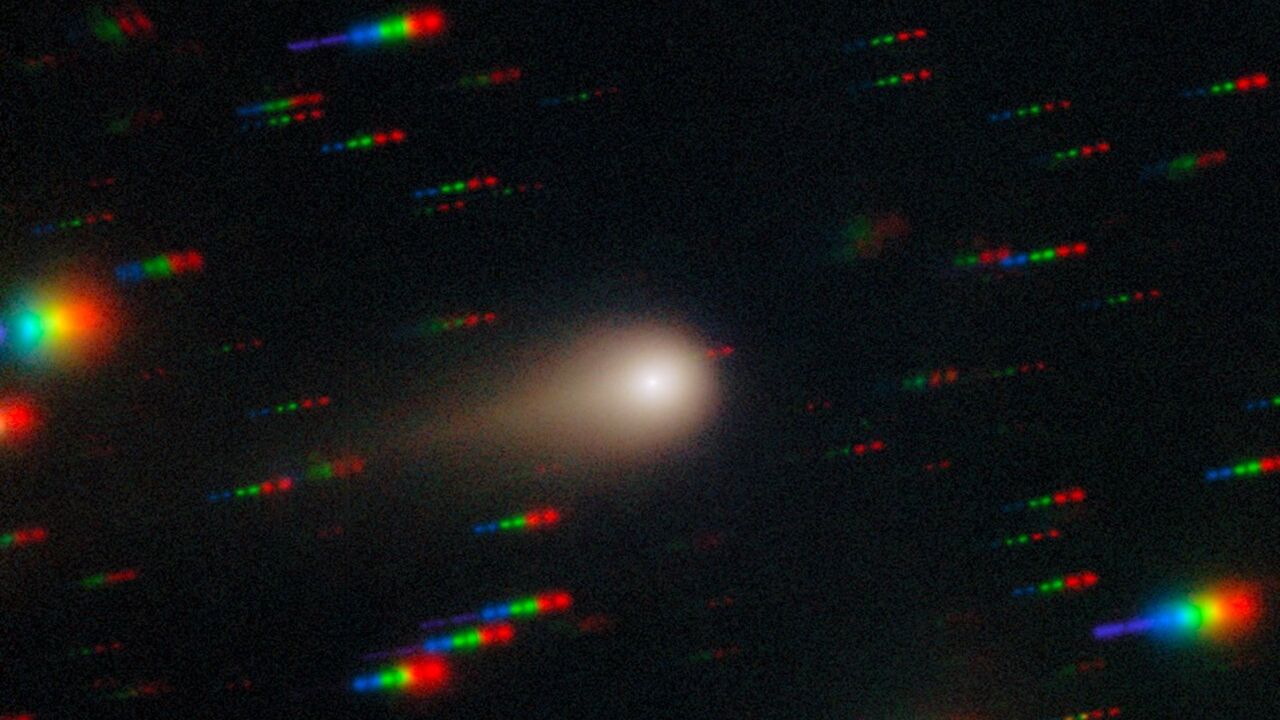
Refresh Get notified of updates November 17, 2025 at 7:21 PM NASA set to share best images of comet 3I/ATLAS yetGood morning, science fans. We’re back with more updates on the comet 3I/ATLAS. Following the end of the U.S. government shutdown, we’re seeing reports that NASA is set to release some of the best-quality images yet of the comet.The images were taken by the HiRISE camera aboard NASA’s Mars Reconnaissance Orbiter, and could have significantly better resolution than those by the Hubble Space Telescope on July 21, 2025.We’re getting to work on what all of this could mean for the rapidly-brightened comet, which is roughly 7-miles (11 kilometers) wide, more than 7 billion years old, and traveling at 130,000 mph (210,000 km/h) as it sheds its highly-irradiated coma across our solar system.In the meantime, check out this breathtaking shot of the 3I/ATLAS snapped by astrophotographer Satoru Murata over the weekend.See moreBen Turner November 17, 2025 at 7:25 PM Everything you need to know about 3I/ATLAS A snapshot of comet 3I/ATLAS taken by the Hubble Space Telescope in August. The image was captured using a colored filter and does not represent the comet's current appearance. (Image credit: NASA/ESA) So what is 3I/ATLAS? And why do people care?3I/ATLAS, which was first discovered in early July, is the third interstellar object ever found in our solar system. That means it doesn't come from our cosmic neighbourhood, but from somewhere else in our Milky Way galaxy.Where exactly in our galaxy the comet came from is unclear — scientists aren't sure whether it came from the Milky Way's 'thin' disk or its 'thick' disk — but depending on its origins it could be more than 7 billion years old, making it more than 3 billion years older than our sun. Tracing 3I/ATLAS’s origins is made even more challenging by its material, which has been transformed by billions of years of exposure to cosmic rays.Telescope observations suggest the comet is roughly 7-mile-wide (11 kilometers) and zooming at more than 130,000 mph (210,000 km/h). Having passed perihelion, or the closest point to our sun, roughly two weeks ago, 3I/ATLAS is now zipping toward its closest point to Earth on Dec. 19.The exotic comet has many peculiar properties, from its chemical composition to its large size. This, alongside radio signals coming from it that are typical of all comets, has fuelled a frenzy of speculation that the 3I/ATLAS is an alien probe.That's almost certainly not the case, but it doesn't mean that astronomers aren't excited to study it. Investigating the comet could yield fresh insights into the conditions around other stars, our early galaxy, and the vast frontier of interstellar space. November 17, 2025 at 7:43 PM Here's a selection of some of our 3I/ATLAS stories so far 'Interstellar visitor' 3I/ATLAS could be the oldest comet ever seen — and could grow a spectacular tail later this yearIs it aliens? Here's why that's the least important question about 3I/ATLAS.Comet 3I/ATLAS has been transformed by billions of years of space radiation, James Webb Space Telescope observations revealNASA spacecraft reveal interstellar comet 3I/ATLAS brightened rapidly as it swooped behind the sunNASA's Hubble telescope reveals most detailed photos of interstellar visitor 3I/ATLAS to date Patrick Pester November 17, 2025 at 8:00 PM When will NASA release images? We don't know when NASA will release new images of comet 3I/ATLAS, but we're seeing reports that it could be early this week.The U.S. government shutdown delayed the release of the images, but that's now over, so they should be on their way. These images are expected to be some of the best yet, and will help researchers further understand the comets makeup and origins. November 17, 2025 at 8:21 PM What is HiRISE? An artist's illustration of Nasa's Mars Reconnaissance Orbiter. (Image credit: Getty Images) The as-of-yet unreleased comet 3I/ATLAS images were taken by the High Resolution Imaging Science Experiment (HiRISE) aboard NASA's Mars Reconnaissance Orbiter. The orbiter has been flying around Mars since 2006, searching for signs of water on the Red Planet. The HiRISE camera managed to get images of comet 3I/ATLAS as it zoomed past Mars in early October.The images are expected to be the highest-resolution images of comet 3I/ATLAS yet, and even clearer than the Hubble Space Telescope's comet snaps taken in July, the New York Post has reported. November 17, 2025 at 8:28 PM Live Science roundup Here's a roundup of some of the stories Live Science published today and over the weekend: First Vera Rubin Observatory image reveals hidden structure as long as the Milky Way trailing behind a nearby galaxy — Space photo of the weekThe more that people use AI, the more likely they are to overestimate their own abilitiesA gulf separating Africa and Asia is still pulling apart — 5 million years after scientists thought it had stoppedMedieval Hungarian duke was murdered in a brutal and coordinated attack, forensic analysis reveals Ben Turner November 17, 2025 at 9:30 PM Other images taken by HiRISE A collage of five images taken by the HiRISE camera aboard NASA's Mars Reconnaissance Orbiter. (Image credit: NASA/JPL-Caltech/University of Arizona) HiRise has imaged vast areas of the Martian landscape in unprecedented detail, according to NASA. Check out the HiRise website, hosted by The University of Arizona, to scroll through hundreds of previous HiRise images. November 17, 2025 at 11:17 PM Why are astronomers interested in 3I/ATLAS? Looped video footage of 3I/ATLAS taken by Las Cumbres Observatory on 2 July 2025, just a day after its initial discovery. (Image credit: ESA/Las Cumbres Observatory) While it is indeed an interstellar visitor from beyond our solar system, most astronomers are confident that 3I/ATLAS is just a normal comet.Well, normal in the sense that it's natural. 3I/ATLAS is actually pretty amazing as comets go, being the oldest ever seen and the most massive of its kind, not to mention only the third interstellar object ever recorded.This means that researchers will carefully study new images of the comet for clues to its makeup, origins, and a better understanding of the journey it took to arrive at our cosmic backyard.Comets heat up as they fly closer to stars, causing ice on their surface to sublimate into gas, which researchers can then detect and study. Previous observations have already revealed that comet 3I/ATLAS appears to be unusually rich in carbon dioxide, with potentially a thick irradiated crust from billions of years of exposure to cosmic rays.The comet’s irradiated nature could make it more difficult to decipher the properties of its material that would otherwise reveal more about the conditions of its home star system. Still, researchers still have a lot to learn about interstellar comets, and just having more data on this one is as good a start as any. November 17, 2025 at 11:44 PM 3I/ATLAS’s trajectory narrowed down ten-fold These blurry images, taken by ESA's ExoMars Trace Gas Orbiter on Oct. 3, show the interstellar comet 3I/ATLAS shooting past Mars. This data has now been used to refine the comet's upcoming trajectory. (Image credit: ESA/TGO/CaSSIS) Since its initial discovery in July, astronomers have answered many questions about what 3I/ATLAS is made of and where it could have come from in our galaxy. Yet, due to insufficient observations, where it’s heading hasn’t been entirely clear.Now, thanks to data collected by the European Space Agency’s (ESA) ExoMars Trace Gas Orbiter during the comet’s flyby of the Red Planet, scientists have improved their estimates of 3I/ATLAS’s trajectory ten-fold.The ESA is hoping to repeat the trick with its Jupiter Icy Moons Explorer (JUICE), which will get a good look at 3I/ATLAS later this month.You can read Harry’s full story here. November 18, 2025 at 12:12 AM That’s all for today folks We’re signing off from the U.K. side now. We’ll hand you over to our U.S. colleagues now for updates from Live Science, science across the web, and maybe even NASA if they choose to drop comet images while we’re off the clock. See you all tomorrow! November 18, 2025 at 1:08 AM Three more Chinese astronauts stranded The Shenzou-21 crew are now stranded after replacing the stranded Shenzou-20 crew. (Image credit: HECTOR RETAMAL/AFP via Getty Images) Three more astronauts are stranded in China’s Tiangong station following the return of their previously stuck colleagues, Senior Staff Writer Harry reports.The latest trio — Zhang Lu, Wu Fei and Zhang Hongzhang — are the crew of the Shenzhou-21 mission, whose return capsule was taken home by the Shenzhou-20 crew following a potential space debris collision that rendered their original capsule inoperable.The development could highlight a potential flaw in China’s space protocols that could put astronauts needlessly at risk.You can read the full story here. November 18, 2025 at 2:30 AM Dueling climate change impacts A schematic of the AMOC (Image credit: NOAA) Tia here with news of dueling climate change impacts. A key Atlantic Ocean current system, the Atlantic Meridional Overturning Circulation (AMOC), could be collapsing, due in large part to climate change.Meanwhile, climate change is also fueling the rapid melt of Antarctic ice.Yet the melting of the West Antarctic ice sheet, which some climate scientists say is "all but inevitable" could have a surprising side effect — staving off the AMOC collapse, New Scientist reports.Still, the ice sheet melting would be catastrophic for sea levels, and the AMOC would still decline by 60% and take 3,000 years to bounce back to its previous strength, according to new research.
Tia Ghose November 18, 2025 at 3:07 AM Dementia more deadly than heart disease? In Australia, dementia is now a bigger cause of death than heart disease. (Image credit: Andrew Brookes/Getty Images) Dementia is now more deadly than heart disease — at least in Australia. The new trend reflects dramatic improvements in health care which mean people live longer in general, Lauren Moran, the head of mortality statistics at the Australian Bureau of Statistics, told the Australian Broadcasting Corporation."People are now more likely to live to an age where they have a higher risk of developing dementia," Moran said.Whether Australia is a harbinger for the rest of the world remains to be seen. In the U.S., for instance, heart disease remains the top killer, closely followed by cancer. Alzheimer's disease is the sixth-leading cause of death, per the Centers for Disease Control and Prevention. November 18, 2025 at 3:47 AM Woman versus goose An image of the carved clay figurine (left) along with an illustration (right) of what archaeologists think the carving depicts. (Image credit: Laurent Davin; CC BY-NC-ND 4.0) A 12,000-year-old clay figurine unearthed in Israel may depict a goose attempting to mate with a squatting woman, archaeologists say.Staff writer Kristina Killgrove reported on the unusual figurine, which may be the oldest representation of an animal and a human interacting.But why did the sculptor depict this event, and what does it say about the Natufians, the ancient culture that crafted the object? You can read the full story here. November 18, 2025 at 4:14 AM NASA sets date to share 3I/ATLAS images NASA will share images of comet 3I/ATLAS taken during its close approach to Mars in a news conference Wednesday (Nov. 19) (Image credit: ESA–D. Ducros) Earthlings eager to see NASA’s newest images of the interstellar comet 3I/ATLAS will have to wait a few more days. The space agency just announced a live image viewing event scheduled for Wednesday (Nov. 19) at 3 p.m. EST.During the event, NASA will share never-before-seen images of the interstellar comet taken during its close approach to Mars in early October. The U.S. government shutdown, which lasted from Oct. 1 to Nov. 12, prevented the agency from releasing these images until now.Space and physics editor Brandon Specktor shared the details on how to watch, and why it matters, in his full story here. November 18, 2025 at 4:46 AM That's all, folks! The U.S. West Coast is out for the evening but check back in tomorrow for all the latest science news from the U.K. team. November 18, 2025 at 5:55 PM Nosy Neanderthals (Image credit: Constantino Buzi/IPHES-CERCA) Good morning, science fans! Patrick here to kick off another day of our science news blog coverage. I want to start with a story about Neanderthal noses, which Live Science's Kristina Killgrove reported on yesterday evening. Researchers re-examined perfectly preserved Neanderthal nose bones, and discovered their sizeable schnozzes weren't evolved for the cold.The new study involved taking a fresh look at the "Altamura Man," which is an exceptionally well-preserved Neanderthal skeleton covered in a thick layer of calcite, sometimes called "cave popcorn." The researchers' findings suggest that the size of Neanderthal noses might not have had anything to do with living in cold temperatures.You can read the full story here.
Patrick Pester November 18, 2025 at 6:03 PM Countdown to NASA's new 3I/ATLAS images Interstellar comet 3I/ATLAS caught streaking through the solar system on Aug. 27 by the Gemini South telescope in Chile. (Image credit: International Gemini Observatory/NOIRLab/NSF/AURA/Shadow the ScientistImage Processing: J. Miller & M. Rodriguez (International Gemini Observatory/NSF NOIRLab), T.A. Rector (University of Alaska Anchorage/NSF NOIRLab), M. Zamani (NSF NOIRLab)) Yesterday, we wrote (at length) about the potential release of NASA's long-awaited comet 3I/ATLAS images. Well, just a reminder that these are coming tomorrow.NASA will host a live news teleconference on Wednesday (Nov. 19) at 3 p.m. EST. The images are expected to be the clearest yet of comet 3I/ATLAS, and should help scientists learn more about the interstellar visitor. November 18, 2025 at 6:17 PM And you think you have family drama? The parasitic ant queen Lasius orientalis (left) infiltrates the nest of Lasius flavus and apporaches their queen (right) to deploy her chemical spray. (Image credit: Keizo Takasuka/Kyushu University) With Thanksgiving and the holiday season both around the corner, many of us are already preparing for some raucous family get-togethers.But no matter how riotous we humans can be, nothing compares to the activities of the worker ants highlighted by this recent study. After being tricked by the pheromone spray of a parasitic queen, some ant species band together to dismember their mother and enable the imposter to usurp the throne for herself.You can read all the gory details in the full story here.
Ben Turner November 18, 2025 at 6:39 PM Live Science roundup Here's a roundup of some of the stories Live Science published today and last night: High-fiber diet may 'rejuvenate' immune cells that fight cancer, study finds'Sophisticated' Bronze Age city unearthed in Kazakhstan 'transforms our understanding of steppe societies'Extreme bloom of toxic algae swirls in Nevada's 'Pyramid Lake' — Earth from spaceMars orbiter narrows down the exact path of interstellar comet 3I/ATLAS by 'ten-fold,' surprising scientists November 18, 2025 at 7:40 PM Cloud down An iPhone displaying a Cloudflare Error in Lafayette, California. (Image credit: Smith Collection/Gado/Getty Images) An ongoing outage to Cloudflare, a US company which defends millions of websites against hacking attacks, has brought down vast swathes of the web, including X and OpenAI, today.Company staff are still investigating what caused the crash."We saw a spike in unusual traffic to one of Cloudflare's services beginning at 11:20 UTC. That caused some traffic passing through Cloudflare's network to experience errors," the company wrote in an emailed statement. "We do not yet know the cause of the spike in unusual traffic. We are all hands on deck to make sure all traffic is served without errors.”Once they’ve addressed the errors, Cloudflare staff will turn to investigating the cause of the "unusual spike in traffic." Could it be yet another AI-driven cyberattack? Cloudflare writes that it will post updates to cloudflarestatus.com and more in-depth analysis to blog.cloudflare.com.Until then, Live Science is still online, so where else do you need to go? November 18, 2025 at 8:17 PM Ignore your deadlines. Do this crossword instead Got some important work to do that’s being hamstrung by the Cloudflare outage?Maybe it’s more important you test your knowledge with this crossword instead. It’s all important science trivia, so you can tell your boss you're upskilling. 0:00 1 2 3 4 5 6 7 8 9 10 11 12 13 14 1 across: European city where world leaders pledged to limit global warming to well below 2 degrees Celsius in 2015 (5) Need a hint? 2 down: When electromagnetic radiation from distant cosmic objects gets stretched, becoming less blue (8) Need a hint? 3 down: A shape with four equal sides (6) Need a hint? 4 down: Branch of science concerned with the processes and phenomena of the atmosphere, often with a focus on the weather (11) Need a hint? 5 down: The largest and most iconic predatory fish on Earth (5,5,5) Need a hint? 6 across: The passing of traits from parents to offspring via genetic information (8) Need a hint? 7 down: The rate at which a wave or periodic event repeats (9) Need a hint? 8 across: A long, open topped glass object used to mix things in a laboratory (you probably used them at school) (4,4) Need a hint? 9 down: Most common chemical element used as fuel in nuclear fission power plants (7) Need a hint? 10 down: The "great comet of 1997" (8) Need a hint? 11 across: Trickster god from Norse mythology, known for shapeshifting (4) Need a hint? 12 across: Tallest mountain in Africa (11) Need a hint? 13 across: Common name of the famous Chinese philosopher Kong Qiu (9) Need a hint? 14 across: Semi-aquatic mammal that lays eggs and has a bill (8) Need a hint? Reveal Reveal letter Reveal word Reveal whole puzzle Cancel hint Really? If you really want to give up you can, but don't forget you can also get hints to help! Get a Hint Keep Going!
Reveal Puzzle Well done! You completed the crossword in Play Another Quiz Out of time! Unlucky, you ran out of time! Take a look at the answers or try another quiz...
View Answers Play Another Quiz Live Science crossword puzzle #19: Tallest mountain in Africa — 12 across Play Now Register & Save Score Log In Browse more quizzes Tip: Use the hint button if you're stuck! Random QuizPlay a Random Quiz Filter by Category Join the community Join the Live Science Family! The best way to keep in touch and to be informed of our latest quizzes and competitions, as well as news and offers. I'm in! Not right now Keep me informed about new quizzes and offers from Future and its partners Contact me with news and offers from Live Science and other Future brands By submitting your information you confirm you are aged 16 or over, have read our Privacy Policy and agree to the Terms & Conditions. Continue Already have an account? Log in Log In Log In Forgotten your password? Reset it Not got an account? Register This page will close automatically once you have completed the authorisation process My Details Update your details below... Keep me informed about new quizzes and offers from Future and its partners Update Keep in the Know Would you like to be kept informed about new quizzes and offers from Future and its partners? Yes Please! No Thanks OK Validate Your Mobile No. We have sent a code to . Please enter it below to verify your account. Validate Update mobile number Resend code Update Your Mobile No. You may enter a new mobile number below. You will be sent a verification code to the phone number you provide.
Update Cancel Hint Activated Answer the question below to receive a letter of the answer.
Submit Validate Your Email Address We have sent a code to . Please enter it below to verify your account. Validate Update email address Resend code Update Your Email Address You may enter a new email address below. You will be sent a verification code to the address you provide.
Update Cancel Create a Username This will be publicly viewable so make it something you like! Check availability Reset your password Enter your email address below. If it is registered with us, we will email you a code that will allow you to reset your password. Submit Check your inbox If your email address was found in our system, you should receive an email in the next few minutes containing a code. Enter that code below to reset your password. Submit Set new password Please enter your new password below. Update password Leaderboard Rank Player Score Time Help Log In or Register More Quizzes Log Out November 18, 2025 at 9:05 PM It's quantum o'clock (Image credit: agsandrew | Shutterstock.com) Researchers have built a teeny tiny quantum clock that requires more energy to read than run.A team led by scientists at the University of Oxford recently explored timekeeping at the quantum level and its thermodynamic cost. In their findings, published last week and announced yesterday, the scientists describe creating the clock from single electrons that jump between two regions in the nanoscale realm — with each leap acting as the 'tick' of a traditional clock.In a classic quantum quirk, the researchers found that the energy needed to read the clock far exceeded the energy required to run the thing, suggesting measurement costs in quantum physics are more significant than previously thought.
Patrick Pester November 18, 2025 at 9:32 PM A thousand years of solartude (Image credit: stevecoleimages via Getty Images) New climate modelling suggests that global warming-fueled heatwaves will continue for 1,000 years after we hit net zero (if we hit net zero), the Guardian reports.Researchers in Australia simulated heatwaves in a hypothetical net zero world, in which the amount of greenhouse gases humans emit are offset by the amount absorbed from the atmosphere — something many scientists hope for and many countries, in theory, support.The team found that heatwaves will be more severe and more frequent the longer it takes us to reach net zero. This isn't really a surprise, given that we know greenhouse gas emissions trap heat in the atmosphere and warm up the planet.However, the fact that it could take at least 1,000 years for heatwaves to return to preindustrial levels, even after we get our emissions in check, is a tad ominous for future generations."The thing with net zero and heat waves is: we're damned if we do, but we're completely stuffed if we don't," study lead author Sarah Perkins-Kirkpatrick, a climate science professor at the Australian National University, told the Guardian. "We're already locked into a certain amount of warming." November 18, 2025 at 9:42 PM Comet 3I/ATLAS's tail as old as time The new photo shows the long tail and secondary anti-tail of 3I/ATLAS, as well as several other smaller jets emerging from its coma. The distant galaxy NGC4691 can also be seen in the top left of the image. (Image credit: Satoru Murata) We can't let even half a day go by without a fresh update on 3I/ATLAS at the moment. Senior staff writer Harry has published a write-up on this breathtaking shot of the comet, which was captured over the weekend by astrophotographer Satoru Murata as it photobombed a distant galaxy.Some of the comet's now iconic features, such as its green glow and its tail and anti-tail, are clearly visible in the photo, and it should be more than enough to whet our appetites ahead of NASA's big reveal of its 3I/ATLAS images tomorrow.You can read the full story here.
Ben Turner November 18, 2025 at 10:41 PM The Crying of Launch Complex 39 A batch of Starlink satellites just before they were released into low Earth orbit in 2023. (Image credit: SpaceX) For many amateur astronomers, just taking a picture of a comet or a planet is a great find. But when Scott Tilley clocked off from his day job this year, he uncovered a vast network of puzzling radio signals being shot into space by U.S. government-run Starlink satellites.It sounds like the setup for a Pynchon novel, but as Harry outlines, it’s all very much true.Here's what he had to say about the strange signals:"Amateur astronomer Scott Tilley discovered the new signals while accidentally monitoring the wrong radio wavelengths. What's really weird is that the signals seem to be deliberately using frequencies normally reserved for "uplinking" by satellite operators. But they are actually being used for "downlinking," or sending messages back down to Earth, which not only goes against international regulations but could also potentially disrupt other spacecraft around them.Not much is known about why they might be doing this or how widespread it is, and we may never know the full story due to the secretive nature of these satellites. Earlier in the year, I also wrote an in-depth report on how priv
Tags
Source Information
Discussion
0 professional contributions
Sign in to join this professional discussion.
Be the first to add a constructive contribution.