
At Its First NYSE Investor Day, D-Wave Bets on Two Quantum Machines, Not One
Understand this faster with AI


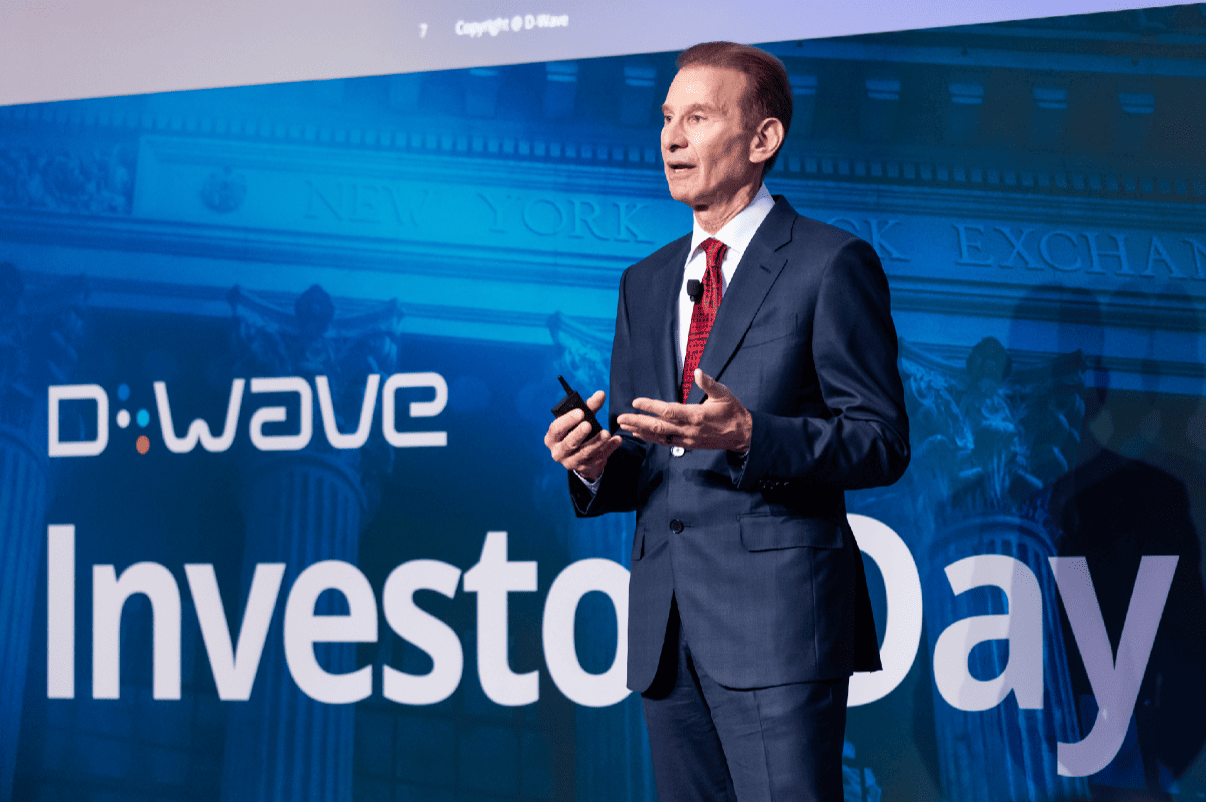
Insider BriefOn June 1, D-Wave Quantum held its first investor day at the New York Stock Exchange under the banner “The D-Wave Difference.” Alan Baratz, CEO of D-Wave, opened by urging the room to be skeptical of quantum computing companies, his own included. Quantum mechanics is hard, the chief executive said, and that makes it easy to sell things that are not real. When a company names a customer, ask who it is and whether you can call them. When it claims a scientific result, find the paper and read it. Always challenge.It is a high bar, and a fair one to apply to the case he then made. The difference D-Wave is selling is breadth. While most of the field is racing to build a single kind of quantum machine, D-Wave is building two modalities, annealing and gate, and is betting that owning both will let it reach a larger share of the market as quantum computing matures. The bet is unproven on one side, and the company is spending heavily to make it. D-Wave has raised more than $1 billion since early 2024. Its bookings for the most recent quarter were $33 million.The size of the prize is what makes the strategy worth taking seriously.
Boston Consulting Group, whose forecast much of the industry has used for years, projects that quantum computing will create $450 billion to $850 billion in economic value globally by 2040, supporting a market for hardware and software providers of $90 billion to $170 billion. BCG sorts that value into four areas: simulation, optimization, machine learning and cryptography.D-Wave makes two kinds of machine, and bills itself as the only provider of both. The first, an annealer, is the kind it has sold commercially for years, and it is suited to optimization, the work of finding the best option among an enormous number of possibilities, such as a delivery route or a production schedule. The second, a gate-model machine of the sort IBM, Google, IonQ and Quantinuum are building, is suited to simulation, including the chemistry and materials problems that drew much of the early scientific interest in the field. A company that builds only one, Mr. Baratz argued, can serve only part of the opportunity.The market data gives the argument room, but not as much as the stage suggested. BCG has revised its near-term expectations downward, noting that hardware has been harder to build than expected, that classical computers have competed better than expected, and that artificial intelligence has begun to solve problems quantum was meant to claim. The firm now places near-term annual value in the hundreds of millions rather than the billions, concentrated in simulation, and one of its authors observed that quantum has yet to have its “ChatGPT moment.” D-Wave’s own position reflects the split. Its annealer ships today. Its gate-model machine, the half of the strategy aimed at simulation, is still a roadmap, targeted for the early 2030s and built on a Yale spinout, Quantum Circuits, that D-Wave bought in January for about $250 million.If anything drew more attention than the market charts, it was artificial intelligence, and D-Wave’s argument runs in two directions.The first is that AI and quantum are complementary rather than rival. A company might use AI to forecast demand, Mr. Baratz said, then use a quantum computer to optimize the supply chain that meets it, with each technology handling the part it does best.The second is bolder. Quantum, he argued, can make AI itself better. D-Wave has worked for about a year with the Japanese pharmaceutical company Shionogi, which trained a model to generate molecular structures for new drugs. According to D-Wave, retraining the model with its quantum computer produced roughly ten times as many structures suited to drug development, and did so faster and with less power. The claim, if confirmed, would matter, because it would tie quantum to the AI spending companies are already making rather than to a distant payoff. It is also, for now, a single collaboration described by one of the two parties, without the published benchmark Mr. Baratz tells investors to demand.D-Wave also offered an early look at a use case it has rarely discussed. Working with a small firm, Post Quantum Labs, it has been running a quantum-classical blockchain testnet built on a new approach to proof of work, the computation that secures many cryptocurrencies. The work can run on conventional processors or on a quantum computer. The testnet has drawn more than 18,000 participants and some 1,600 compute nodes, most of them conventional.D-Wave’s machine joins for only about five minutes a day. When it does, Mr. Baratz said, it wins nearly every block, using less power, and the system is built to resist attack by a quantum computer. The company says it has begun a more substantial benchmarking phase and will publish results. Until it does, this is an early and self-reported experiment, more suggestive than demonstrated.The clearest outside validation D-Wave brought to the room is also the newest, and it did not arrive for D-Wave alone. In May, the company signed a Letter of Intent for $100 million in proposed funding under the CHIPS and Science Act, administered by the Commerce Department. In exchange, D-Wave would issue $100 million of its common stock to the government, a structure that hands Washington an equity stake and dilutes existing shareholders. The funding is not final. It depends on definitive award documents the company has not yet executed.It was part of a broader federal push into quantum. D-Wave was one of nine companies that signed letters of intent for about $2 billion in proposed CHIPS Act incentives.
The Commerce Department offered $100 million each to D-Wave, Atom Computing, Infleqtion, PsiQuantum, Quantinuum and Rigetti, up to $38 million to Diraq, and its two largest awards to manufacturing, $375 million to GlobalFoundries and roughly $1 billion to IBM for a domestic quantum foundry. The recipients span the field’s competing approaches, from D-Wave’s superconducting annealing to Atom Computing’s neutral atoms and Quantinuum’s trapped ions. Quantum stocks across the sector jumped on the news. For D-Wave, the endorsement matters in part because it covers both annealing and gate-model work, but it places the company inside a crowded field of federally backed competitors rather than ahead of it.The clearest sign of how D-Wave sees its next chapter is where it is putting the company. D-Wave is moving its headquarters to Boca Raton, Florida, after a recruitment effort tied to a broader push to build out the state’s quantum ecosystem. I had a hand in that push through Quantum Coast Capital, the Florida firm I founded to invest in quantum computing, networking, sensing and post-quantum security infrastructure, and which courted D-Wave in part with a drive around the area to make the case. Mr. Baratz said he expects the headquarters running by September or early October, with a research and development center to follow, ideally by the first quarter of next year.What drew him, he said, was the ecosystem more than the address. The region’s universities work together, he noted, and a single relationship can open a path to many of them, along with other technology companies nearby. For a company that argues quantum’s value will be realized through partnerships across industry, government and academia, settling inside a collaborative cluster fits the thesis.It also raises the stakes on it. D-Wave has now told investors, at the New York Stock Exchange, that two technologies beat one, that quantum can sharpen AI rather than lose to it, and that the proof is on its way. The market it is chasing is large, and the federal interest is real. Whether the difference D-Wave is selling becomes the difference that defines the company will be settled by the standard its own chief executive set. Name the customer, publish the paper, and let the timeline meet the lab.Share this article:Keep track of everything going on in the Quantum Technology Market.In one place.
Tags
Source Information
Discussion
0 professional contributions
Sign in to join this professional discussion.
Be the first to add a constructive contribution.