
Explore NVIDIA CUDA-Q Applications Hub and Academic Library with Amazon Braket
Understand this faster with AI


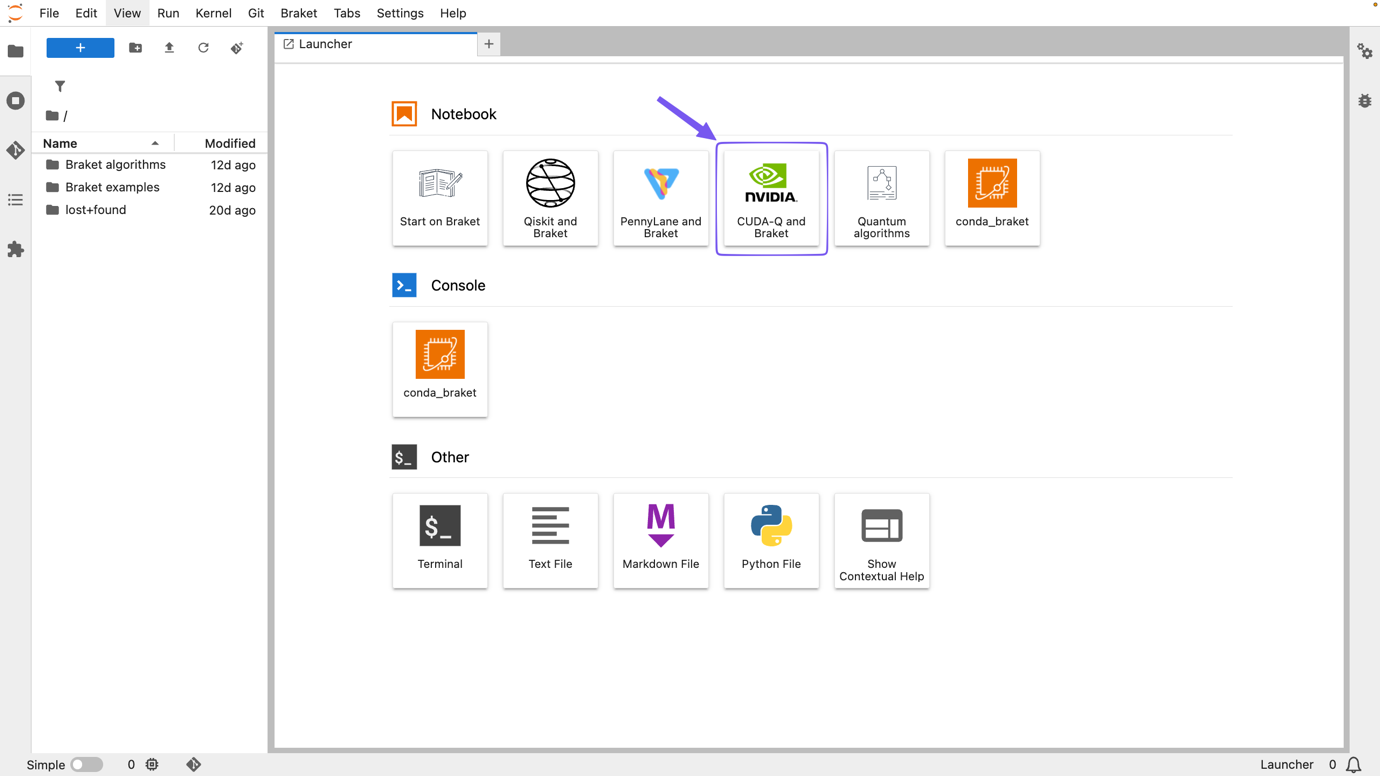
Amazon Braket managed notebook instances (NBIs) now include NVIDIA CUDA-Q Applications Hub and CUDA-Q Academic Library launch notebooks, bringing peer-reviewed quantum research examples and structured learning resources directly into your Braket environment and making it simple to explore and develop hybrid quantum-classical applications. Braket NBIs support a range of Amazon Elastic Compute Cloud (Amazon EC2) instances so you can match your applications to the right compute resources. Deploy a low-cost general-purpose ml.t3.medium instance for light applications or the ml.p4de.24xlarge instance with 8 NVIDIA A100 GPUs and 640 GB of memory when working with GPU-accelerated applications that require parallel compute and high memory.In this blog post we walk you through the process of launching the new notebooks and enabling the CUDA-Q Application Hub and CUDA-Q Academic Library on an Amazon Braket NBI.NVIDIA CUDA-Q is an open-source platform for hybrid quantum-classical computing. It enables seamless integration of accelerated computing with quantum processors and supports scaling complex hybrid algorithms across simulators and real quantum hardware.NVIDIA maintains two curated repositories that make CUDA-Q capabilities accessible to researchers and students:To follow along, you need: Figure 1: “CUDA-Q and Braket” icon in a Braket notebook instance opens the CUDA-Q examples repository Figure 2: Launch notebooks in a Braket notebook instance for CUDA-Q Applications Hub and CUDA-Q Academic HubNote: The cells download content provided by NVIDIA. While most notebooks run as expected, some may not be fully functional within an Amazon Braket notebook instance. If you encounter issues, open a GitHub issue in the CUDA-Q Applications Hub repo or the CUDA-Q Academic repo.CUDA-Q Applications Hub features research-backed examples across:CUDA-Q Academic library covers structured learning paths including:Browse the full Applications Hub at nvidia.github.io/cuda-quantum and the Academic learning paths at nvidia.github.io/cuda-q-academic.Amazon Braket managed notebook instances now provide access to the NVIDIA CUDA-Q Applications Hub and Academic Library, connecting researchers and students to peer-reviewed quantum examples and structured learning resources on AWS. To learn more about Amazon Braket, visit the Amazon Braket Developer Guide. Give it a try today!Have questions or feedback? Leave a comment below or open an issue on GitHub. Tyler Takeshita is a Senior Applied Scientist for Quantum Computing with AWS. Prior to joining AWS, he was the Lead of Quantum Technology at Mercedes-Benz Research and Development North America, a Daimler company. Tyler received his PhD in Chemistry in 2015 from the University of Illinois at Urbana-Champaign specializing in theoretical quantum chemistry. He then went on to be a postdoctoral fellow in the College of Chemistry at the University of California, Berkeley.Efrat Shabtai is a senior product manager for CUDA-Q and NVIDIA Quantum Cloud at NVIDIA. Prior to NVIDIA, Efrat worked as a principal engineering manager at Microsoft, building innovative products in Azure Quantum, Microsoft Research, and Azure Machine Learning, to name a few. Efrat holds a BSc in computer science from the Technion - Israel Institute of Technology.Monica VanDieren is Senior Manager of Technical Product Marketing for Quantum at NVIDIA, focused on technical enablement for quantum-GPU supercomputing. She works to equip researchers and developers with the knowledge and tools to leverage NVIDIA's quantum computing platform, including partnerships with universities worldwide. Previously at IBM Quantum, she developed training for enterprise clients. She holds a PhD in Mathematical Sciences from Carnegie Mellon University and has over 20 years of academic experience at institutions including Stanford and the University of Michigan.Ishaan Lyngdoh Pakrasi is a Senior Product Manager on the Amazon Braket team. He holds a B.S. and M.S. in Mechanical Engineering from the University of Illinois at Urbana-Champaign, where his work on dancing robots combined engineering, art, and human-robot interaction. A graduate of the National Science Foundation’s I-CORPS program, Ishaan received grant funding to commercialize a robotics startup. His career spans robotics research, startup entrepreneurship, deep-tech commercialization, and product management across multiple industries. Outside of work, he enjoys soccer, travel, and creative technology projects that blend design, code, and motion.Ryan Shaffer is an Applied Science Manager at AWS, where he leads a team of scientists and engineers building tools for quantum programming and execution through Amazon Braket. He holds a PhD in Physics from UC Berkeley, where he researched efficient operation and verification of quantum computers, as well as graduate degrees from MIT and Boston University. Outside of work, Ryan is a devoted Cleveland baseball fan, whose championship hopes every year are like macroscopic quantum tunneling - theoretically possible, but never observed.
Source Information
Discussion
0 professional contributions
Sign in to join this professional discussion.
Be the first to add a constructive contribution.