
Engineers Link Fluxonium Gate Speed to Qubit-Pad Geometry
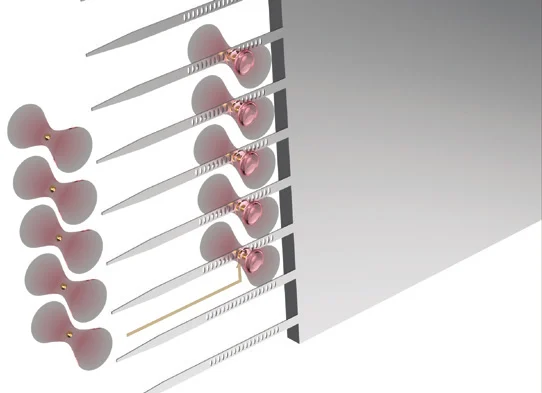
Understand this faster with AI


Engineers have numerically demonstrated ultrafast, high-fidelity two-qubit gates in two-dimensional fluxonium architectures by carefully engineering the geometry of qubit pads, a result challenging the previously held belief that capacitive loading posed a fundamental barrier to scaling these quantum processors. Fluxonium qubits offer millisecond-scale coherence times, positioning them as a strong candidate for building practical, scalable quantum computers. Researchers at the Quantum Science Center of Guangdong-Hong Kong-Macao Greater Bay Area, Shenzhen, China identified parasitic capacitances within Josephson junctions and arrays as the dominant source of capacitive loading hindering the move to 2D designs. Their work reveals that capacitive loading does not constitute a fundamental limit for 2D fluxonium quantum processors.
Fluxonium Qubit Performance & Scalability Challenges Fluxonium qubits are rapidly becoming favored architectures for scalable quantum computing, distinguished by millisecond-scale coherence times, a substantial advantage over competing qubit technologies. However, translating this promise into large, interconnected processors presents significant engineering hurdles, primarily centered around capacitive loading as devices move from one-dimensional to two-dimensional layouts. The core challenge lies in maintaining strong qubit coupling to external circuit elements while simultaneously integrating an increasing number of components. This is particularly acute for fast microwave-activated phase (MAP) gates, which demand exceptionally strong qubit-coupler connections. Compared to transmon qubits, fluxonium qubits operate with limited capacitance budgets; every desired and parasitic capacitive channel consumes a portion of this finite resource, reducing achievable coupling strength. This phenomenon, described as a major obstacle to highly connected 2D processors, has now been subjected to rigorous analysis, stemming from the ability to engineer the qubit-pad geometry to mitigate the effects of parasitic capacitance. By carefully designing the physical layout, researchers can effectively redistribute capacitive loading and maintain strong qubit-coupler interactions even in complex 2D architectures. The study demonstrates this through detailed modeling of various coupling configurations, including grounded qubits and floating qubits with couplers attached to single or distributed pads.
The team numerically demonstrated ultrafast, high-fidelity two-qubit gates in 2D fluxonium architectures, including parasitic capacitive coupling paths to model realistic devices.
Analytical Relation Between Capacitance Budget and Coupling Researchers at the Quantum Science Center of Guangdong-Hong Kong-Macao Greater Bay Area, Shenzhen, China have derived an analytical relationship between a qubit’s capacitance budget, its limited electrostatic resources, and the strength of its coupling to external circuit elements, pinpointing parasitic capacitances as the primary culprit. The researchers write that “capacitive loading has emerged as a major obstacle to highly connected 2D fluxonium quantum processors,” but their work suggests this obstacle can be overcome through careful design. The core of their approach lies in understanding how to redistribute capacitive loading, demonstrated by meticulously modeling various coupling configurations, including grounded and floating qubits.
The team’s analysis establishes “an explicit quantitative relation between the capacitance budget and the effective interaction strength,” showing that coupling strength is determined by both grounding capacitances and these participation ratios. They extended this analysis to more complex, high-connected 2D architectures, including parasitic capacitive coupling paths to model realistic devices. Parasitic Capacitance of Josephson Junctions & Arrays While fluxonium qubits boast millisecond-scale coherence times, a significant advantage over other qubit types, scaling these devices to two dimensions presents unique challenges related to capacitive loading.
The team’s recent work focuses on pinpointing the physical origins of this loading and demonstrating that it isn’t an insurmountable barrier to building complex quantum processors. The core issue lies in the increasing complexity of connecting qubits in a 2D architecture; as more components are integrated, the finite electrostatic resource shared by all capacitive channels becomes strained. Unlike conventional transmon qubits, fluxonium qubits operate with a constrained capacitance budget, meaning every additional connection diminishes the potential for strong qubit coupling. Their analysis began with a minimal model consisting of a grounded qubit capacitively coupled to a grounded coupler, allowing them to derive “an analytical relation between the qubit capacitance budget and its achievable capacitive coupling to external circuit elements.” This detailed modeling revealed two key capacitance participation ratios governing the effect: the inter-pad participation, and the qubit-to-ground participation. The inter-pad participation defines the fraction of the qubit’s effective capacitance arising from mutual capacitance between its pads, while the qubit-to-ground participation represents the fraction of the effective ground capacitance contributed by the direct pad-to-ground path. They included parasitic capacitive coupling paths to model realistic devices. Scaling up fluxonium qubits for practical quantum computation demands overcoming a persistent challenge: capacitive loading.
The team discovered that the core issue stems from the increasing complexity of interconnecting qubits.
The team began by establishing a crucial link between design parameters and performance, allowing them to model how these parasitic capacitances impact qubit-coupler interaction strength. Crucially, the researchers found that the arrangement of the qubit pads, the interface between the qubit and its control circuitry, plays a critical role. They numerically demonstrated ultrafast, high-fidelity two-qubit gates in 2D fluxonium architectures by optimizing the qubit-pad geometry, and extended this analysis to more complex, high-connected 2D architectures, including parasitic capacitive coupling paths to model realistic devices. Fluxonium qubits, distinguished by their millisecond-scale coherence times, are increasingly viewed as frontrunners in the race to build practical quantum computers. However, scaling these superconducting circuits from linear chains to densely connected two-dimensional (2D) architectures presents a significant hurdle: capacitive loading. The core issue stems from the finite electrostatic resources, the capacitance budget, available within each fluxonium qubit. These unwanted capacitances effectively siphon away electrostatic energy that would otherwise contribute to strong qubit-coupler interactions. This revealed that the coupling isn’t simply determined by the bare capacitance values, but crucially by how capacitance is distributed between grounding channels.
The team extended this analysis to more complex 2D architectures, including parasitic capacitive coupling paths to model realistic devices. The resulting equation, detailed in their publication, highlights that the qubit-coupler coupling strength is governed by two critical capacitance participation ratios. Source: https://arxiv.org/abs/2607.22138 Stay currentSee today’s quantum computing news on Quantum Zeitgeist for the latest breakthroughs in qubits, hardware, algorithms, and industry deals. Tags:
Tags
Source Information
Discussion
0 professional contributions
Sign in to join this professional discussion.
Be the first to add a constructive contribution.