
Energy Department Announces Partnership with Fermilab and Qblox to Manufacture Foundational Quantum Control Platform for U.S. Research and Innovation
Understand this faster with AI


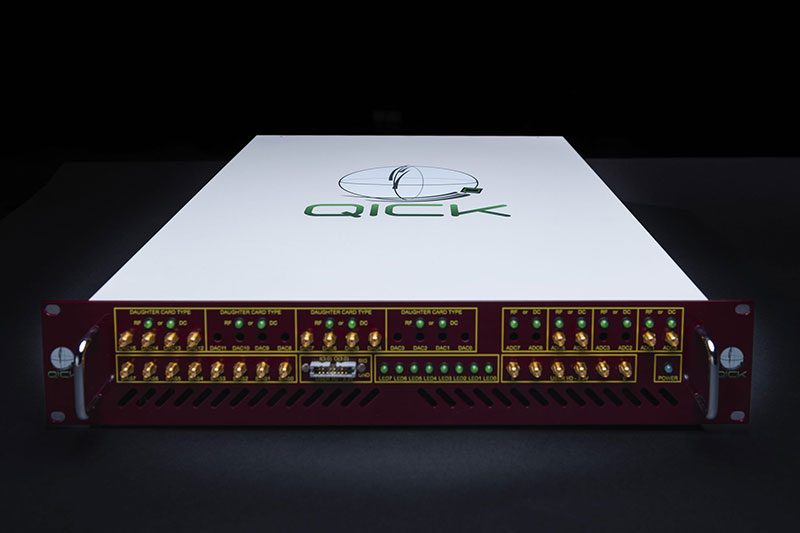
Editor’s note: This press release was originally posted by the Department of Energy Office of Technology Commercialization. Fermilab began developing the Quantum Instrumentation Control Kit (QICK) in 2021. QICK’s use has expanded, reaching a community of about 500 users, primarily at U.S. national labs, in academia and industry. Partnering with Qblox will facilitate a new way to distribute QICK to a much wider audience in the U.S, including universities and industry, and bolster the quantum computing workforce.The QICK team at Fermilab will continue scientific development of the tool, while Qblox will take on new workforce development, training and support. The QICK Kit developed at Fermilab is a fully integrated, cost effective, 32 RF/DC channel box with maximum flexibility for scientists. Credit: Ryan Postel, Fermilab The U.S. Department of Energy’s (DOE) Office of Technology Commercialization today announced a partnership between Fermi National Accelerator Laboratory (Fermilab) and Qblox to manufacture and distribute the Quantum Instrumentation Control Kit (QICK) in the United States, a platform for advancing quantum research and building a high-tech workforce. Facilitated by DOE’s Office of Technology Commercialization, this effort marks an important step in advancing U.S. capabilities in quantum computing, sensing, and networking. Developed by Fermilab, QICK is an open-source platform for managing quantum readouts and controls. It plays a critical role in synchronizing quantum processors and sensors, making it a foundational technology for the growing quantum ecosystem. Through the partnership, Qblox, a leader in control and readout electronics that bridge quantum and classical systems, will coordinate QICK manufacturing, distribution, and supply chain operations in the United States. “This partnership demonstrates how DOE’s National Laboratories and private industry can work together to accelerate the commercialization of quantum technologies while strengthening U.S. manufacturing and workforce capabilities,” said Energy Department Under Secretary for Science Dr. Darío Gil. “By supporting the transition of QICK from research to production, we are laying the groundwork for scalable, interoperable quantum systems that serve national and scientific priorities.” Sho Uemura, the lead software developer and a core member of the QICK development team at Fermilab, led the rollout of QICK version 2.0, which features new software and firmware that adds functionality, including a brand-new core processor to improve quantum control. Credit: Ryan Postel, Fermilab “This collaboration underscores Qblox’s commitment to open-source developments and advancing the U.S. quantum ecosystem through workforce development and innovation” said Qblox Founderand CEO, Niels Bultink. “Qblox is proud to facilitate this Made-in-the-USA platform to strengthen America’s quantum infrastructure, cultivate a highly skilled talent pool, and cement the nation’s position as a global leader in quantum technology.” The collaboration is being launched through a Letter of Intent between Fermilab and Qblox, with plans to formalize under a Cooperative Research and Development Agreement (CRADA) and full licensing arrangement in the coming weeks.Together, DOE, Fermilab, and Qblox are creating a scalable model for public-private collaboration — one that ensures key elements of the quantum supply chain are developed and built domestically. Recommended reading View all news Fermilab’s SQMS Center funded with $125 million to shape the future of quantum information science November 4, 2025 DOESQMS CenterPress release The SQMS Center enters a new era focused on scaling quantum systems from discovery to deployment — driving innovation in computation, communication and sensing. ‘Squeezed light’ technology could accelerate path to quantum networking September 30, 2025 AQNETemerging technologiesquantumFermilab feature Scientists at Fermilab and Caltech have demonstrated the feasibility of their method of using squeezed light to dramatically increase the rate at which quantum networks can generate entangled particle pairs over long distances. This advance addresses a critical bottleneck in building large-scale quantum networks. A minute with Troy England August 20, 2025 detectorsemerging technologiesmicroelectronicsquantumFermilab feature Troy England is an engineer at Fermilab who designs microelectronics that can function in the ultracold spaces required by quantum systems. His work is helping scientists get better data to explore particle interactions and understand qubit behavior.
Tags
Source Information
Discussion
0 professional contributions
Sign in to join this professional discussion.
Be the first to add a constructive contribution.