
Wall Street Has Proven Resilient Through a Geopolitical Shock, a Rate Freeze, and $110 Oil. Here Is What That Tells Long-Term Investors.
Understand this faster with AI


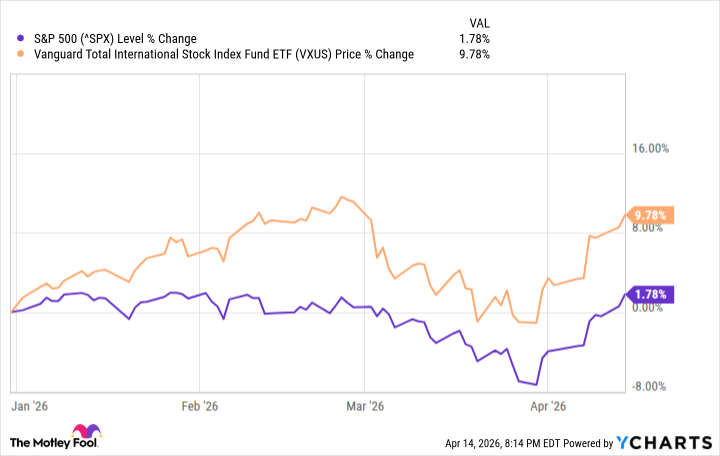
Ever since the Iran war started on Feb. 28, the news has been full of alarming headlines, dire predictions, and tragic stories of human suffering. The price of oil had spiked to over $110 a barrel, the Federal Reserve has paused interest rate cuts due to worries about higher inflation, and the world is facing uncertainty about when (or if) the Strait of Hormuz will be open to economically vital shipments of oil and gas anytime soon. But despite this geopolitical crisis, the stock market has been surprisingly resilient. The S&P 500 index is up about 1.8% year to date and has gained about 10% since March 30. The rest of the world is doing even better -- the Vanguard Total International Stock Index Fund ETF (VXUS 0.27%) is up 9.8% year to date. ^SPX data by YCharts. Instead of the Iran war derailing the global economy, the stock market seems to be looking ahead and moving on. Here are five reasons why stocks have been so resilient, despite the conflict. 1. The world economy is vast, and the stock market is varied Today it's easier than ever before to instantly get news updates and social media posts that zoom in on the places on Earth that are having wars, disasters, and tragedies. The stock market has to take in data and trends not just about any one place, but on a larger picture of the unfolding human experience across the global economy. The closure of a strategically important passageway for oil like the Strait of Hormuz has a big impact on energy prices and other aspects of life all over the planet. But for the most part, no single country, conflict, or news event -- no matter how important it is to the people directly involved -- is "big" enough to completely disrupt the global stock market. The stock market is trying to make sense of an even bigger, worldwide puzzle. And on a mundane level, the news everywhere in the world is not always so bad. The typical everyday human experience does not involve drone strikes. Instead, most people spend their days going to work, building, creating, learning, trading, collaborating with people, generating value, making a living, and making a life. That spirit of human ingenuity and teamwork is what moves the stock market most of the time, more than any one tragic conflict or distressing news event. Image source: Getty Images. 2. The stock market is a forward-looking indicator The stock market is always looking ahead. Stock prices change based not on which companies are making money today, but which companies investors believe will make money in the future. The stock market tends to bottom before the lowest point of an economic downturn and starts rising again before the economic news headlines start getting better. Sometimes this feels like the market is overlooking too much bad news in the world. But the stock market's bias toward optimism is well-founded. Most of the time, in the long run, many things get better: The economy grows, companies get more efficient, consumers get access to more goods and services, the standard of living rises, and the stock market goes up. 3. Oil is less important than it used to be The price of oil matters. There's no doubt the Iran war is causing pain for consumers at the gas pump and grocery store, and problems for emerging market economies in countries that are less able to afford a sudden increase in energy costs. However, the conflict is unlikely to cause another devastating 1970s-style oil crisis. That's because in the decades since the OPEC oil embargo, the global economy has gotten less reliant on oil as an energy source. According to research from Standard Chartered PLC, the "energy intensity" of the global economy declined by 58% from 1970 to 2022, and the amount of oil needed to generate $1,000 of global GDP growth fell by 1.5 liters per year since 1984. Factories have gotten smarter, vehicles have gotten more fuel-efficient, and buildings and appliances have been designed to conserve energy. Crude oil prices are up to 2022 levels, not all-time highs. Just look at the long-term trend in this chart: WTI Crude Oil Wholesale Spot Petroleum Price data by YCharts. The recent rise in oil prices has been shockingly fast, but the economic damage is likely to be manageable. 4. It's all about corporate earnings Why do people buy stocks? Because they want to own a share of the earnings of businesses. And so far in 2026, energy prices, tariffs, and more, corporate earnings are still looking strong. Recent research from Morgan Stanley strategists said that the stock market is in the "final phase" of a correction, and that the market "has appropriately and surgically discounted the risks both at the index and stock level." According to Bloomberg, Wall Street analysts expect 12% growth in first-quarter earnings for the S&P 500. 5. Crises come and go The stock market usually has a short memory. It's worth reminding ourselves that we've been through some tough, bizarre times before -- very recently. Six years ago, we were all stuck at home during the COVID-19 pandemic, not sure if or when we'd be able to go to a movie theater or walk down a grocery store aisle without a mask on. The S&P 500 index plummeted by about 30% from February to March 2020. And yet, by the end of 2020, the market had gone up 16%. SPY data by YCharts. And for most people, life soon went "back to normal." The crisis ended. We survived one of the most stressful and surreal events of our lifetime, and the economy kept growing, and the stock market kept going up. Odds are good that the conflict with Iran will also end, hopefully soon, and humanity will keep building a brighter future together.
Tags
Source Information
Discussion
0 professional contributions
Sign in to join this professional discussion.
Be the first to add a constructive contribution.