
The $1 Trillion Race: Why Eli Lilly Is Leaving Novo Nordisk in the Dust
Understand this faster with AI


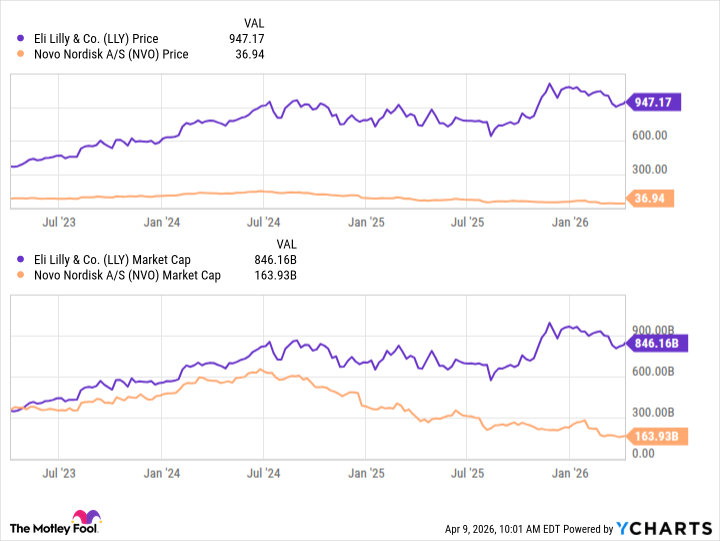
By Prosper Junior Bakiny – Apr 15, 2026 at 1:26PM ESTKey PointsEli Lilly has a stronger weight-loss portfolio than Novo Nordisk.Eli Lilly also has a deep pipeline beyond its core therapeutic area.Novo Nordisk's shares could be a bargain at current levels. Three years ago, Eli Lilly (LLY 2.00%) and Novo Nordisk (NVO +3.31%) had about the same market value. Given how well both were performing, they were leading candidates to be among the first healthcare stocks to reach a $1 trillion market cap. However, Eli Lilly and Novo Nordisk have moved in opposite directions since, with the former hitting $1 trillion in value last year, though it has since lost some momentum. Why has Eli Lilly performed so much better? And which, if any, of these two stocks is a buy right now? Let's find out. LLY data by YCharts Leapfrogging Novo Nordisk Novo Nordisk generates the majority of its revenue from its GLP-1 franchise. The company's semaglutide, marketed under brands such as Wegovy for weight loss and Ozempic for diabetes, has been a market leader and pioneer. Novo Nordisk dominated the GLP-1 and chronic management niche before Eli Lilly launched tirzepatide, branded as Mounjaro for diabetes and Zepbound for weight loss. Eli Lilly has since taken the lead from its rival in the anti-obesity market for one key reason: Zepbound has proven more effective than Wegovy in a head-to-head clinical trial. The former led to an average weight loss of 20.2% over 72 weeks, compared with 13.7% for the latter. Further, Zepbound helped reduce waist circumference -- which correlates with visceral fat -- more than Wegovy in the trial. Image source: Getty Images. It also helps that Zepbound earned approval in treating obstructive sleep apnea in overweight and obese patients, a condition from which many in this population suffer. Besides losing the lead to its competitor, Novo Nordisk hit several clinical setbacks. Its next-gen anti-obesity medicine, CagriSema, somewhat disappointed in phase 3 studies and also proved inferior to Zepbound. So, Eli Lilly should remain the leader in this market for the foreseeable future, especially given the strong prospects of its pipeline candidates. Eli Lilly's retatrutide posted an impressive 28.7% mean weight loss (at the highest dose) in a 68-week phase 3 study while also helping relieve knee pain in patients. Eli Lilly's superior portfolio and pipeline in weight loss explain why it has outperformed Novo Nordisk over the past three years. ExpandNYSE: LLYEli LillyToday's Change(-2.00%) $-18.50Current Price$904.00Key Data PointsMarket Cap$872BDay's Range$888.32 - $930.0052wk Range$623.78 - $1133.95Volume108KAvg Vol3.1MGross Margin83.04%Dividend Yield0.68% Think, long-term How will both stocks perform from here on out? Let's start with Eli Lilly. The company's weight management portfolio now features Foundayo. This oral GLP-1 therapy recently earned approval. It should add retatrutide to its list of approved medicines in the next few years, and it boasts several others in development. Increased competition from other companies may somewhat erode its pricing power. Still, Eli Lilly should continue posting outstanding financial results over the next five years thanks to its dominance in this space. And beyond this market, Eli Lilly has launched new products in other areas in recent years -- and should launch more -- that are likely to exceed $1 billion in annual sales. The company has improved its pipeline, too, thanks to acquisitions and licensing deals. Eli Lilly is branching out beyond its core areas of expertise, something that may help keep its revenue and earnings growing at a good clip as drugmakers launch more anti-obesity therapies. In short, the stock still looks attractive, especially after its recent dip. ExpandNYSE: NVONovo NordiskToday's Change(3.31%) $1.30Current Price$40.62Key Data PointsMarket Cap$132BDay's Range$39.67 - $40.6252wk Range$35.12 - $81.44Volume463KAvg Vol23MGross Margin80.90%Dividend Yield4.58% But what about Novo Nordisk? The Denmark-based pharmaceutical leader's portfolio of anti-obesity drugs -- which also includes oral Wegovy -- remains second only to Eli Lilly's, and it has a deep pipeline in weight management. With several catalysts on the horizon, the stock could jump significantly in the next few years if it posts excellent phase 3 results for promising candidates, such as amycretin, a dual GLP-1/amylin agonist currently undergoing phase 3 studies in oral and subcutaneous formulations. Perhaps the best reason to consider Novo Nordisk stock is its valuation. The company is trading at 11.2x forward earnings, compared to the 17.2x average for healthcare stocks. Novo Nordisk could still deliver outstanding returns for investors who buy its shares today and hold them for a while, given its vast pipeline, which should allow it to launch brand-new products and boost sales and profits. Read NextApr 13, 2026 •By David Jagielski, CPAAfter Obtaining Approval for Its Weight Loss Pill, Is It Off to the Races for Eli Lilly Stock?Apr 11, 2026 •By Prosper Junior BakinyEli Lilly Isn't Replacing Zepbound -- It's Building an Obesity EmpireApr 8, 2026 •By Adria CiminoWhich of These Healthcare Stocks Is More Likely to Be a Millionaire Maker?Apr 7, 2026 •By Parkev Tatevosian, CFAGreat News for Eli Lilly Stock Investors!Apr 7, 2026 •By Prosper Junior BakinyIs Eli Lilly Stock a Buy After a Brand New Approval?Apr 6, 2026 •By Lyle DalyThe Largest Healthcare Companies by Market Cap in April 2026About the AuthorProsper Junior Bakiny is a contributing Motley Fool healthcare analyst covering biotechnology, pharmaceuticals, and healthcare stocks.
Before The Motley Fool, Prosper wrote about investing topics ranging from stock market news to private equity for various companies. He holds a master’s degree in corporate finance from the University of Maryland Global Campus.TMFPBakinyStocks MentionedEli LillyNYSE: LLY$903.79(-2.03%)-$18.71Novo NordiskNYSE: NVO$40.61(+3.28%)+$1.29*Average returns of all recommendations since inception. Cost basis and return based on previous market day close.
Tags
Source Information
Discussion
0 professional contributions
Sign in to join this professional discussion.
Be the first to add a constructive contribution.