
See inside Coe Hall, a 65-room mansion built by a Gilded Age businessman who was booked on the Titanic's return voyage
Understand this faster with AI


The Camellia Greenhouse. Gabbi Shaw/Business Insider Updated 2026-04-13T16:58:30.464Z Share Copy link Email Facebook WhatsApp X LinkedIn Bluesky Threads lighning bolt icon An icon in the shape of a lightning bolt.
Impact Link Save Saved Read in app This story is available exclusively to Business Insider subscribers. Become an Insider and start reading now. Have an account? Log in. Coe Hall is a 65-room mansion that was built on the Gold Coast of Long Island, New York, in 1921. The home, built by insurance exec William Robertson Coe, is inside the Planting Fields Arboretum. The main house, along with its multiple greenhouses and gardens, is open to the public. AI-generated summary Summaries are generated by an AI model trained on Business Insider's articles. AI may make mistakes or provide inaccurate/incomplete information. We're unable to load that answer right now. Please try again. Who were the Olmsted Brothers? How did Coe influence the Titanic voyage? What is the Planting Fields Arboretum? What is the Gold Coast of Long Island? What inspired Coe Hall's design? In the village of Upper Brookville on Long Island, New York, you can step back 100 years. All you need to do is enter the Planting Fields Arboretum, a 409-acre state park that houses an expansive mansion, multiple greenhouses, gardens, and a tea house straight out of a fairy tale.The mansion, Coe Hall, was built by William Robertson Coe, an executive who succeeded in the insurance and railroad businesses, and his wife, Mai Rogers, an heiress to a fortune built on Standard Oil money. In fact, Coe was the president of the company that brokered the insurance for the hull of what was known as an unsinkable ship: the Titanic. He was even booked on the return voyage of the Titanic from New York City to England, per the Long Island Press. Coe Hall — the second mansion to be built on the property after the original from 1906 burned down in 1918 — looks like it was transplanted from the English countryside and dropped on the Gold Coast, a stretch of Long Island's North Shore that earned its nickname for the opulent estates built by wealthy families around the turn of the 20th century.That's on purpose, as they wanted to make it seem like the home had been there for decades, making them "old money."During my tour of the property in spring 2025, a docent told me some architectural touches didn't match at the time of construction, as if to give the appearance that the home had been remodeled over the years. In addition to the main house, which was designed by the architectural firm Walker & Gillette, the arboretum is home to beautiful landscaping and gardens designed by the famous Olmsted Brothers, who also designed Central Park and Oheka Castle.Here's what it's like to visit one of the largest Gold Coast mansions left on Long Island.
The Planting Fields Arboretum is a 409-acre state park on Long Island, New York. A map of the Planting Fields. Gabbi Shaw/Business Insider The estate was purchased by William Robertson Coe, an insurance and railroad tycoon, in 1913. The entryway. Gabbi Shaw/Business Insider It's now open for tours. It cost $8 to park there, and another $15 to tour the house. There are many fields at Coe Hall. Gabbi Shaw/Business Insider The property was in the Coe family until his death in 1955, when it was given to the state of New York. A view of the main driveway of Coe Hall. Gabbi Shaw/Business Insider The centerpiece of the park is Coe Hall, a 65-room Tudor mansion built in 1918. Coe Hall from the lawn. Gabbi Shaw/Business Insider There are personalized touches all over the house's limestone exterior.
The West Portico. Gabbi Shaw/Business Insider For example, this ship carved into the house is a nod to Coe's ties to the maritime industry and his love of sailing. An etching on the portico. Gabbi Shaw/Business Insider The building was modeled after English manor homes to evoke "old money" vibes rather than the "new money" that Coe had made. Coe Hall. Gabbi Shaw/Business Insider You get almost a medieval feel from the moment you walk through the entryway. The entryway. Gabbi Shaw/Business Insider It took three years to complete Coe Hall. A hallway. Gabbi Shaw/Business Insider There are taxidermied animals throughout the house — Coe was an avid hunter and summered in Wyoming. The ram head was just one of many. Gabbi Shaw/Business Insider One of the first rooms you can view is Coe's den. The den. Gabbi Shaw/Business Insider It's covered in dark wood, giving a masculine atmosphere. The den. Gabbi Shaw/Business Insider The shelves were filled with priceless books, like this signed copy of Mark Twain's autobiography. Twain was a close friend of the family. A signed copy of a Mark Twain book. Gabbi Shaw/Business Insider Photos of Coe and his second wife, Mai Rogers, are on display. They had married in 1900. Photos of the Coes. Gabbi Shaw/Business Insider This house was built amid Prohibition. So Coe knew he had to prepare for an alcohol shortage. A secret door. Gabbi Shaw/Business Insider He built his very own hidden speakeasy in his den. A docent told us he spent millions of dollars in today's money to stockpile alcohol. The speakeasy. Gabbi Shaw/Business Insider The docent said Coe and his wife had opposing style tastes and suggested visiting her salon across the hall. Don't miss the suit of armor. Gabbi Shaw/Business Insider He was right. If her husband's taste was English, this parlor was straight out of Versailles. Mai Rogers' salon. Gabbi Shaw/Business Insider On the way to look at the rest of the home, we passed a small side room that displayed a bison head and one of Coe's hunting rifles. A buffalo. Gabbi Shaw/Business Insider The art in the living room is original to the home. The living room. Gabbi Shaw/Business Insider It's certainly not a bad place to spend your weekends. The living room. Gabbi Shaw/Business Insider This mezzanine was built as a place for the four Coe children to play and store their toys and musical instruments without getting underfoot. An area for the kids to play. Gabbi Shaw/Business Insider The Great Hall is at the back of the home. It was perfect for the parties of the Roaring '20s.
The Great Hall. Gabbi Shaw/Business Insider This box on the second floor looks like it was made for people-watching, but it was actually where musicians would play during parties. There were many books on the shelves all around the room. Gabbi Shaw/Business Insider The craftsmanship throughout the house was impossible to miss. Woodwork on the mantel. Gabbi Shaw/Business Insider Every detail was intentional. These flowers are a reference to Rogers' love of plants — the property itself became an arboretum. More woodwork. Gabbi Shaw/Business Insider There was another portrait of Coe hanging in the corner. A painting of William Robertson Coe. Gabbi Shaw/Business Insider On the left is Rogers, and on the right is their youngest child and only daughter, Natalie. She was married in this room in 1934. Paintings of Mai Huttleston Rogers Coe and her daughter, Natalie. Gabbi Shaw/Business Insider Above the massive fireplace is a portrait of the three Coe boys: William, Robert, and Henry. A painting of their sons. Gabbi Shaw/Business Insider A docent told us it took $1.7 million annually — in 1927 dollars — to maintain Coe Hall. That's around $32 million today. There were stained-glass windows throughout. Gabbi Shaw/Business Insider There was another reading room set off the great hall. The shelves were filled with antiques and old books. Another side room. Gabbi Shaw/Business Insider The last viewable room on the first floor was this formal dining room. The dining room. Gabbi Shaw/Business Insider The main staircase felt straight out of a castle. The stairway. Gabbi Shaw/Business Insider This hallway led to three guest bedrooms and the Coes' suites; there are nine bedrooms total. The second floor had all the bedrooms. Gabbi Shaw/Business Insider This was the only guest room open for visitors. Each room has a walk-in closet and its own bathroom. A guest room. Gabbi Shaw/Business Insider At the end of the hall were Coe and Rogers' bedrooms and bathrooms. The hallway. Gabbi Shaw/Business Insider This was Rogers' bedroom. Like her salon downstairs, it is bright and airy. Rogers' bedroom. Gabbi Shaw/Business Insider And no, that's not wallpaper. This design was hand-painted onto the wall. The art was intricate. Gabbi Shaw/Business Insider The windows gave her a view of the gardens she painstakingly designed. The chandeliers are all original to the time of the Coes. Gabbi Shaw/Business Insider This is her bathroom. Once again, it's very French. Rogers' bathroom. Gabbi Shaw/Business Insider In addition to a bathtub, she had a needle bath. Jets of water came out from different points on the cage-like contraption. A needle bath. Gabbi Shaw/Business Insider Across the hall is her husband's bathroom, where he had his own interesting contraption: an electric light cabinet, similar to an infrared sauna. Coe's bathroom. Gabbi Shaw/Business Insider Down the other hallway were the kids' bedrooms. They were all closed, though, because Netflix filmed season three of "The Diplomat" at Coe Hall, and these rooms were used as storage. The kids' rooms. Gabbi Shaw/Business Insider Coming back down the stairs, I got another look at just how intricate and intentional every detail in the house was. The staircase. Gabbi Shaw/Business Insider Now it was time to check out the much-revered grounds. Another view of Coe Hall. Gabbi Shaw/Business Insider Right off the bat, this fountain caught my eye. The fountain. Gabbi Shaw/Business Insider I also enjoyed this courtyard. The landscaping was by the Olmsted Brothers, who also designed Central Park and Oheka Castle. A courtyard. Gabbi Shaw/Business Insider Near the house, there's a small pond and a bench off a hidden path. It's the perfect spot for quiet contemplation. A secret garden. Gabbi Shaw/Business Insider But the main draws of the backyard are the Blue Pool Garden and the Tea House. The backyard. Gabbi Shaw/Business Insider Before the pool was here, this area was a tennis court. It took 16 workers to dig out 16,000 square yards of soil to build the sunken pool.
The Blue Pool. Gabbi Shaw/Business Insider At the end of the garden is the Tea House, which was built in 1906.
The Tea House. Gabbi Shaw/Business Insider The exterior makes the Tea House look like something out of a fairytale.
The Tea House. Gabbi Shaw/Business Insider Can't you just hear someone saying, "Once upon a time…"? A bench outside the Tea House. Gabbi Shaw/Business Insider Rogers entertained her friends in the Tea House on nice days. Inside the Tea House. Gabbi Shaw/Business Insider It looks like the inside of a Tiffany's box. Monochrome has been a popular trend for over 100 years. Gabbi Shaw/Business Insider The other structure in this area of the park is the Playhouse, which was built so Natalie, the Coes' daughter, could have a place to play house. The Playhouse. Gabbi Shaw/Business Insider As we continued walking around the park, we came to this archway made of pine trees. An archway leading to a greenhouse. Gabbi Shaw/Business Insider Walking through it felt like walking through a storybook. Inside the tunnel. Gabbi Shaw/Business Insider On the other side of the archway is the Main Greenhouse, built in 1914.
The Main Greenhouse. Gabbi Shaw/Business Insider This was originally called the Hibiscus House, but now it's a mixture of tropical plants. Inside the Main Greenhouse. Gabbi Shaw/Business Insider One corner of the building was anchored by this giant palm tree. A palm tree. Gabbi Shaw/Business Insider There were plenty of paths to walk down to get the full experience. Inside the Main Greenhouse. Gabbi Shaw/Business Insider We then walked the Azalea Walk, one of 13 trails at the Planting Fields.
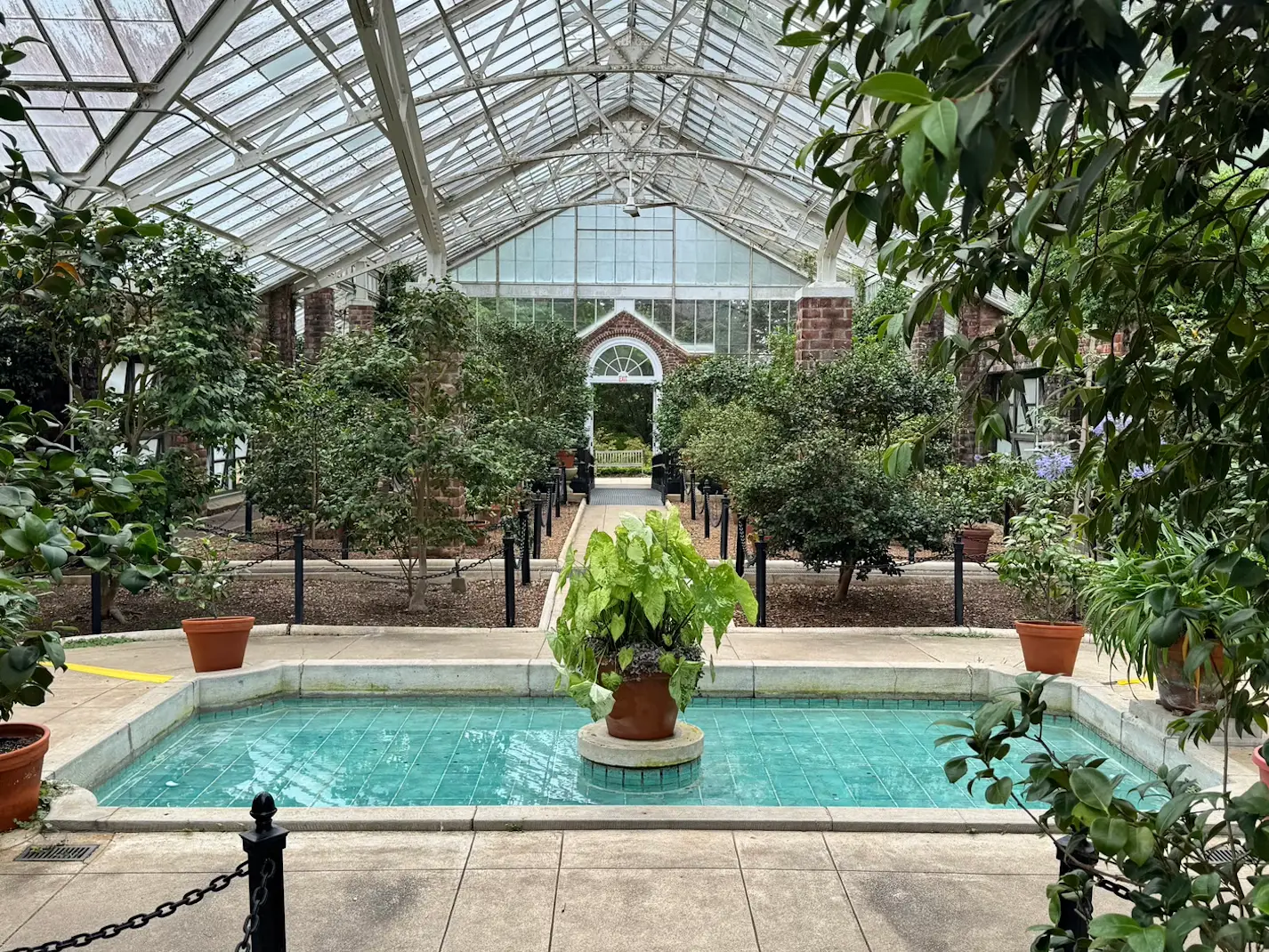
The Azalea Walk. Gabbi Shaw/Business Insider That led us to the other greenhouse on-site, the Camellia Greenhouse, built in 1917.
The Camellia Greenhouse. Gabbi Shaw/Business Insider It has the largest collection of camellias under glass in the northeast. Inside the Camellia Greenhouse. Gabbi Shaw/Business Insider However, camellia season is in January, so we missed it. Inside the Camellia Greenhouse. Gabbi Shaw/Business Insider But there were still plenty of flowers and plants to check out in this greenhouse. Inside the Camellia Greenhouse. Gabbi Shaw/Business Insider There are many more gardens to see at Coe Hall, including a rose garden, a hydrangea collection, and a dahlia garden. One of the many paths. Gabbi Shaw/Business Insider Walking around Planting Fields and Coe Hall felt like stepping back in time and revealed the remarkable wealth of Gilded Age families. Any history buff should pay it a visit, if they can. Coe Hall. Gabbi Shaw/Business Insider
Source Information
Discussion
0 professional contributions
Sign in to join this professional discussion.
Be the first to add a constructive contribution.