
The Market Got Everything it Could Have Wanted From January's CPI and Jobs Reports, But the Devil is in the Details
Understand this faster with AI


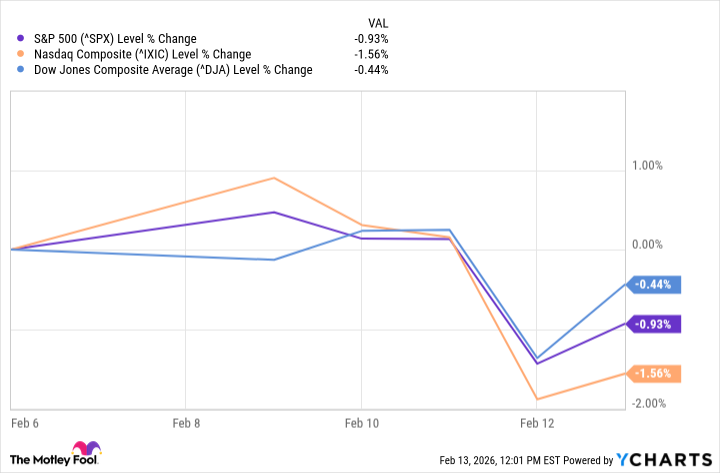
Both January's nonfarm payrolls report and the Consumer Price Index came in better than expected, yet the market has not responded well.Heading into this week, I think if you had told investors that economic data would show the economy added 130,000 jobs in January, unemployment dipped to 4.3%, and the Consumer Price Index rose only 2.4% year over year, most would have been pretty pleased and bought the broader stock market. Yet, with just a few hours of trading left on Friday, the major stock indexes all find themselves in the red for the week. ^SPX data by YCharts On the surface, the data looks good. The economy added way more jobs than expected, and inflation is moving toward the Federal Reserve's preferred 2% target. The lower inflation report could also signal that the expected one-time inflationary impact from President Donald Trump's tariffs has passed. Yet, when looking under the hood, there's more than meets the eye. The devil is always in the details. Data is not conclusive Starting with the labor report, the economy added more than twice the number of jobs that most economists expected, while unemployment fell slightly to 4.3%. Don't get me wrong, that's still positive. However, most of the new jobs added were in the healthcare and social assistance sectors, both of which are fairly reliant on government funding. In fact, if jobs from these sectors had been removed over the course of last year, the U.S. economy would have actually lost jobs in 2025. Following revisions, the U.S. economy added 584,000 jobs last year, down from 2 million in 2024 and the weakest number since the start of the century. Image source: Getty Images. Turning to the inflation report, the number once again is better than a hot report. However, according to Moody's Chief Economist Mark Zandi, inflation data is still being impacted by the government shutdown that went 43 days last year, from Oct. 1 to Nov. 12. Specifically, Zandi noted that the government assumed no price increases occurred last October for most CPI categories. Moody's estimated that if the data had been properly recorded, inflation would likely be 2.7% right now. Now, there are still positives from this report, in my mind. For one, the CPI hit 3% last September, so inflation is still coming down, and most economists were likely aware of the caveat Zandi refers to when making their estimates. Ultimately, these finer details also mean that the recent economic data is not as cut-and-dry as the headline numbers suggest. If inflation remains at 2.7%, well above the Fed's target, and unemployment continues to decline or stays where it is, many Fed members are likely to be more cautious about cutting interest rates. The further away we get from last year's shutdown, the clearer the data will become. If it keeps heading in this direction, particularly on the inflation front, that would be good news for the market. However, I don't think the data is entirely conclusive yet.Read NextFeb 13, 2026 •By Adam SpataccoWill the Stock Market Crash in 2026? Here's What the Data Suggests Will Happen.Feb 13, 2026 •By Trevor JennewineWill the Stock Market Crash Under President Donald Trump in 2026?
Wall Street Has a Surprising Answer for Investors.Feb 12, 2026 •By Emma NewberyStock Market Today, Feb. 12: AI Fears Slam Markets as Nasdaq Drops 2%Feb 11, 2026 •By Emma NewberyStock Market Today, Feb. 11: S&P 500 Flatlines as Strong Jobs Data Reduces Rate Cut LikelihoodFeb 11, 2026 •By Manali Pradhan, CFAThe Stock Market Is Doing Something It's Only Done 1 Time Since 1871.
Should You Be Worried for 2026?Feb 10, 2026 •By Josh Kohn-LindquistStock Market Today, Feb. 10: Markets Slide Lower as December Retail Figures UnderwhelmAbout the AuthorBram Berkowitz is a contributing Motley Fool stock market analyst covering financials, technology, consumer goods, and macroeconomic trends.
Before The Motley Fool, Bram worked in equity research covering bank stocks and as a reporter for local publications. He holds FINRA Series 7 and 66 licenses, as well as a bachelor’s degree in business with a minor in economics from Syracuse University.TMFBramX@BramBerkoStocks MentionedS&P 500 IndexSNPINDEX: ^GSPC$6865.45 (+0.48%) $+32.69Dow Jones Industrial AverageDJINDICES: ^DJI$49591.76 (+0.28%) $+139.78NASDAQ Composite IndexNASDAQINDEX: ^IXIC$22686.18 (+0.39%) $+89.03Moody'sNYSE: MCO$428.95 (+3.34%) $+13.87*Average returns of all recommendations since inception. Cost basis and return based on previous market day close.
Tags
Source Information
Discussion
0 professional contributions
Sign in to join this professional discussion.
Be the first to add a constructive contribution.