
International ETFs Have Outperformed U.S. Stocks -- but Is There More Upside Left?
Understand this faster with AI


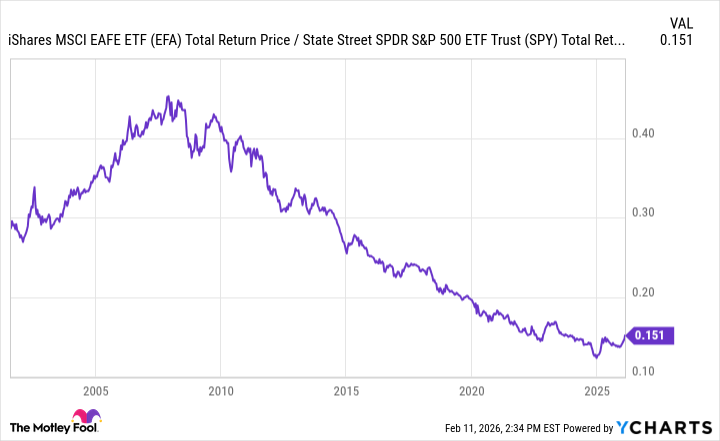
By David Dierking – Feb 16, 2026 at 2:00PM ESTKey PointsThe S&P 500 has steadily outperformed international stocks since the end of the financial crisis.Thanks to the falling dollar and an improved outlook, international stocks outperformed by a wide margin in 2025.Improved earnings growth and attractive valuations mean the good times for foreign investing might not nearly be over.These 10 Stocks Could Mint the Next Wave of Millionaires ›NYSEMKT: EEMiShares - iShares Msci Emerging Markets ETFToday's Changeangle-down(0.43%) $0.26Current Price$61.12Price as of February 13, 2026 at 4:00 PM ETInternational stocks finally outshined the S&P 500 in 2025. Could this be just the beginning of a longer rally ahead?International stocks finally had a moment of outperformance relative to the S&P 500 (^GSPC +0.05%) in 2025. But those moments have been rare over the past several years. With few exceptions, U.S. stocks have steadily and consistently outperformed international stocks since the financial crisis. Fundamental Chart data by YCharts But now it's looking like the pendulum may be ready to swing in the other direction. With the S&P 500 at historically high valuations and still very top-heavy with the "Magnificent Seven" stocks, the current rotation away from megacap stocks may provide the opening for a lengthier run for foreign stocks. Image source: Getty Images. Current market performance: International vs. U.S. stocks In 2025, the iShares MSCI EAFE ETF (EFA +0.09%) beat the State Street SPDR S&P 500 ETF (SPY +0.04%) by a 31.6% to 17.7% margin. The iShares MSCI Emerging Markets ETF (EEM +0.43%) did even better by returning 34%. The biggest driver hasn't necessarily been the move away from U.S. tech stocks, although that has contributed. It has been the rotation from growth into value. The U.S. labor market continues to slow, and retail sales activity has begun to slip. Investors are hesitant to keep bidding up expensive growth stocks and are interested in something more reasonably valued to provide a bit of protection. That move to value, along with a weakening dollar, has helped give international stocks a boost as well. ExpandNYSEMKT: EFAiShares Trust - iShares Msci Eafe ETFToday's Change(0.09%) $0.09Current Price$104.24Key Data PointsDay's Range$103.44 - $104.4352wk Range$72.14 - $105.23Volume23M ETF investors have taken notice too. On a relative basis, international and emerging markets equity ETFs have taken in new money over the past year at nearly twice the rate of U.S. equity ETFs. The case for international stocks to move higher Foreign equities have a number of tailwinds working in their favor. Lower valuations: The S&P 500 currently trades at a forward price-to-earnings (P/E) ratio of around 29. International developed and emerging markets stocks trade at 19 and 18 times earnings, respectively. Foreign stocks often trade at lower multiples than U.S. stocks, but the current valuation gap presents an attractive opportunity for those seeking better value. Economic tailwinds: Fiscal stimulus efforts in places like Germany, productivity gains, and a lower dollar could accelerate growth rates overseas. Earnings growth: 2025 saw near-stagnant earnings growth rates in most of Europe and other developed regions. In 2026, estimates call for high single-digit to low double-digit earnings growth rates across developed and emerging markets. This supports the fundamental case for higher stock prices. Diversification: Many international markets are much less reliant on tech to drive growth. Their exposure to different economic cycles and sector compositions means a potentially different pattern of returns. Current risks facing international stocks Even though the environment for international stocks has improved, a number of risk factors at play could damage momentum. Geopolitical risk is still front and center. Global trade tensions have intensified, and any further increase in tariff rates is likely to hinder growth potential. A sustainable rebound in the dollar index would act as a headwind for international stocks relative to the S&P 500. Many international economies are cyclically sensitive. Therefore, any slowdown in manufacturing or trade might be felt especially strongly overseas. Is the time right for international stocks to keep moving higher? Given that U.S. stocks outperformed pretty much nonstop from the end of the financial crisis through the mid-2020s, it's safe to say that international stocks are long overdue for an extended period of outperformance. Overall, international stocks are 1) more cyclically sensitive on average than U.S. stocks and 2) demonstrate much better value when considering metrics such as the price-to-earnings ratio. Neither of those has been much help since investors consistently preferred U.S. tech and growth. Sentiment is beginning to change. Value is back in favor, and the comparatively better growth acceleration expectations of international markets could be the thing that finally unlocks it. If foreign companies can deliver on those expectations, it could be another good year for international investing.Read NextFeb 14, 2026 •By Robert IzquierdoBetter International ETF: Vanguard's VXUS vs. iShares' EEMFeb 7, 2026 •By Jake LerchEEM vs. VXUS: Should Investors Favor Emerging Markets Upside or Broad International Stability?Feb 3, 2026 •By Cory RenauerThe Vanguard Total International Stock ETF (VXUS) Offers Broader Global Exposure Than the iShares MSCI Emerging Markets ETF (EEM)Jan 26, 2026 •By Adé HennisHow Does This Eco-Friendly ETF Match Up Against This International Fund?Jan 26, 2026 •By Adé HennisEEM Offers More Of An Internation Focus on Tech Than IXUSJan 25, 2026 •By Matt DiLalloWant to Add Emerging Markets To Your Portfolio? EEM Offers a Tech Focus While SCHE Is More AffordableStocks MentionediShares - iShares Msci Emerging Markets ETFNYSEMKT: EEM$61.12 (+0.43%) $+0.26SPDR S&P 500 ETF TrustNYSEMKT: SPY$681.75 (+0.07%) $+0.48S&P 500 IndexSNPINDEX: ^GSPC$6836.17 (+0.05%) $+3.41iShares Trust - iShares Msci Eafe ETFNYSEMKT: EFA$104.24 (+0.09%) $+0.09*Average returns of all recommendations since inception. Cost basis and return based on previous market day close.
Source Information
Discussion
0 professional contributions
Sign in to join this professional discussion.
Be the first to add a constructive contribution.