
Watch an AI-powered table tennis robot beat elite players
Summarize this article with:


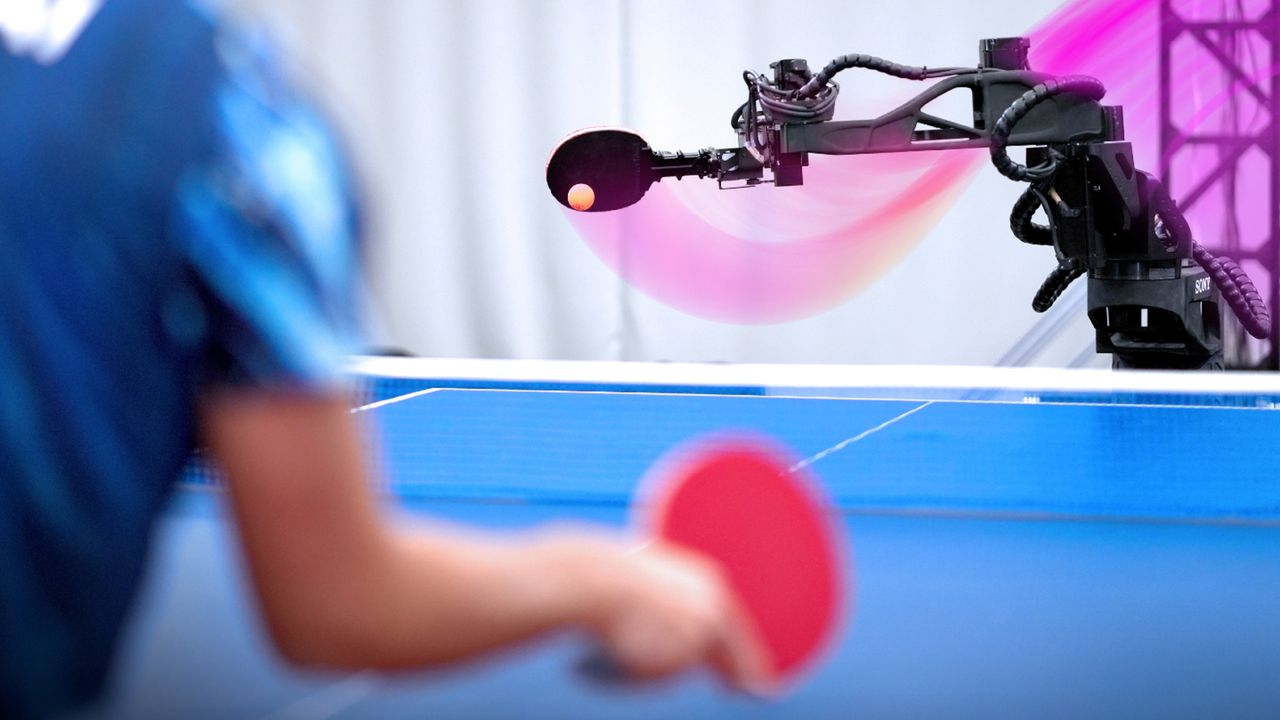
Using high-precision cameras and an AI system, Sony AI's Ace is revealing the advancements robotics. When you purchase through links on our site, we may earn an affiliate commission. Here’s how it works. Get the world’s most fascinating discoveries delivered straight to your inbox.Become a Member in Seconds Unlock instant access to exclusive member features.You are now subscribedYour newsletter sign-up was successfulWant to add more newsletters?Delivered DailyDaily NewsletterSign up for the latest discoveries, groundbreaking research and fascinating breakthroughs that impact you and the wider world direct to your inbox.Once a weekLife's Little MysteriesFeed your curiosity with an exclusive mystery every week, solved with science and delivered direct to your inbox before it's seen anywhere else.Once a weekHow It WorksSign up to our free science & technology newsletter for your weekly fix of fascinating articles, quick quizzes, amazing images, and moreDelivered dailySpace.com NewsletterBreaking space news, the latest updates on rocket launches, skywatching events and more!Once a monthWatch This SpaceSign up to our monthly entertainment newsletter to keep up with all our coverage of the latest sci-fi and space movies, tv shows, games and books.Once a weekNight Sky This WeekDiscover this week's must-see night sky events, moon phases, and stunning astrophotos. Sign up for our skywatching newsletter and explore the universe with us!Join the clubGet full access to premium articles, exclusive features and a growing list of member rewards.The world of table tennis may be in for a shake-up after Sony's AI division unveiled Ace — an autonomous robot that can compete with expert table tennis players.Using a combination of high-speed cameras and proprietary state-of-the-art hardware, Ace scored 16 unchallenged points, or "aces," after serving against multiple elite players.This is the first time a robot has achieved "expert-level play in a commonly played competitive sport in the physical world," Sony AI representatives said in a statement."This breakthrough is much bigger than table tennis," Peter Stone, chief scientist at Sony AI, said in the statement. "It represents a landmark moment in AI research, showing, for the first time, that an AI system can perceive, reason, and act effectively in complex, rapidly changing real-world environments that demand precision and speed."A study detailing how the robot works was published April 22 in the journal Nature. AI systems have already shown prowess in strategy games, such as Go, chess and role-playing games.However, moving AI into a robotic body, where quick reflexes are paired with physical movements, can be more challenging. Here, the software and hardware components have to work seamlessly — and in table tennis, where speed and hand-eye coordination are vital, this pairing has to work to win.Get the world’s most fascinating discoveries delivered straight to your inbox."Table tennis is a game of enormous complexity that requires split-second decisions as well as speed and power," Peter Dürr, director of Sony AI in Zurich and project lead for Ace, said in the statement. "This research breakthrough highlights the potential of physical AI agents to perform real-time interactive tasks, and represents a significant step toward creating robots with broader applications in fast, precise, and real-time human interactions."Ace's strategy builds on Sony AI's previous research on its AI agent Gran Turismo Sophy, with Ace using advanced sensors and high-speed software to perceive its environment. These sensors include nine active pixel sensor cameras that help Ace identify the ball's exact position in 3D space, along with three gaze systems that use mirrors and event-based vision cameras to measure the ball's spin and angular velocity as it moves through the air.Running these cameras is Sony AI's proprietary AI control system, which is based on model-free reinforcement learning, where an AI agent learns directly from interactions in its environment without making a predictive model first. This technology allows Ace to adapt and make decisions faster, without relying on a preprogrammed model.Lastly, Ace's robotic body, which includes a swiveling arm with a paddle-like appendage at its end, was created with the company's robotic hardware.In April 2025, scientists had Ace play against five elite players (each with over 10 years of experience and around 20 hours of weekly training) and two professional table tennis players (Minami Ando and Kakeru Sone, both in the Japanese professional league). While players in both tiers are skilled at table tennis, professional athletes make their living by playing table tennis, whereas elite players may not have the same caliber to make the sport their livelihood.Ace won three out of five matches with the elite players and boasted a 75% serve return rate. Its autonomous system also allowed the robot to return unusual shots, such as balls bouncing off the net. It however lost both matches against the pros.Then, in December 2025, Sony AI had Ace play a series of separate matches in which it competed against two professional and two elite players. This time, Ace beat both elite players and one of the professionals. Company representatives said the robot moved closer to the table edge, had higher shot speeds and launched faster-paced volleys against its opponents.Given that less than two years ago, Google DeepMind's robotic table tennis robot was defeated by elite players, Ace's victories show how quickly this field of robotics is advancing in a short time."Once AI can operate at an expert human level under these conditions, it opens the door to an entirely new class of real-world applications that were previously out of reach," Stone said in the statement.Kenna Hughes-Castleberry is the Content Manager at Live Science. Formerly, she was the Content Manager at Space.com and before that the Science Communicator at JILA, a physics research institute. Kenna is also a book author, with her upcoming book 'Octopus X' scheduled for release in spring of 2027. Her beats include physics, health, environmental science, technology, AI, animal intelligence, corvids, and cephalopods.You must confirm your public display name before commentingPlease logout and then login again, you will then be prompted to enter your display name.