
These Tiny Robots 50x Smaller Than a Hair Can Hunt and Move Bacteria
Summarize this article with:


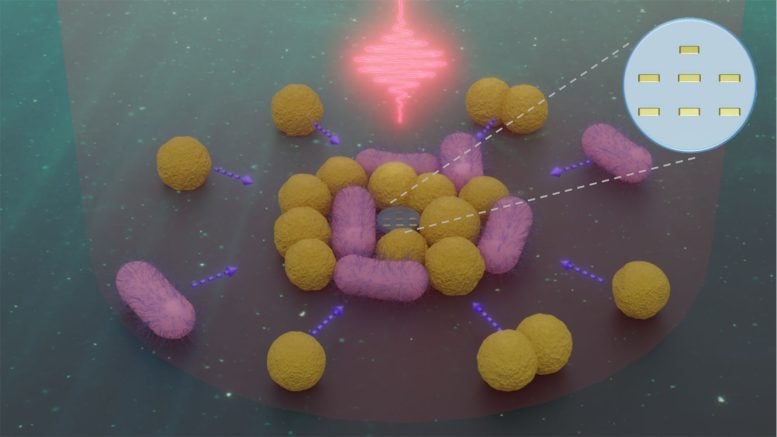
Share Facebook Twitter LinkedIn Pinterest Telegram Email Reddit Artistic view of a nanorobot (center and inset) interacting with several bacteria of two distinct types. The dashed arrows indicate the attractive thermophoretic force exerted by the nanorobot on the bacteria in the vicinity while being illuminated. Credit: Jin QinPhoton-driven nanorobots can steer, capture, and move bacteria with precision, enabling controlled manipulation in microscopic environments and offering new tools for microbiology.Tiny robots about 50 times smaller than the diameter of a human hair are opening new possibilities for working at very small scales. They allow scientists to precisely manipulate objects far beyond the reach of human hands, moving closer to the long-standing goal of directly interacting with the microscopic world.This is especially important for biological materials in liquid environments, such as single cells or bacteria. Controlling these tiny objects with precision has been a major challenge, but these nanorobots show that tasks like collecting and relocating bacteria can now be done.One of the biggest hurdles is how to power and guide machines at such a small scale. At Julius-Maximilians-Universität Würzburg (JMU), a team led by Professor Bert Hecht has developed a solution using the recoil of individual photons to move micrometer-sized devices known as microdrones.Photon Recoil Powers MicrodronesThese devices contain up to four plasmonic nanoantennas that absorb light with specific properties and then emit it in a directed way. Each emitted photon produces a tiny recoil force, similar in principle to the kickback from firing a bullet. Because the microdrones have extremely low mass, even these small forces can generate high speeds and rapid acceleration.In this latest work, the researchers further reduced the size of these light-powered robots to less than one micrometer (about 0.000039 inches). A major advance was simplifying how they are steered while maintaining photon-based propulsion.The team takes advantage of the fact that nanoscale antenna wires inside the robot naturally align with the polarization of incoming light. By adjusting that polarization, they can control the robot’s orientation while movement continues to rely on photon recoil, similar to how larger vehicles are steered.Light-Driven Steering and Bacteria Capture“In essence, we have built a light-driven nanorobot that can track down and collect bacteria,” says Jin Qin, lead experimental scientist of the study. “By simplifying the design, we reached a size at which these robots can operate directly in the microbial world—almost like microscopic cleaning devices.”These nanorobots are highly agile. They can make very fast 90° turns, which allows them to scan large sample areas in a systematic and efficient way. They can also selectively capture, transport, and release significant numbers of bacteria.This ability allows them to effectively “clean” microscopic environments in controlled lab settings by gathering bacteria and placing them at specific locations.Applications in Microscopic Cleaning and Research“This is a striking example of how light can be used not only to observe the microscopic world, but also to actively shape it,” adds Bert Hecht. “The idea of tiny robotic cleaners may sound futuristic, but we are already demonstrating the physical principles that make it possible.”Even when carrying larger clusters of bacteria, the nanorobots remain fully maneuverable, although they move slightly more slowly. This durability highlights their promise for future use in microbiology, biomedical research, and precise manipulation at very small scales.Reference: “A nanoscale robotic cleaner” by Jin Qin, Carsten Büchner, Xiaofei Wu and Bert Hecht, 27 March 2026, Nature Communications. DOI: 10.1038/s41467-026-70685-9Never miss a breakthrough: Join the SciTechDaily newsletter.Follow us on Google and Google News.Biomedical Engineering Microbiology Nanotechnology Robotics University of Würzburg MagicDNA: Tiny, Complex DNA Robots Designed in Minutes Instead of Days New Magnetic Spray Transforms Objects Into Insect-Scale Robots for Biomedical Applications Scientists Direct the Growth of Hydrogel to Mimic Plant and Animal Tissue Structure Ultra-Strong Artificial Muscles Made From Carbon Nanotubes Magnetic Nanoparticles Control Thousands of Cells Simultaneously Cancer-Fighting DNA Nanorobots Could Target Specific Cells for Repair New Biomimetic Strategy Quickly Dissolves Blood Clots Portable Diagnostics Use Vibration to Move Drops of Liquid Researchers Study the Use of Photosystem-I as Photovoltaic Panels Monster Storms on Jupiter Unleash Lightning Beyond Anything on Earth Scientists Create “Liquid Gears” That Spin Without Touching The Simple Habit That Could Help Prevent Cancer Millions Take These IBS Drugs, But a New Study Finds Serious Risks Scientists Unlock Hidden Secrets of 2,300-Year-Old Mummies Using Cutting-Edge CT Scanner Bread Might Be Making You Gain Weight Even Without Eating More Calories Scientists Discover Massive Magma Reservoir Beneath Tuscany Europe’s Most Active Volcano Just Got Stranger – Here’s Why Scientists Are Rethinking It