
Scientists Create “Liquid Gears” That Spin Without Touching
Summarize this article with:


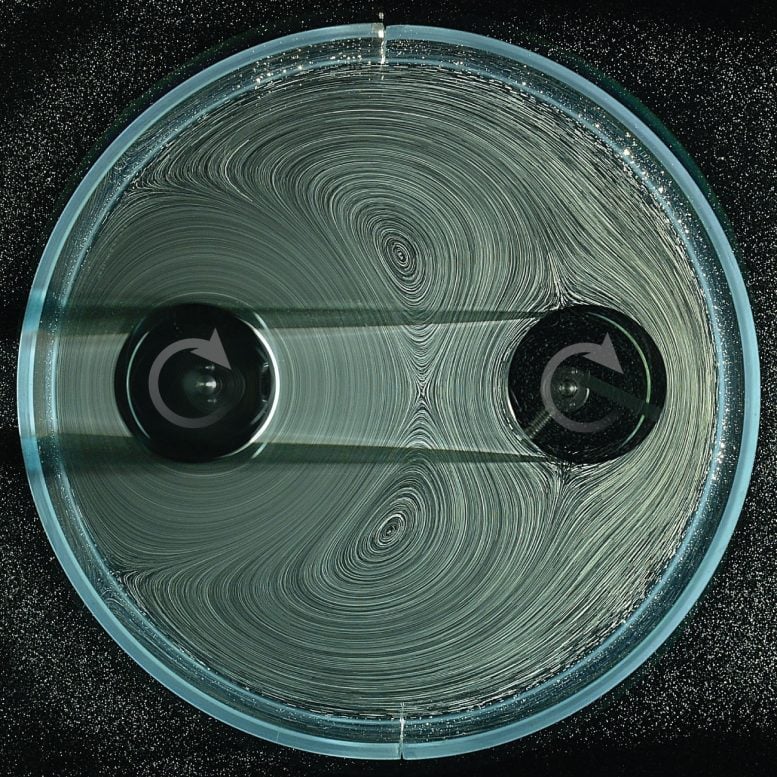
Physics Scientists Create “Liquid Gears” That Spin Without TouchingBy James Devitt, New York UniversityApril 23, 20264 Mins Read Facebook Twitter Pinterest Telegram LinkedIn WhatsApp Email Reddit Share Facebook Twitter LinkedIn Pinterest Telegram Email Reddit Two spinners inside a circular container and surrounded by liquid with bubbles that help to visualize the flows. The left spinner is actively driven to rotate with a motor (not shown) and the right one passively rotates due to the flows. Credit: NYU’s Applied Mathematics Laboratory“Fluid gears” invention shows promise for improving mechanical devices.A group of researchers at New York University has developed a new type of gear system that uses fluid motion to produce rotation. This approach could pave the way for mechanical devices that are more adaptable and resilient than traditional gears, which trace their origins back to ancient China.The findings are detailed in the journal Physical Review Letters.“We invented new types of gears that engage by spinning up fluid rather than interlocking teeth—and we discovered new capabilities for controlling the rotation speed and even direction,” says Jun Zhang, a professor of mathematics and physics at NYU and NYU Shanghai and the senior author of the paper.Rethinking gears beyond solid teethGears have been a fundamental part of machinery for thousands of years, with early examples dating to around 3,000 BCE in China, where they were used in two-wheeled chariots that traveled across the Gobi Desert. Over centuries, they have played roles in devices such as the Antikythera mechanism in ancient Greece, which predicted astronomical events, as well as in windmills, clocks, and modern robotics.Remnants of the Antikythera mechanism, displayed in the National Archaeological Museum in Athens, Greece. Peulle. Credit: Wikimedia CommonsDespite their long history, traditional gears come with limitations. Their teeth, whether made of wood, metal, or plastic, are rigid and prone to damage, and they must align precisely to function correctly.Motivated by these constraints, Zhang worked with colleagues Leif Ristroph, an associate professor of mathematics at NYU’s Courant Institute School of Mathematics, Computing, and Data Science, and Jesse Etan Smith, an NYU doctoral candidate, to explore whether gear-like behavior could be achieved without physical teeth or direct contact between components.Because moving air and water already drive systems such as turbines, the researchers proposed that carefully controlled fluid flows could effectively take on the role of gear teeth.Fluid flows replace mechanical contactTo test this concept, the team carried out detailed experiments using cylindrical rotors submerged in a liquid mixture of glycerol and water. By adjusting properties such as viscosity and density, they were able to control how the fluid behaved. A gear mechanism created by NYU researchers relies on water to generate movement. Under some conditions, the rotors spin in the same direction like pulleys looped together with a belt (first video below); in others, the rotors spin in opposite directions like a pair of gears (second video below). Credit: Videos courtesy of NYU’s Applied Mathematics LaboratoryIn each setup, one cylinder was powered to rotate while the second remained passive. The researchers predicted that motion from the active cylinder would generate fluid currents capable of turning the passive one. To visualize these flows, they introduced tiny bubbles into the liquid, allowing them to observe how the fluid transferred motion. Experiments were conducted at different distances between the cylinders and at varying rotation speeds.The results showed that the interaction between rotating cylinders and the surrounding fluid could mimic different mechanical systems. When the cylinders were positioned close together, the fluid acted like the interlocking teeth of traditional gears, causing the passive rotor to spin in the opposite direction. When the cylinders were farther apart and the active rotor moved faster, the fluid wrapped around the passive cylinder in a way that resembled a belt and pulley system, causing both to rotate in the same direction.New control and design possibilitiesThe researchers highlight several potential advantages of this fluid-based approach over conventional gear systems.“Regular gears have to be carefully designed so their teeth mesh just right, and any defect, incorrect spacing, or bit of grit causes them to jam,” explains Ristroph. “Fluid gears are free of all these problems, and the speed and even direction can be changed in ways not possible with mechanical gears.”Reference: “Hydrodynamic Spin-Coupling of Rotors” by Jesse Etan Smith, Leif Ristroph and Jun Zhang, 13 January 2026, Physical Review Letters. DOI: 10.1103/m6ft-ll2cThe research was supported by a grant from the National Science Foundation (DMS-2407787).Never miss a breakthrough: Join the SciTechDaily newsletter.Follow us on Google and Google News.Engineering Fluid Dynamics Materials Science Mechanical Engineering New York University Share.
Facebook Twitter Pinterest LinkedIn Email Reddit Related Articles “Like Liquid Metal”: Scientists Create Strange Shape-Shifting Material Complications for Clean Energy Storage and Transportation Created by Hydrogen Embrittlement More Efficient Thermal Cooling Method Bioinspired by Plants MIT Engineers Show How Hairy Tongues Help Bats Drink Researchers Reveal a New Way to Enhance or Reduce the Adhesion of Freezing Droplets A New Approach to Designing Hydrogen-Resistant Zirconium Alloys Scientists Predict Material with Record-Setting Melting Point, More Than 4,400 Kelvins How Electrical Charge Carriers Move in Conjugated Polymers Orbital Engineering, Yale Engineers Change Electron Trajectories