
Amazon Braket launches trapped-ion quantum computer from Alpine Quantum Technologies
Understand this faster with AI


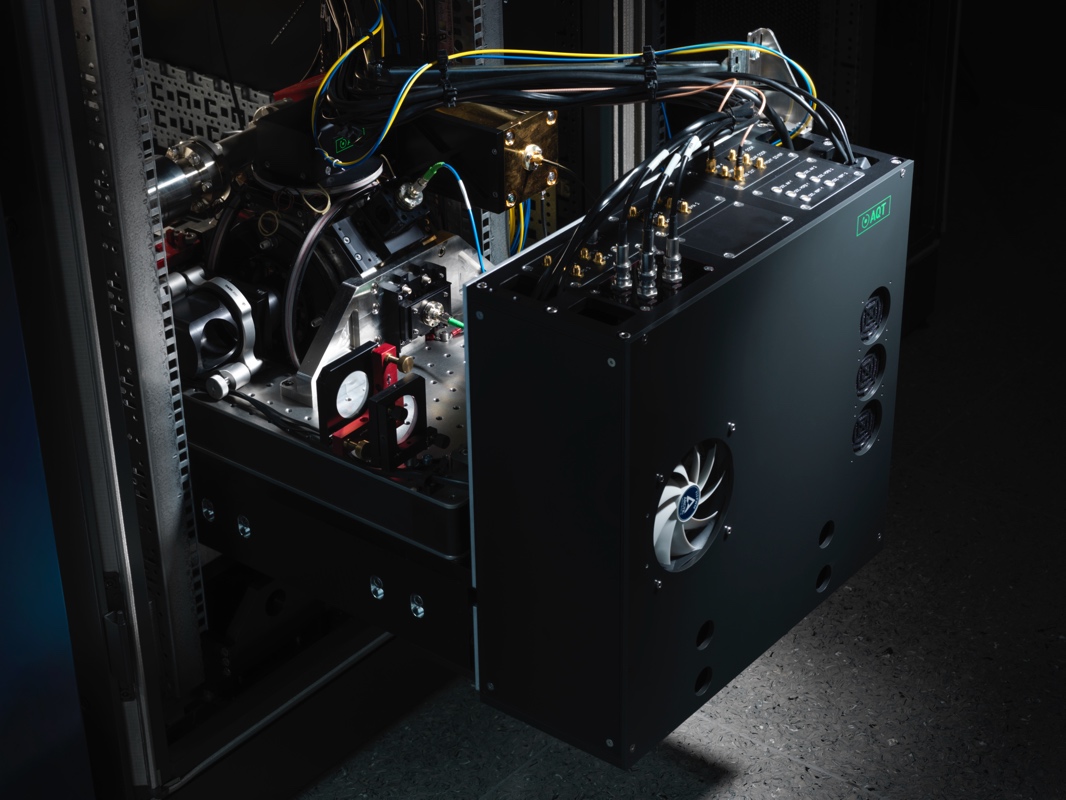
Amazon Braket enables customers to design and run quantum algorithms on a broad selection of quantum hardware through a unified interface. Today, we expand the hardware available on Braket by adding Alpine Quantum Technologies (AQT) as a new quantum hardware provider. AQT brings their IBEX Q1 trapped-ion quantum computer to Braket, offering customers a 12-qubit fully connected trapped-ion system. The IBEX Q1 device is physically located in Innsbruck, Austria and is available through the eu-north-1 Region (Stockholm).Figure 1: Photo of an AQT rack-mounted trapped-ion quantum processorIBEX Q1 joins Amazon Braket’s existing quantum hardware portfolio to provide customers in Europe with access to locally hosted trapped-ion technology. This addition addresses the needs of European customers who require data residency within the EU while exploring quantum computing applications. The device fits into two standard 19-inch data center racks, operates at room temperature, and consumes less than 2 kilowatts of power.In this NISQ era of quantum computing, experimentation across a variety of available devices is crucial for developing quantum algorithms to eventually address complex problems across domains like finance, energy, pharmaceuticals, and logistics. Customers worldwide can now run experiments on AQT’s quantum hardware using on-demand access for designing and executing programs. Customers looking for priority access should use Amazon Braket Hybrid Jobs for running variational quantum algorithms, all with simple pay-as-you-go pricing. For workloads with latency or time-sensitive requirements, customers can reserve dedicated capacity on the IBEX Q1 through on a per-hour basis.IBEX Q1 is based on a crystal of calcium-40 ions confined in a radio frequency trap within an ultra-high vacuum chamber. The device encodes quantum information in the electronic spin state of these charged atoms. Entangling gates are realized through controlled, collective vibrations running through the chain of ions. This interaction mechanism, enabled by the long-range Coulomb interaction in the ion crystal, provides all-to-all connectivity, meaning any qubit can directly interact with any other qubit in the system.At the time of launch, this device achieves average two-qubit gate fidelity of 97.7% across all qubit pairs in the register. The device supports RZ, R, and RXX as its native gate set. IBEX Q1 automatically calibrates on a regular basis to maintain quantum gates. Up-to-date characterization data can be found on IBEX Q1’s device details page in the Amazon Braket Management Console.The device is available Tuesdays and Wednesdays from 09:00 to 16:00 UTC, providing customers in European time zones convenient access during their work hours. This availability window enables researchers, developers, and enterprises across Europe, Africa, the Middle East, and parts of Asia to integrate quantum computing experiments into their regular workflows without time zone constraints.Customers can build, test, and run quantum programs on IBEX Q1 with the Braket SDK, CUDA-Q, PennyLane, and Qiskit. To execute programs on IBEX Q1, specify the Amazon Resource Name (ARN) in the device definition before running your circuit:The all-to-all connectivity of IBEX Q1 enables efficient implementation of quantum algorithms that require interactions between distant qubits. Without full connectivity, quantum circuits often require additional SWAP gates to move quantum information between qubits that are not directly connected, increasing circuit depth and introducing additional sources of error. The following example demonstrates how IBEX Q1’s full connectivity allows direct CNOT operations between qubit 0 and all other qubits without requiring intermediate SWAP gates:The GHZ state is a maximally entangled state of multiple qubits, and achieving high-fidelity GHZ states across all qubits in a device serves as an important benchmark for quantum computing systems.We sat down with Thomas Monz, cofounder and CEO of Alpine Quantum Technologies, to discuss what excites him most about making IBEX Q1 available through Amazon Braket. In the following clip, Thomas shares his perspective on how cloud access will expose AQT’s hardware to a diverse set of customers and use cases beyond traditional on-premises deployments at high performance computing centers.Thomas Monz, cofounder and CEO of Alpine Quantum Technologies, and Sebastian Hassinger, Principal Specialist – Amazon Braket at AWS have a conversation about IBEX Q1 on Amazon BraketVisit the Amazon Braket Management Console to view the device topology, availability, and real-time calibration data to help you understand the current performance characteristics of the device.Researchers at accredited institutions can apply for AWS credits to support experiments on Amazon Braket through the AWS Cloud Credits for Research program. This program provides funding to explore quantum computing applications across a wide range of research domains.To get started with running your own quantum programs on the IBEX Q1 processor, refer to our GitHub repository for example notebooks and tutorials. You can run these programs using one of our managed Jupyter notebooks or from your local development environment. The example notebooks include getting started guides, algorithm implementations, and best practices for working with trapped-ion quantum computers.Zia Mohammad is a Sr. Product Manager at Amazon Braket, bringing his experiences from venture capital and AI to quantum computing. Zia holds degrees in Electrical Engineering and Computational Neuroscience from The Ohio State University. Beyond his professional interests, Zia is getting his pilot’s license, is interested in science diplomacy, and is perpetually on the quest for NYC’s best dessert shop.Andrew Fargo is the Head of Operations at AQT, where he directs the company’s day-to-day operations and leads infrastructure, logistics, production, cloud and customer service activities to ensure the security, scalability, and reliability of the company’s quantum-computing platforms. Formerly a U.S. Army officer commissioned from the United States Military Academy at West Point, he leverages his leadership and operational experience to drive organizational excellence and advance AQT’s mission of building accessible, high-performance quantum systems.Charunethran Panchalam Govindarajan is a Sr.
Product Marketing Manager at AWS, focused on High-Performance Computing and Quantum Technologies. He has worked across a broad range of technology domains, with a core interest in intersection of R&D and product development. Charunethran holds a Master's degree in Electrical Engineering from Stanford University. Outside of work, he enjoys sketching and philosophical conversations.Felix is a Senior Business Developer at AQT, supporting the growth of the cloud business and the integration of on-premise systems for HPC customers. Felix is an ion-trapper by training, he studied at the Technical University of Munich (TUM) and set up two ion traps from scratch to study quantum networking during his PhD at the Institute of Photonic Sciences (ICFO). Since then, he has served in different roles in industry, and managed product lines like optical frequency combs and ultra-stable lasers for the quantum technology and metrology market.Florian leads the development of the AQT cloud API (ARNICA), the interface between Amazon Braket and the quantum computers of AQT. He holds a MSc in Computer Science from the University of Innsbruck and has more than 10 years of experience in software development. In his free time, he likes to travel and all kinds of outdoor activities.Milena was born in Costa Rica and has lived in Austria since 2016. She did her PhD at the University of Innsbruck in the Quantum Optics and Spectroscopy group of Rainer Blatt where she worked with Optical clocks with trapped ions. She then did a Postdoc in the AQTION team of Thomas Monz, where she developed and exploited a robust, compact trapped-ion quantum computer based on scalable quantum hardware and widespread industry standards. At AQT she focusses on the continuous operation of cloud setups and sets up new systems.Ishaan Lyngdoh Pakrasi is a Senior Product Manager on the Amazon Braket team. He holds a B.S. and M.S. in Mechanical Engineering from the University of Illinois at Urbana-Champaign, where his work on dancing robots combined engineering, art, and human-robot interaction. A graduate of the National Science Foundation’s I-CORPS program, Ishaan received grant funding to commercialize a robotics startup. His career spans robotics research, startup entrepreneurship, deep-tech commercialization, and product management across multiple industries. Outside of work, he enjoys soccer, travel, and creative technology projects that blend design, code, and motion.Peter Komar is an Applied Scientist in the Amazon Braket team where he works on integration of new quantum devices to the Braket service and researches their applications. He holds a PhD in physics from Harvard University where he conducted theoretical research in the field of quantum metrology, searching for practical ways to achieve ultimate measurement accuracy, set by the Heisenberg limit. Peter is passionate about all means of extracting maximal information from limited data.
Tags
Source Information
Discussion
0 professional contributions
Sign in to join this professional discussion.
Be the first to add a constructive contribution.