
Young Men are at High Risk for Gambling Addiction as Sports Betting Surges
Summarize this article with:


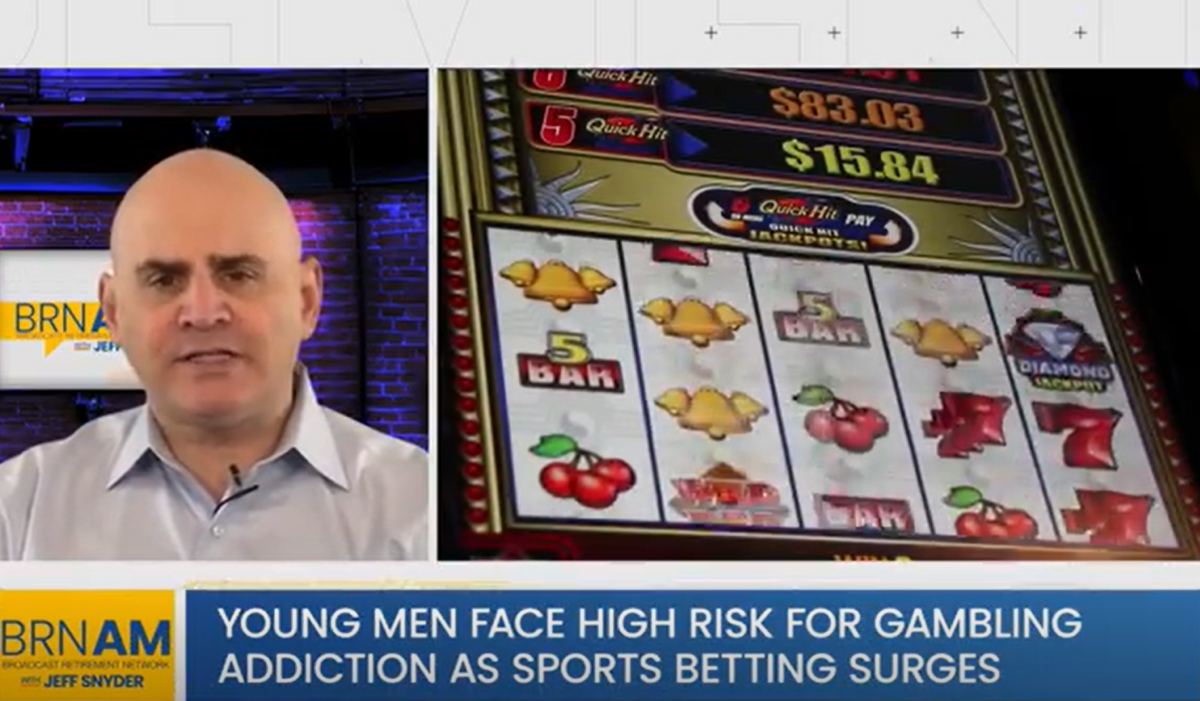
Young Men are at High Risk for Gambling Addiction as Sports Betting Surges (14:39) Driven by the explosion of mobile betting platforms and a lack of age-targeted resources, many see betting as a form of entertainment or investing − until it’s too lateBroadcast Retirement Network's Jeffrey Snyder discusses gambling addiction with James Whelan, PhD. of the Tennessee Institute for Gambling Education and Research.Jeffrey Snyder, Broadcast Retirement NetworkWell, good morning, welcome back to the broadcast Retirement Network. This is BRNAM for Thursday, January 18th, 2024. And our top story today, young men are at high risk for gambling addiction as sports betting surges.Joining me now to discuss this and a lot more, Dr. James Whelan of the Tennessee Institute for Gambling Education and Research. James, it's great to see you. Thanks so much for joining us on the program this morning.James Whelan, PhD., Tennessee Institute for Gambling Education and ResearchThanks for having me. I appreciate being here.Jeffrey Snyder, Broadcast Retirement NetworkYeah. This is a story, you know, you can't help but turn on the TV, doctor, if you're watching a sporting event and you see betting, I mean, every sports league in this country and abroad, they're aligned with some level of betting. How pervasive is betting among young men and what's the impact to their mental health?James Whelan, PhD., Tennessee Institute for Gambling Education and ResearchWell, to the first part about how many are engaging in it, it's really not clear. The best data that exists right now is about 20 percent of the population engages in sports betting. Yeah.And those data suggest that the most popular, the most common type of gambler, a person who's gambling on sports, tends to be younger, below the age of 35, and is at least historically been slanted towards men.Jeffrey Snyder, Broadcast Retirement NetworkOh, go ahead. I'm sorry. I interrupted you.Go ahead.James Whelan, PhD., Tennessee Institute for Gambling Education and ResearchNo. What was your second part of your question?Jeffrey Snyder, Broadcast Retirement NetworkI was going to ask you, like, why is it so pervasive? Why? You know, I don't understand why it's, I mean, I guess I understand people.It's easy to swipe and do things with your phone, but it's so impactful on someone's mental health.James Whelan, PhD., Tennessee Institute for Gambling Education and ResearchYeah. And the impact on the mental health is for a minority of people who do sports wager or any form of wagering. But for that minority, the impact could be completely life-changing.I mean, it could be put just at the financial end. It could put people in debt, similar to buying a home. It has an enormous impact on people's lives.And of course, that reverberates to the other parts of their life, the relationship with others, family members, friends, as well as it impacts experiences of anxiety and depression. And it includes a higher risk of suicidal thoughts and actually completed suicide. Now, what is really capturing people here?Well, I think at the base of it is we love sports. You know, I don't know about you, but myself and many of my friends, many of the family members I know, men and women, watching sports, talking about sports is a key part of our life. And particularly for young men, becoming knowledgeable about sports is sort of not just a rites of passage, but also a way of communicating with each other, Monday morning quarterbacking per se.And so the result of that is men in particular feel themselves knowledgeable. They feel like they know their teams or they know this league, this conference, whatever it might be. And they feel like that knowledge gives them an upper edge when they wager.But the other parts of it are equally important to pay attention to. And that is what has happened since the Supreme Court decision in 2018 is that gambling has moved from a trip, a drive to being on your phone. And it is so easily accessible and it's hard for us to untangle that popularity of sports from that easy accessibility.And then I'm going to go back to your original comment. And that is the third factor that's really weighing heavily here is how much advertising is occurring. There's so much information and encouragement to bet, not just from bought ads on radio, TV, whatever, but also commentators.We go to ESPN, which is now a gaming company. You can't watch an ESPN program without wagering being discussed as though it is actually part of that sport, part of that event, all the way through to looking at social media, where in addition to pay ads on social media, there are tons of people out there willing to talk about what bets they make, how much they won, people suggesting you can contact them and they can sell you good information so you can make better bets.That information is pervasive. So one is we love sports and we think we're smart. Two, we got easy access.Three, we're bombarded with information telling us you ought to go back.Jeffrey Snyder, Broadcast Retirement NetworkYeah, and just to follow up on that and then we'll go to a commercial break. How analogous is this addiction to drug addiction, cigarette addiction, other types, sexual addictions, as example? Does it throw off the same dopamine?I'm not a doctor, clearly, but does it show the same type of, you know, internal feelings that that those other things do?James Whelan, PhD., Tennessee Institute for Gambling Education and ResearchRight. And it does. To really put it simply, the hit of dopamine that everyone talks about is because we get motivated to do something and that dopamine release actually further motivates us to do that.And that that sort of event in the brain happens regardless of what you're excited about. So in that way, it's very similar across all addictions. The other similarity across all addictions is that this brain chemistry event doesn't occur in isolation.It incurs in a complex of someone's life where they're bored or they need money or they are harmed or traumatized in some way. So the person who has the struggles with the harms are often those people who not only are they heavily invested in this, but they also got complications to their life that drive them to go to what's rewarding.Jeffrey Snyder, Broadcast Retirement NetworkDr. Whalen, you talked about the Supreme Court decision in 2018, which basically said, hey, you want to be in gambling, you can be in gambling. And it is very pervasive. If you turn on the TV shows, ESPN, they actually have or CBS or whatever right before the game.And they're like, here's who I would bet if and they all had their picks. I just I was just watching the Ravens game. That's my team.I'm originally from Baltimore and they were doing that. So I thought that was really interesting, to say the least. Is there a role here for public policymakers?And I'm talking about federal and state and local. How did they get involved? Because preventative, you know, just like cigarettes, just like drugs or any other type of addiction, how do you prevent people from hurting themselves?And what's the role of government in that?James Whelan, PhD., Tennessee Institute for Gambling Education and ResearchYeah, great question. It begins with the fact that the federal government says nothing about gambling because that Supreme Court decision was about states' rights to legislate it. So consequently, there is no guidance.There is no federal policies that are other than money laundering, et cetera, that's impacted Nevada forever. The rest of it all happens at the jurisdictional level. It also means the lack of federal involvement also means there's a lack of federal money to research and understand and promote a non-harmful ways of gambling.And how to help people who have harms. But we get down to the jurisdictional level. One of the things that's happening is that everybody in who is regulating it now, for the most part, with a couple of exceptions, are brand new to doing this.And as I mentioned before, the rapid speed at which we've moved to not just sports wagering, but online and all the advertising regulators are trying to figure out something they've never had to regulate before. I think the secret to the future of regulations is for there to be conversations between jurisdictions to talk about advertising, to talk about safeguards to youth getting engaged, to talk about how to place a responsibility on operators to ensure that people aren't harming themselves. All of those things have to happen, which is a conversation between regulators and maybe even the industry and the operators involved.Jeffrey Snyder, Broadcast Retirement NetworkYeah. And I know that the industry, you bring up the industry. I know that there have been some PSA announcements from the industry saying, you know, don't overextend yourself.But that's kind of like out of one side of the mouth and the other side of the mouth they're making the picks and trying to get people engaged. Is there a role here, sir, for the federal communications, FCC and some of the other bodies? Because now you mentioned it just in passing, ESPN is really a gaming company now.They have a vested interest. So they're almost advocating for betting in a way by incorporating this. Is there a role here for those bodies that have oversight over news and sports, etc.?James Whelan, PhD., Tennessee Institute for Gambling Education and ResearchYeah, I'm going to stretch it a little further than what you said. I think not only is ESPN a gaming company now, they do own a gaming company. They are live in many states now taking bets as ESPN bets.But the other part of it is all these leagues are, in fact, partners with the gaming industry. So the NFL, NHL, NBA, Major League Soccer, all those things are involved as people who make money from sports wagering. So now what is the space for the federal government?Well, I think it's considerable. I think we can shortcut the problems and come to quicker solutions if, in fact, there was a federal way of connecting and informing jurisdictions to make sure that there were similar laws and rules and regulations. And we knew what it meant to gamble safely and what it meant to gamble in a destructive way.Jeffrey Snyder, Broadcast Retirement NetworkWe're talking a lot, doctor, about the role of some of the regulatory bodies. There's obviously a role for personal responsibility. And a lot of these people are above 18.So the parent doesn't really have a say anymore because the kid is over 18. They can do whatever they want. But is there a role to play for friends and family to say, hey, little Johnny or little Jane, you know, you need to watch out?I mean, is there a role there's a role for government here, both state or clearly state and local and maybe federal, but also a role of personal responsibility for those that care for other people. If you notice someone getting out of bounds with doing this and people are really good, by the way, doctor, of keeping secrets to themselves. But you can kind of pick up on things if you're a close friend of somebody or a family member.James Whelan, PhD., Tennessee Institute for Gambling Education and ResearchOh, you know, we are a very individualistic culture. And so we tend to move things to the individual to take action. But the one of the things we've known for decades is.We don't exist without friends and family, we don't exist without social supports to get things done. What's important for those people to understand is don't confront, blame, stigmatize, but instead have a healthy conversation saying, hey, I'm worried. What is your relationship with gambling?Does this fit with who you think you are? How could I be helpful to you? So those facilitative things, those things that we actually most of us realize is is support and love and caring is what really helps us to move forward.And that's critical because we do know we have actually growing. Evidence that treatments they're focused on gambling, that they're informed by the gambling literature can effectively help 87 percent of the people who are experiencing harms. So that social support is critical.And it's sometimes that social support to encourage people to go get help from an educated, informed professional is key.Jeffrey Snyder, Broadcast Retirement NetworkYeah, absolutely. Well, Dr. Raylan, I think this is something we're going to continue to be talking about, unfortunately. But, you know, awareness is part of treating the issue.Great to see you. Thanks so much for joining us. And we look forward to having you back on the program again very soon.James Whelan, PhD., Tennessee Institute for Gambling Education and ResearchGreat, Jeffrey.Jeffrey Snyder, Broadcast Retirement NetworkTake care. And that wraps up this episode of BRNAM. Have a topic of interest, someone you think we should talk to?Drop us a line. And don't forget, for all the latest curated news and lifestyle wellness, finance, tech, so much more in all in one place. Check out today's edition of our daily newsletter, The Morning Pulse.Want to search our archives, check out our latest content? Well, then visit our website. We're back again tomorrow with another edition of BRNAM.We'll have a very special guest and another important topic. Until then, I'm Jeff Snyder. Stay safe, keep on saving and don't forget, roll with the changes.Now, it's your opportunity to co-create content around any topic on the FIRST Lifestyle and Wellness Network, reach a global audience through our platform and co-own exclusive branded content. All of our programs are available on demand and also as audio only podcasts. So you can take us on the go.Broadcast, radio, and television. Available anytime, anywhere, and on any device.