
Strange, Record-Breaking Gamma-Ray Explosion Lasted 7 Hours and Defies Explanation
Summarize this article with:


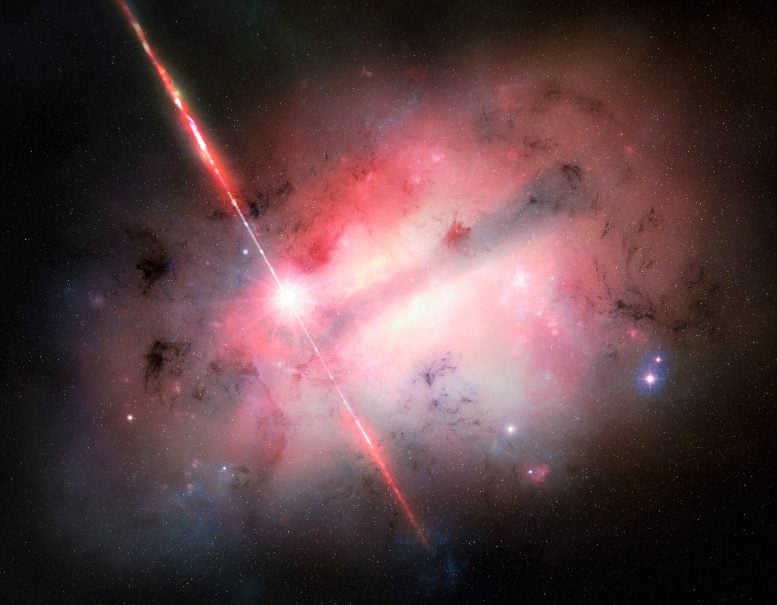
This artist’s illustration, which shows a high-speed jet of material being launched from a source that is embedded in a very dusty galaxy, depicts GRB 250702B — the longest gamma-ray burst that astronomers have ever observed. This powerful, extragalactic explosion was first detected on 2 July 2025. It exhibited repeated bursts that lasted over seven hours. Credit: NOIRLab/NSF/AURA/M. Garlick Data collected using multiple NSF NOIRLab facilities reveal a gamma-ray burst that lasted more than seven hours and originated in a massive, extremely dust-rich galaxy. Gamma-ray bursts (GRBs) rank among the most extreme explosions known in the Universe, surpassed only by the Big Bang itself. Most of these events appear briefly, releasing a sudden flash of high-energy radiation that disappears within seconds or, at most, a few minutes. On 2 July 2025, however, astronomers detected a highly unusual source that produced repeated outbursts and continued emitting gamma rays for more than seven hours. This extraordinary event, named GRB 250702B, has become the longest gamma-ray burst ever observed. The first detection of GRB 250702B came from NASA’s Fermi Gamma-ray Space Telescope (Fermi). After the initial gamma-ray signal was recorded and its position was narrowed down using X-ray observations from space-based instruments, researchers across the globe quickly began follow-up studies using many different types of telescopes. A major early breakthrough occurred when infrared data collected with ESO’s Very Large Telescope (VLT) confirmed that GRB 250702B originated far beyond the Milky Way. Until those observations, astronomers had not been certain whether the source lay inside our own galaxy or outside it. Tracking the Fading Afterglow Building on these discoveries, a research team led by Jonathan Carney, a graduate student at the University of North Carolina at Chapel Hill, focused on monitoring the burst’s afterglow. This afterglow is the gradually dimming light that follows the initial, intensely bright flash of gamma rays. By analyzing how this emission changes over time, scientists can gain valuable insight into the physical process that produced the gamma-ray burst. To better understand the nature of this record-breaking event, the team used three of the world’s most powerful ground-based telescopes: the NSF Víctor M. Blanco 4-meter Telescope and the twin 8.1-meter International Gemini Observatory telescopes. This trio observed GRB 250702B starting roughly 15 hours after the first detection until about 18 days later.
The team presents their findings in a paper recently published in The Astrophysical Journal Letters. The Blanco telescope is located in Chile at NSF Cerro Tololo Inter-American Observatory (CTIO), a Program of NSF NOIRLab.
The International Gemini Observatory consists of the Gemini North telescope in Hawai‘i and the Gemini South telescope in Chile. It is partly funded by the NSF and operated by NSF NOIRLab. This video begins with the stellar field around the host galaxy of GRB 250702B — the longest gamma-ray burst that astronomers have ever observed. Credit: International Gemini Observatory/CTIO/NOIRLab/DOE/NSF/AURA/N. Bartmann (NSF NOIRLab) Image processing: M. Zamani & D. de Martin (NSF NOIRLab) Music: Stellardrone – Billions and Billions “The ability to rapidly point the Blanco and Gemini telescopes on short notice is crucial to capturing transient events such as gamma-ray bursts,” says Carney. “Without this ability, we would be limited in our understanding of distant events in the dynamic night sky.” The team used a suite of instruments for their investigation: the NEWFIRM wide-field infrared imager and the 570-megapixel DOE-fabricated Dark Energy Camera (DECam), both mounted on the Blanco telescope, and the Gemini Multi-Object Spectrographs (GMOS) mounted on Gemini North and Gemini South.
Peering Through Cosmic Dust Analysis of the observations revealed that GRB 250702B could not be seen in visible light, partly due to interstellar dust in our own Milky Way Galaxy, but more so due to dust in the GRB’s host galaxy. In fact, Gemini North, which provided the only close-to-visible-wavelength detection of the host galaxy, required nearly two hours of observations to capture the faint signal from beneath the swaths of dust. Carney and his team then combined these data with new observations taken with the Keck I Telescope at the W. M. Keck Observatory, as well as publicly available data from VLT, NASA’s Hubble Space Telescope (HST), and X-ray and radio observatories. They then compared this robust dataset with theoretical models, which are frameworks that explain the behavior of astronomical phenomena. Models can be used to make predictions that can then be tested against observational data to refine scientists’ understanding. A Relativistic Jet in a Dense Environment The team’s analysis established that the initial gamma-ray signal likely came from a narrow, high-speed jet of material crashing into the surrounding material, known as a relativistic jet. The analysis also helped characterize the environment around the GRB and the host galaxy overall. They found that there is a large amount of dust surrounding the location of the burst, and that the host galaxy is extremely massive compared to most GRB hosts. The data support a picture in which the GRB source resides in a dense, dusty environment, possibly a thick lane of dust present in the host galaxy along the line-of-sight between Earth and the GRB source. These details about the environment of GRB 250702B provide important constraints on the system that produced the initial outburst of gamma-rays. Left: The stellar field around the host galaxy of GRB 250702B — the longest gamma-ray burst that astronomers have ever observed. Right: Close-up view of the host galaxy taken with the Gemini North telescope. This image is the result of over two hours of observation, yet the host galaxy appears extremely faint due to the large amount of dust surrounding it. Credit: International Gemini Observatory/CTIO/NOIRLab/DOE/NSF/AURA Image processing: M. Zamani & D. de Martin (NSF NOIRLab) Of the roughly 15,000 GRBs observed since the phenomenon was first recognized in 1973, only a half dozen come close to the length of GRB 250702B. Their proposed origins range from the collapse of a blue supergiant star, a tidal disruption event, or a newborn magnetar. GRB 250702B, however, doesn’t fit neatly into any known category. Possible Origins of a Record-Breaker From the data obtained so far, scientists have a few ideas of possible origin scenarios: (1) a black hole falling into a star that’s been stripped of its hydrogen and is now almost purely helium, (2) a star (or sub-stellar object such as a planet or brown dwarf) being disrupted during a close encounter with a stellar compact object, such as a stellar black hole or a neutron star, in what is known as a micro-tidal disruption event, (3) a star being torn apart as it falls into an intermediate-mass black hole — a type of black hole with a mass ranging from one hundred to one hundred thousand times the mass of our Sun that is believed to exist in abundance, but has so far been very difficult to find. If it is the latter scenario, this would be the first time in history that humans have witnessed a relativistic jet from an intermediate mass black hole in the act of consuming a star. While more observations are needed to conclusively determine the cause of GRB 250702B, the data acquired so far remain consistent with these novel explanations. “This work presents a fascinating cosmic archaeology problem in which we’re reconstructing the details of an event that occurred billions of light-years away,” says Carney. “The uncovering of these cosmic mysteries demonstrates how much we are still learning about the Universe’s most extreme events and reminds us to keep imagining what might be happening out there.” Reference: “Optical/Infrared Observations of the Extraordinary GRB 250702B: A Highly Obscured Afterglow in a Massive Galaxy Consistent with Multiple Possible Progenitors” by Jonathan Carney, Igor Andreoni, Brendan O’Connor, James Freeburn, Hannah Skobe, Lewi Westcott, Malte Busmann, Antonella Palmese, Xander J. Hall, Ramandeep Gill, Paz Beniamini, Eric R. Coughlin, Charles D. Kilpatrick, Akash Anumarlapudi, Nicholas M. Law, Hank Corbett, Tomas Ahumada, Ping Chen, Christopher Conselice, Guillermo Damke, Kaustav K. Das, Avishay Gal-Yam, Daniel Gruen, Steve Heathcote, Lei Hu, Viraj Karambelkar, Mansi Kasliwal, Kathleen Labrie, Dheeraj Pasham, Arno Riffeser, Michael Schmidt, Kritti Sharma, Silona Wilke and Weicheng Zang, 26 November 2025, The Astrophysical Journal Letters. DOI: 10.