
Yao Lu receives Early Career Award to harness quantum entanglement for dark matter search
Understand this faster with AI


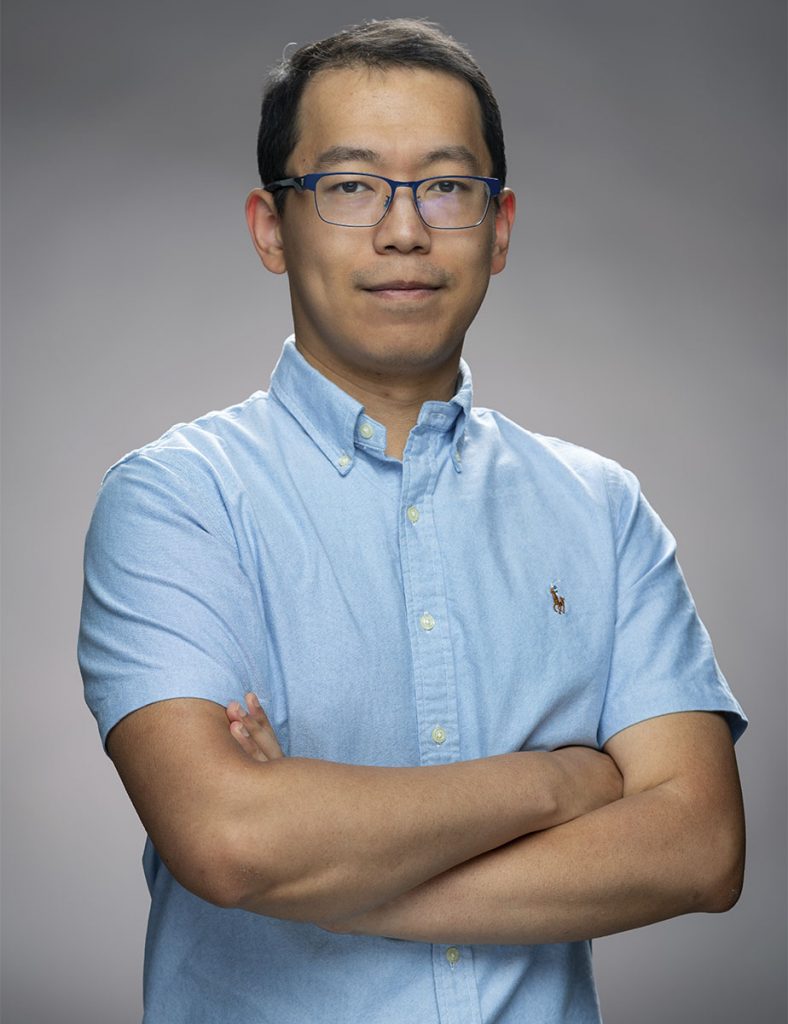
Much of the universe remains invisible to us, and scientists at the U.S. Department of Energy’s Fermi National Accelerator Laboratory are developing new quantum technologies to search for it. While ordinary matter makes up stars, planets and people, it accounts for only a small fraction of the universe’s mass. The rest is dark matter, a mysterious substance that does not reflect, emit or absorb light. Now, Fermilab associate scientist Yao Lu is leading a project to advance quantum technology that will enable searches for subtle, indirect signals from dark matter interactions. Yao has received a 2025 DOE Early Career Award to fund his research. Yao’s work focuses on developing a scalable superconducting cavity array, which will enable quantum-enhanced searches for a dark matter candidate known as the dark photon. Lu’s research will take place in the Superconducting Quantum Materials and Systems Center, hosted at Fermilab. SQMS is one of five DOE National Quantum Information Science Research Centers — part of a national initiative to develop the world’s most powerful quantum computers and sensors. Yao Lu is a recipient of a 2025 DOE Early Career Award Credit: Ryan Postel, Fermilab Dark photons are hypothetical particles that behave like an extremely weak, invisible version of an electromagnetic field. If they exist, they might occasionally deposit a tiny microwave signal into a detector. The challenge for physicists is that they do not know the signal’s frequency in advance. It’s like scanning an endless radio dial of white noise, hoping to stumble upon a lone, faint broadcast from an unknown station. In a standard search, scientists use a microwave cavity, essentially a carefully engineered metal resonator, as a sensitive antenna. If a dark photon exists at the right frequency, it could deposit a faint signal into the cavity. But because the frequency is unknown, searches must tune and listen, one setting at a time. To break through this scanning bottleneck, Lu is combining ultra-coherent cavity hardware with entangling operations, quantum-state preparation, and low-loss interconnects — specialized links that allow the cavities to share signals efficiently — so multiple cavities can function as a coordinated sensor array. By linking the cavities via remote quantum entanglement, the sensors can operate as a single cohesive unit. This quantum-enhanced array allows the system to scan through the “radio dial” of frequencies much faster and with far greater sensitivity than a single sensor ever could. “The key is not just building better cavities.” Lu said. “It is learning how to make many ultra-coherent sensors work together so entanglement becomes a real advantage in the experiment.” A four-cavity prototype, designed as a foundation for larger arrays, is the project’s first milestone. While the initial system is modest in size, the architecture is built to scale. “If we can demonstrate the right architecture and control at that scale, we can extend the same framework to much larger arrays,” Lu said. The project leverages techniques from superconducting quantum computing, which are now proving especially powerful for sensing. These methods make it possible to prepare, entangle, and nondestructively measure highly excited nonclassical cavity states, which are key resources for turning quantum coherence into a practical sensing advantage. Lu’s research aims to demonstrate a measurable quantum advantage in dark matter detection while also guiding the design of broader classes of quantum sensors, including future searches for particles such as axions. Beyond sensing, the same hardware and interconnect architecture is also key to the development of SQMS’s modular quantum computing and distributed quantum communication. These advances could ultimately benefit our society by enabling faster, more efficient computing systems and communication networks that are much more secure.
Fermi National Accelerator Laboratory is America’s national laboratory for particle physics and accelerator research.
Fermi Forward Discovery Group manages Fermilab for the U.S. Department of Energy Office of Science. Visit Fermilab’s website at www.fnal.gov and follow us on social media.
The Superconducting Quantum Materials and Systems Center is one of the five U.S. Department of Energy National Quantum Information Science Research Centers. Led by Fermi National Accelerator Laboratory, SQMS is a collaboration of more than 40 partner institutions — national labs, academia and industry — working together to bring transformational advances in the field of quantum information science. The center leverages Fermilab’s expertise in building complex particle accelerators to engineer multiqubit quantum processor platforms based on state-of-the-art qubits and superconducting technologies. For more information, please visit sqmscenter.fnal.gov. Recommended reading View all news New electronically tunable quantum detector speeds up search for dark matter April 6, 2026 dark matteremerging technologiesquantumFermilab feature Scientists designed a state-of-the-art detector to electronically tune itself, enabling scientists to search broader frequency ranges for evidence of weak signals produced by dark photons — possible dark matter particles — much faster and more precisely than ever before. New ultra-fast particle detector could help unmask dark matter March 24, 2026 CMSdark matterHigh-Luminosity Large Hadron ColliderFermilab feature The CMS experiment at CERN is building a new detector that will unravel the chaotic particle collisions at the Large Hadron Collider, helping scientists identify particles based on their speeds. A chilling new search for dark matter will soon be underway March 17, 2026 cryogenicsdark matterFermilab feature Fermilab has contributed vital components to the SuperCDMS experiment, located deep underground in a nickel mine outside of Sudbury, Canada.
Tags
Source Information
Discussion
0 professional contributions
Sign in to join this professional discussion.
Be the first to add a constructive contribution.