
What I Heard at Quantum Harlem
Summarize this article with:


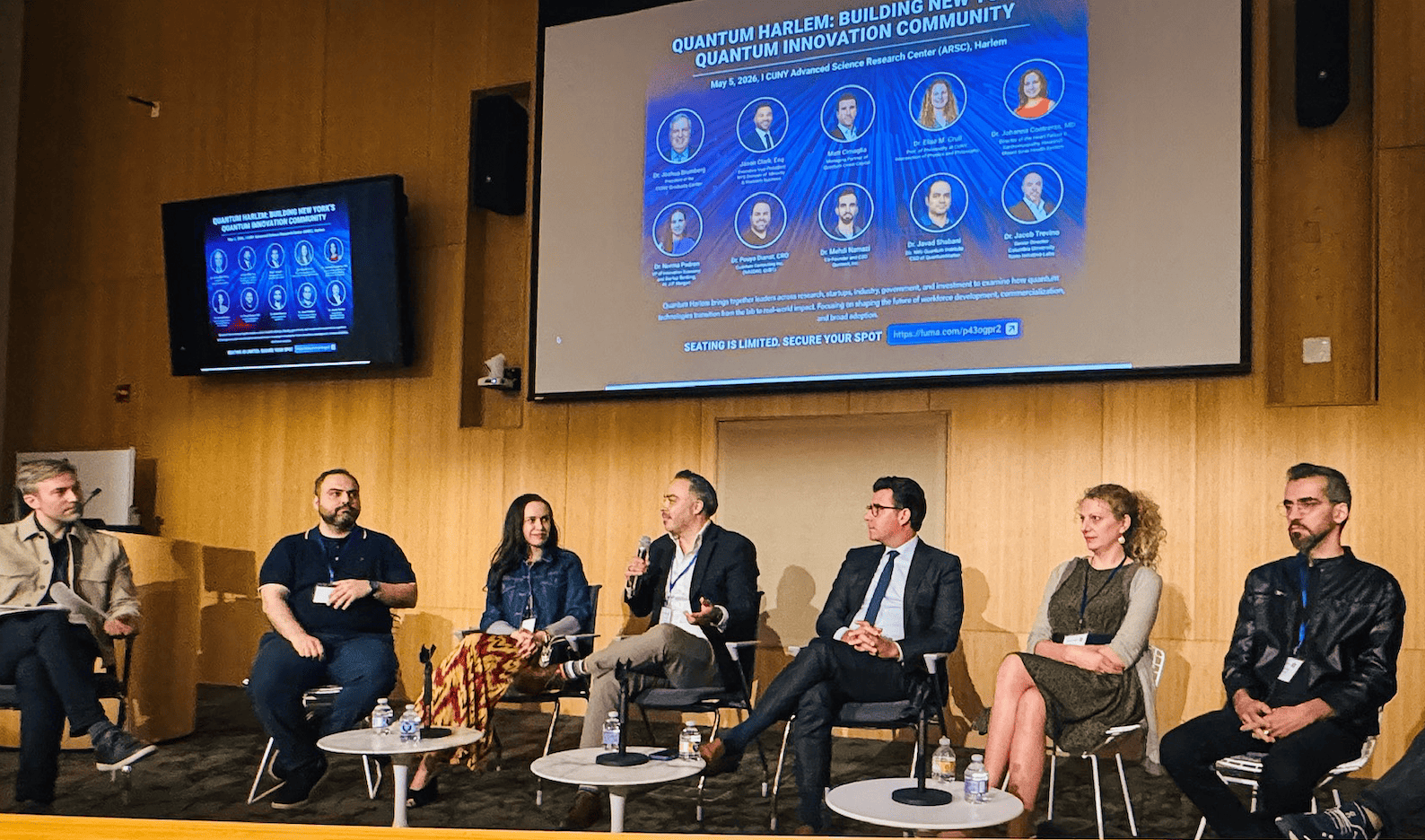
By Matt CimagliaI spent the evening of May 5 at CUNY’s Advanced Science Research Center for a panel called Quantum Harlem: Building New York’s Quantum Innovation Community. One number framed the whole evening for me. Tim Dutta of QuantumCue noted that the global quantum workforce is still under 30,000 people. That is not a sign that the industry is small. It is a sign that the people building it still know each other by name, that the network effects of the field are concentrated, and that the firms moving now are doing so before the curve steepens. I was one of the panelists, and like most panels worth attending, I learned more than I contributed. What follows is what I took away, since I think it says something about where quantum actually is right now, as opposed to where the press releases say it is.The most clarifying moment came from Mehdi Namazi, who built Qunnect out of Stony Brook. He walked the room through his timeline. He did the I-Corps program in the same building we were sitting in, in November 2017. He got a $50,000 check. He kept his postdoc for two years while his cofounder went full time. He did not leave academia until March 2020, which, he noted, was not the best week to join a startup. The first venture check came from a New York State fund, because state funds are the ones that care most about state universities. Qunnect now ships commercial products and has manufacturing in New Mexico.That arc is what the right kind of quantum investment looks like. The capital that backed Mehdi understood what it was underwriting, which was a multi-year build toward a real product in a real market, with hardware that had to actually work. The investors who got in early are now sitting on a company with manufacturing, customers, and a defensible position in quantum networking. The ones who passed because the timeline did not fit a standard fund model are watching from the outside. That is the pattern I keep seeing in this industry. The returns are going to the firms that show up early, stay patient, and know enough about the science to underwrite the risk properly.Javad Shabani from NYU pointed to where the next round of those opportunities is hiding. He said the most underserved part of the ecosystem is not applications or end-stage hardware, which already attract attention. It is the building blocks in between, the materials and components and instruments that the hardware companies need to operate. Those companies are smaller, harder to evaluate, and require investors who can tell a real technical advantage from a wrapper. Javad built one of those companies himself, raising from angels rather than institutional venture, and the company is already at revenue. The point he was making, and the point I think anyone allocating to deep tech should hear, is that this layer of the stack is where the best risk-adjusted entries are right now, for investors who know how to look.Norma Padrón from JPMorgan offered the framing I think most outside investors are missing. The quantum field, she said, is already deeply interconnected across disciplines. The engineers working on control optimization talk to the people working on AI hardware. The materials people talk to the sensing people. The communities have been overlapping for years before finance started paying attention. Most emerging technologies get described as a single thing looking for a market. Quantum is not that. It is several things, with several markets, and the people working in it already know each other.When my turn came, the point I made was about the culture. I have spent a couple of decades in deep tech, and the openness of this field is genuinely unusual. Founders root for their competitors here in a way I have not seen elsewhere. The market is big enough that everyone understands the only way anyone scales is if a lot of people scale at once. I think that culture is one of the most valuable things this industry has, and I worry about losing it as the capital base grows and the incentives change.The comment I have not stopped thinking about came from Elise Crull, who teaches philosophy of physics at CUNY. She said no tool is ethically neutral, because no tool is ever deployed in isolation. She told a story about the de Blasio administration distributing air conditioners to Harlem housing communities during a heat wave. It was a humane decision. It also drove up electricity bills, strained the local grid, and ended a tradition of people sitting on stoops in the evening, which had been the way the community talked to itself. The technology fix broke something nobody thought to measure.I have heard a lot of philosophy-of-science talks. Most do not land with investors and engineers. This one did, because the people in the room have started to feel the weight of what they are building. Quantum is going to get deployed into real places. It will change cryptography, it will change drug discovery, it will change how networks are secured and how sensors see. The decisions about what it changes first, and for whom, are being made now, by people who mostly know each other and mostly mean well. The question is whether meaning well is going to be enough.I do not have a tidy answer to that. Neither did anyone else on the panel, which is part of why the evening was worth the trip uptown. The honest version of where quantum is right now is that the technology is starting to work, the ecosystem is starting to coordinate, the capital is starting to show up, and the hard questions are still ahead of us. That is a better place to be than most of what gets called an emerging industry. It is not the same as being finished.Share this article:Keep track of everything going on in the Quantum Technology Market.In one place.