
At Vanderbilt Quantum Forum, Tennessee Made Its Case as a Serious Quantum State
Summarize this article with:


Insider Brief The Vanderbilt Quantum Forum underscored a shift from research to execution, with speakers emphasizing that quantum’s impact will depend on coordinated ecosystems linking talent, infrastructure, and real-world applications rather than isolated technical advances. Panelists highlighted that quantum systems are beginning to move beyond the lab into hybrid use alongside classical computing, with emerging applications in optimization, healthcare, security, and infrastructure planning. Policymakers and regional leaders positioned Tennessee as a developing quantum hub, focusing on workforce expansion, institutional alignment, and long-term economic strategy to translate early investments into sustained growth. There were about two hundred people in the room, and what stood out was not how many of them worked in quantum, but how many did not. Business leaders from across the region sat alongside researchers, policymakers, and students, many of them there not as experts but as observers trying to understand what this field might mean for their industries. The audience reflected a broader shift that has been building. Quantum is no longer confined to academic departments or specialized labs. It is beginning to draw in those responsible for decisions.
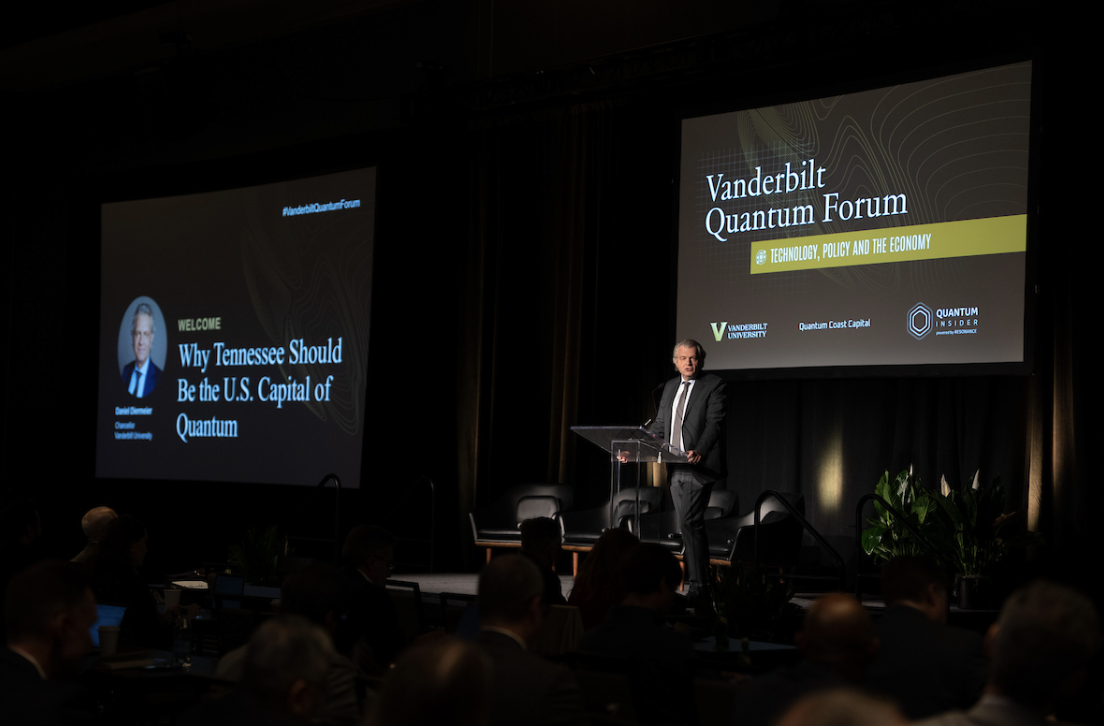
The Vanderbilt Quantum Forum, convened through Vanderbilt University, The Quantum Insider, and Quantum Coast Capital, was designed with that shift in mind. The day followed a deliberate progression, beginning with fundamentals and moving toward application, policy, and economic development. The goal was not to isolate quantum as a technical subject, but to place it in the context of systems that already exist. The morning began with opening remarks from Vanderbilt Chancellor Daniel Diermeier, who framed quantum not as a distant technology, but as one already influencing industries such as healthcare, logistics, finance, and energy. More important than the list of applications was the framework he used to describe competition. “The places that will lead in quantum will be those that can most quickly connect foundational research to real world use and match talent with opportunity.” That framing set the direction for the day. Leadership in quantum, Diermeier argued, will depend less on isolated breakthroughs and more on the ability to organize institutions around them. Tennessee, he said, is positioned to do exactly that, drawing on assets such as Oak Ridge National Laboratory, a strong university system, and early investments in infrastructure. “In Tennessee, we have already what other states are still building, a quantum ecosystem.” The first panel translated that perspective into practical terms. Ryan Harring, Lorenzo Martinelli, and Jenni Strabley described a field that is advancing, but unevenly and in ways that depend heavily on use case. There was a noticeable effort to avoid overstatement, reflecting a shift away from the idea that quantum is perpetually just out of reach. Strabley emphasized that quantum systems will operate alongside classical computing rather than replace it. Martinelli framed value more directly: “Value is strictly driven on what are you trying to achieve.” Harring described the broader transition underway, noting that the industry is “moving to a realm that is outside of the lab space,” as organizations begin integrating quantum into real workflows. From there, the discussion moved into national security and quantum networking, where the tone became more practical. Conversations around encryption and infrastructure resilience framed quantum less as a distant disruption and more as something requiring immediate planning. The designation of 2026 as the Year of Quantum Security (YQS2026), emerged as a marker for when these considerations begin to take on greater urgency. By late morning, the focus turned toward deployment. Chattanooga emerged as a central example. During the session on the Institute for Quantum Innovation, Mayor Tim Kelly described quantum as an opportunity for cities like his to “break this glass ceiling into the knowledge economy” and build competitive industries around emerging technologies. That perspective was reinforced by EPB’s trajectory, which evolved from a Department of Energy pilot into one of the first commercially oriented quantum networking environments in the United States. The transition from experiment to infrastructure reflects a broader shift across the field. The collaboration between EPB and Vanderbilt illustrates how these ecosystems are forming. Rather than operating independently, institutions are beginning to align around shared capabilities. As one speaker noted, the focus is on understanding “what can we do together that we cannot do alone,” particularly when moving quantum technologies into real-world environments. After the midday break, the conversation moved into application. Mehmet Aydeniz explored how quantum computing and artificial intelligence may converge in healthcare, particularly in drug discovery. The challenge is not a lack of data, but the complexity of biological systems. Quantum simulation, combined with AI, offers a path to model interactions that are otherwise difficult to analyze. The applied session that followed made the discussion more immediate. Duncan Huffman described how hybrid quantum-classical systems are already being used in optimization problems, expanding the range of possible solutions rather than simply improving speed. By the early afternoon, the focus shifted to policy and economic development.
Senator Bill Hagerty described the convergence of quantum science, advanced computing, and energy systems as a defining moment, emphasizing that regions investing now will be best positioned for long-term growth. That message was reinforced at the state level.
Tennessee House Speaker Cameron Sexton framed quantum as both an opportunity and a strategic necessity, pointing to the state’s positioning across energy, research, and infrastructure. “I think we’re primed. I think it allows Tennessee to compete on the international stage.” He expanded on that point by tying quantum directly to long-term economic outcomes: “If we can get this to a point, then the jobs and the investments, the degrees, and everything else that comes with it will be very beneficial for us long term.” The workforce discussion made that point more tangible. Speakers emphasized that the future quantum workforce will extend well beyond researchers. Engineers, technicians, and professionals capable of translating between technical and operational environments will be essential. The inclusion of Palm Beach State College, represented by Associate Dean Luis Pentzke, reflected the growing role of regional institutions in building that workforce. That perspective carries relevance beyond Tennessee. With Vanderbilt expanding its efforts and the development of the Palm Beach State College Quantum Innovation Center, there is an opportunity to connect ecosystems that are geographically separate but strategically aligned. These connections suggest that quantum hubs will develop not in isolation, but as part of a broader network. By the end of the day, the conversation had moved decisively away from theory and toward execution. The central questions were no longer whether quantum will matter, but how to integrate it into existing systems, how to build the workforce required, and how to align policy with long-term technological change. The forum’s emphasis on coordination, public policy, and talent development signaled that Tennessee wants to be seen not as a bystander to quantum’s growth, but as one of the places where that growth will be organized and accelerated. Across remarks from Vanderbilt leadership, policymakers, and industry executives, one message came through clearly: the next quantum race will not be won by breakthroughs alone. It will be won by ecosystems across the nation and with our allies.