
University of Nebraska Engineer Aims to Build ‘Bridge’ For Quantum Superhighways
Understand this faster with AI


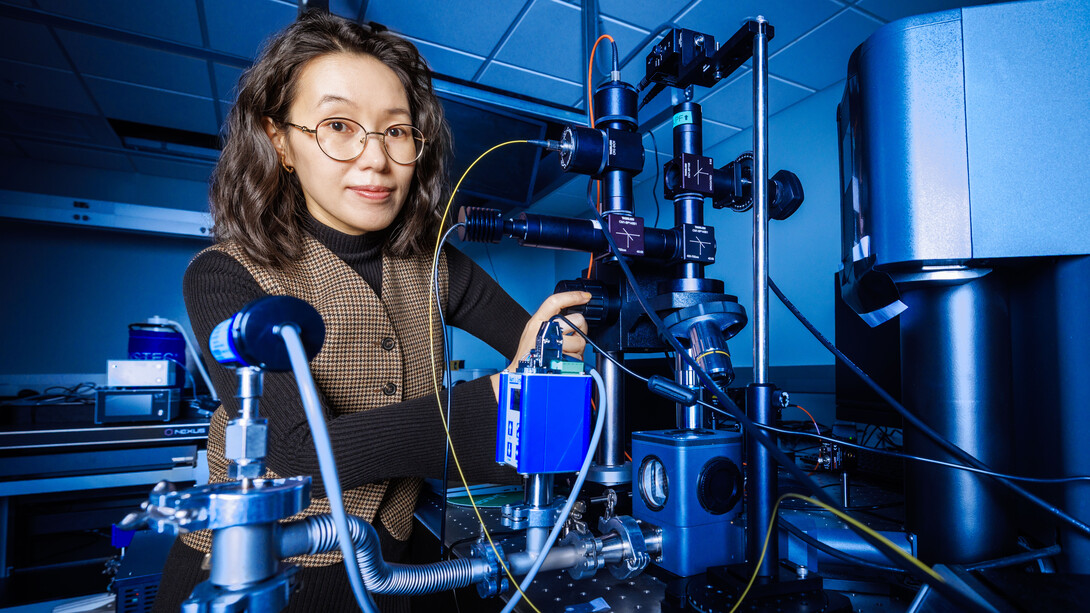
Insider Brief A University of Nebraska–Lincoln researcher has secured a five-year, $876,663 award from the U.S. Department of Energy to develop technology that could connect isolated quantum computers into a functional network. The project targets a core engineering barrier—bridging the frequency mismatch between microwave-based quantum processors from companies like IBM and Google and optical communication systems used for long-distance data transfer. The research will use atomically thin materials such as graphene to build devices that convert signals between computing and communication systems, aiming to enable scalable quantum networks analogous to the early internet. Story: University of Nebraska. Image: Jordan Opp / University Communication and Marketing PRESS RELEASE — Quantum computers are often described as the supercharged engines of the future — machines capable of solving certain problems that are classically intractable for today’s most powerful computers. But there’s a catch: even the most advanced quantum computers cannot yet easily communicate with one another over long distances. “It’s like building a network of high-capacity power plants without the transmission lines needed to connect them into a grid,” said Yanan (Laura) Wang, assistant professor of electrical and computer engineering at the University of Nebraska–Lincoln, who is working to build that missing piece with support from one of the U.S. Department of Energy’s most competitive grant programs. Wang received a five-year, $876,663 Early Career Research Program award, which runs through August 2030. The objective is to solve one of the most challenging engineering problems in quantum technology. Today’s quantum computers, developed by industry leaders like IBM and Google, operate using microwave frequency signals, while quantum communication systems — needed to link those computers together — use light at frequencies hundreds of thousands of times higher. “The computation unit and the communication unit have this huge frequency mismatch,” Wang said. “That’s why it requires a bridge to transfer the information between those two.” Without that connection, a true quantum network — the equivalent of the internet for quantum machines — remains out of reach. Wang’s solution centers on quantum grade mechanical resonators and waveguides, devices capable of interacting with both microwave and optical signals. Her team will build these devices using van der Waals-layered crystals, a family of materials that includes graphene and other atomically thin semiconductors. These materials can be peeled down to a single atomic layer while retaining exceptional strength, making them ideal for high performance mechanical devices. “They are just atomically thin … but the in-plane covalent bonds are really strong,” Wang said, noting that graphene’s carbon structure shares the same elemental foundation as diamond. Wang’s research will explore “quantum and nonclassical states in phononic and optomechanical devices enabled by van der Waals layered crystals,” with the goal of creating integrated quantum photonic–phononic circuits capable of coherent information processing and quantum signal routing. These circuits would serve as the long-awaited connector between quantum processors and quantum communication lines. Wang sees this work as essential for the field’s next stage. While major strides have been made in quantum computing hardware, she notes that the systems remain isolated. “Although there are already commercial systems, they only focus on the individual computer itself, not connecting with other units through a network yet,” she said. As quantum technology approaches a turning point — much like the dawn of the internet in the 1990s — Wang’s work positions Nebraska at the forefront of building the next era of computing. “Going from the classical (system) to quantum is a natural transition, but it’s like things were for personal computer users in the 1990s when the internet started to become more commonly used,” she said. “We need that bridging capability (in the quantum realm), and we have the expertise (at Nebraska) to do it right.” Matt Swayne LinkedIn With a several-decades long background in journalism and communications, Matt Swayne has worked as a science communicator for an R1 university for more than 12 years, specializing in translating high tech and deep tech for the general audience. He has served as a writer, editor and analyst at The Quantum Insider since its inception. In addition to his service as a science communicator, Matt also develops courses to improve the media and communications skills of scientists and has taught courses. matt@thequantuminsider.com Share this article:
Tags
Source Information
Discussion
0 professional contributions
Sign in to join this professional discussion.
Be the first to add a constructive contribution.