
Rice Hosts Global Quantum Experts in Paris For Cutting-edge Conference
Summarize this article with:


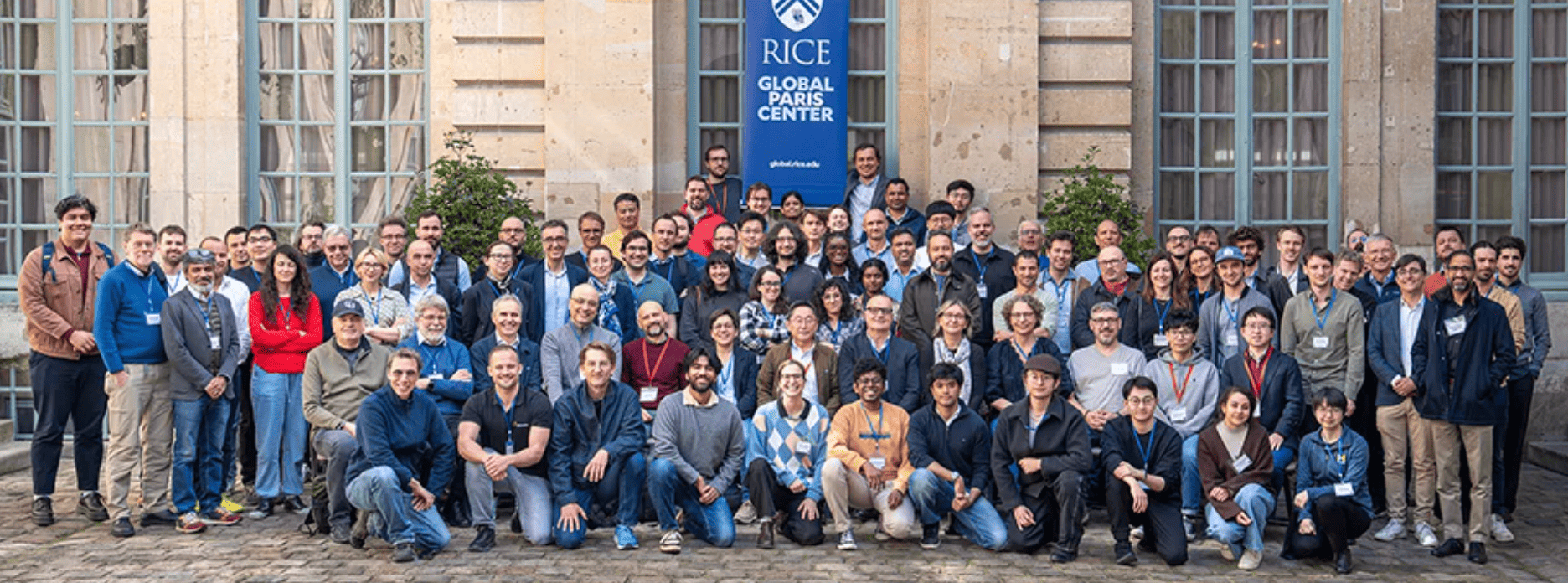
Insider Brief Researchers from global institutions gathered in Paris for a Rice University-led conference highlighting cavity quantum electrodynamics as a key framework for controlling light-matter interactions in emerging quantum technologies. The five-day workshop focused on cavity engineering, interaction control and dissipation, solid-state phenomena, and quantum light applications for sensing and imaging, reflecting the field’s expanding interdisciplinary scope. Organizers emphasized the event’s role in strengthening international collaboration, training early-career scientists, and positioning Rice as a hub for global quantum research partnerships. Image: Jorge Vidal, Rice University PRESS RELEASE — As quantum technologies move closer to real-world applications, cavity quantum electrodynamics is emerging as a central framework for controlling the interaction of light and matter at the most fundamental level. That momentum brought researchers from around the world to the Rice Global Paris Center April 13-17 for the Frontiers of Cavity Quantum Electrodynamics conference, hosted by the Smalley-Curl Institute’s Rice Center for Cavity QED (RCCQ). Organized by Rice faculty members Alessandro Alabastri, Andrey Baydin, Songtao Chen, Junichiro Kono and Yonglong Xie, along with Carlo Sirtori of École Normale Supérieure, the five-day program convened experts from Europe, the United States and Asia to examine new approaches to engineering and controlling quantum systems. Cavity quantum electrodynamics studies how individual light particles interact with atoms or molecules when they are confined in a tiny, mirrored space that enhances and controls those interactions. The field underpins advances in quantum computing, sensing and communication and is increasingly shaping research across condensed matter physics, materials science, electrical engineering and chemistry. The workshop centered on four areas: cavity engineering; controlling interactions and dissipation; cavity-enhanced phenomena in solids; and quantum light for sensing and imaging. “For decades, cavity QED was primarily associated with atomic physics, but what’s remarkable now is how broadly its concepts have spread,” said Kono, director of Rice’s Smalley-Curl Institute. “Researchers from condensed matter physics, quantum photonics, quantum communication and even chemistry are now engaging with the same ideas.” The choice of Paris reflects both the field’s history and Rice’s efforts to expand its global research footprint. Early experiments in atomic cavity quantum electrodynamics were conducted in the city in the 1970s, and Europe remains a major hub for the field. At Rice, that work builds on a longer institutional history, with the Smalley-Curl Institute tracing its origins to the Rice Quantum Institute founded in 1979 by Richard Smalley, Robert Curl and others. “Hosting the conference in Paris made it more accessible for many of the leading groups in Europe,” Kono said. “At the same time, bringing researchers from the United States created an opportunity for close, in-person exchange.” The Rice Global Paris Center served as a hub for those interactions, providing a setting designed to support sustained collaboration and dialogue among researchers working across disciplines and geographic regions. Events like this workshop are part of the university’s broader effort to build long-term international partnerships and position Rice as a central connector in quantum science. “We were able to bring 13 graduate students to Paris as part of this conference, 10 of them through the NSF Research Traineeship program that focuses precisely on cavity QED,” said Alabastri, co-director of RCCQ and director of the applied physics graduate program. “It gave them a unique opportunity to engage directly with leading researchers and experience international collaboration firsthand, which is essential for training the next generation of researchers.” In addition to invited talks, the program included networking events and a poster session featuring graduate students and early career researchers, reflecting the field’s growing interdisciplinary reach. “Having 63 invited speakers allowed us to capture a broad cross section of the field,” said Chen, co-director of RCCQ. “The program brought together researchers working on different problems but increasingly connected by shared ideas and approaches.” Participants included speakers from institutions such as Columbia University, ETH Zurich, Max Planck institutes, Université de Strasbourg, Politecnico di Milano, University of Michigan, Yokohama National University, Université de Genève, Université Paris-Saclay, Stockholm University, Instituto de Nanociencia y Materiales de Aragón and the Indian Institute of Science. The conference was supported by the Rice Global Paris Center, the Smalley-Curl Institute, Rice’s Office of Research, the Wiess School of Natural Sciences and the Department of Physics and Astronomy, along with external partners including the Gordon and Betty Moore Foundation, COMSOL Inc., attocube systems GmbH, Light Conversion Inc. and Cell Press. The event is part of ongoing efforts by Rice to expand international collaboration and strengthen its role in advancing quantum science through global engagement.
Matt Swayne LinkedIn With a several-decades long background in journalism and communications, Matt Swayne has worked as a science communicator for an R1 university for more than 12 years, specializing in translating high tech and deep tech for the general audience. He has served as a writer, editor and analyst at The Quantum Insider since its inception. In addition to his service as a science communicator, Matt also develops courses to improve the media and communications skills of scientists and has taught courses. matt@thequantuminsider.com Share this article: