
Quobly and Hon Hai Research Institute Release an Open-Source Toolbox to Explore Quantum Phase Estimation
Summarize this article with:


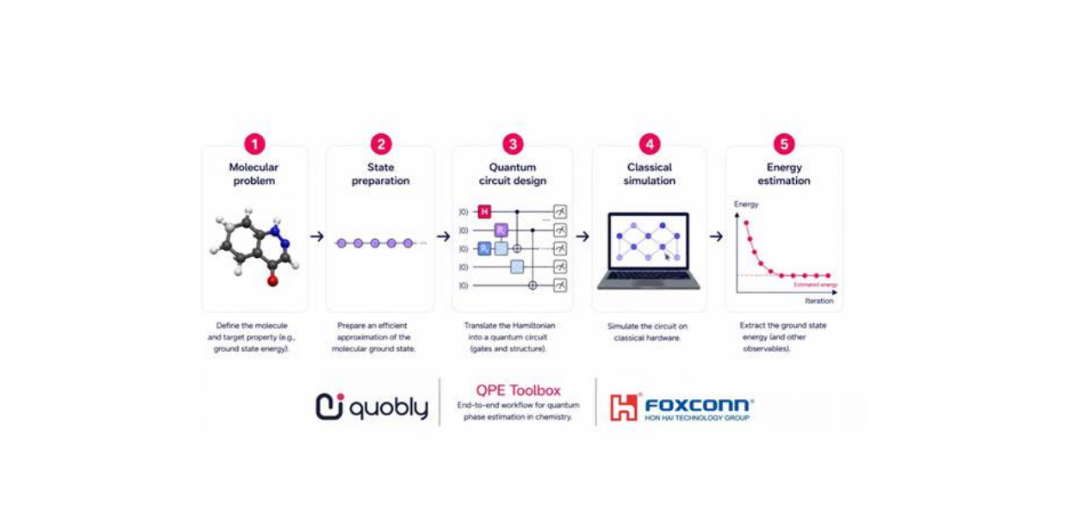
Insider Brief Quobly and Hon Hai Research Institute released an open-source toolbox for exploring Quantum Phase Estimation (QPE) algorithms used in fault-tolerant quantum computing. The toolbox enables researchers to study quantum chemistry workflows, Hamiltonian encoding methods, and QPE resource trade-offs using tensor-network techniques. The software is designed as a practical and educational framework for testing realistic QPE implementations on classically tractable systems. PRESS RELEASE — Quobly, a French pioneer in silicon-based quantum computing, and Taiwan’s Hon Hai Research Institute, the R&D arm of Hon Hai Technology Group (Foxconn), today announced the release of an open-source numerical toolbox, jointly developed by the two partners, dedicated to the Quantum Phase Estimation (QPE) algorithm, a cornerstone of fault-tolerant quantum computing with major applications in quantum chemistry and materials science. QPE is widely regarded as a key algorithm for computing ground-state energies of molecular systems on future fault-tolerant quantum computers. While its theoretical properties and asymptotic cost scalings are well understood, practical resource estimates and realistic performance trade-offs remain largely unexplored, due to the difficulty of simulating QPE beyond toy models. The newly released toolbox aims to bridge this gap by providing researchers with a practical environment to explore QPE implementations and their resource implications, with a strong focus on understanding algorithmic building blocks and their practical implementation constraints. From Theory to Practice: Exploring the Full QPE Pipeline The QPE Toolbox is designed to give quantum algorithm practitioners a hands-on, numerical understanding of the full QPE workflow, from chemistry preprocessing to phase estimation, in a regime that challenges classical simulation while remaining computationally tractable. Built on advanced tensor network techniques, the toolbox enables users to: Prepare physically motivated initial states using DMRG and matrix product states, Encode molecular Hamiltonians into quantum circuits via trotterization or block-encoding / qubitization methods, Compare textbook QPE with single-ancilla Robust Phase Estimation (RPE), Analyze circuit depth, gate counts, and error sources without necessarily executing the circuit. The toolbox relies on the open-source quimb library and interfaces with standard quantum chemistry tools such as PySCF, ensuring compatibility with established workflows. The first release is designed as an educational and exploratory framework, enabling researchers to build intuition around the practical implementation of QPE and its variants. A Modular Tool for Realistic Numerical Experiments Rather than attempting to simulate early fault-tolerant quantum computers, which are by nature beyond classical reach, the QPE Toolbox focuses on practical, interpretable numerical experiments in regimes accessible to classical computation, where algorithmic choices, initialization fidelity, and Hamiltonian encoding strategies can be explored in detail. Illustrative use cases enabled by the toolbox include (non-exhaustive): Full circuit executions for ~10–20 qubits and circuits ranging from <1,000 to ~100,000 gates, Ground state preparation for systems up to ~20–30 qubits, Hamiltonian encoding for systems up to ~20–30 qubits, typically within a few hours or less on a standard laptop. These capabilities allow researchers to study trade-offs between precision, circuit depth, and resource requirements, and to build practical intuition about the behavior of QPE building blocks. The toolbox is therefore designed primarily as a pedagogical and exploratory platform, helping bridge the gap between theoretical proposals and their concrete implementation constraints. Open, Collaborative, and Evolving The QPE Toolbox is released as open source and is intended to evolve with the community. Future developments will include variational circuit synthesis, compressed fermionic encodings, and larger-scale tensor-network simulations. The toolbox is available on GitHub: https://github.com/quobly-sw/qpe-toolbox Documentation and example workflows are provided to help researchers explore the different components of the QPE pipeline. “Our goal is to provide a practical, numerical playground for QPE, one that helps researchers move beyond purely theoretical cost models and develop realistic intuition for fault-tolerant quantum algorithms,” said Thibaud Louvet, Quantum Algorithms Scientist at Quobly. “By combining state-of-the-art quantum algorithms with advanced tensor-network techniques, this toolbox offers researchers a structured environment to explore and better understand the practical requirements of future quantum applications,” said Min-Hsiu Hsieh, Director of the Quantum Computing Research Center at Hon Hai Research Institute. The jointly developed software is free for use by academics and researchers. This collaboration reflects a shared commitment by Quobly and Hon Hai Research Institute to advancing algorithm-hardware co-design and accelerating progress toward practical fault-tolerant quantum computing.
Mohib Ur Rehman LinkedIn Mohib has been tech-savvy since his teens, always tearing things apart to see how they worked. His curiosity for cybersecurity and privacy evolved from tinkering with code and hardware to writing about the hidden layers of digital life. Now, he brings that same analytical curiosity to quantum technologies, exploring how they will shape the next frontier of computing. Share this article: