
A Quantum Payload Reaches Orbit, Commercial Quantum Communication Is on the Horizon
Understand this faster with AI


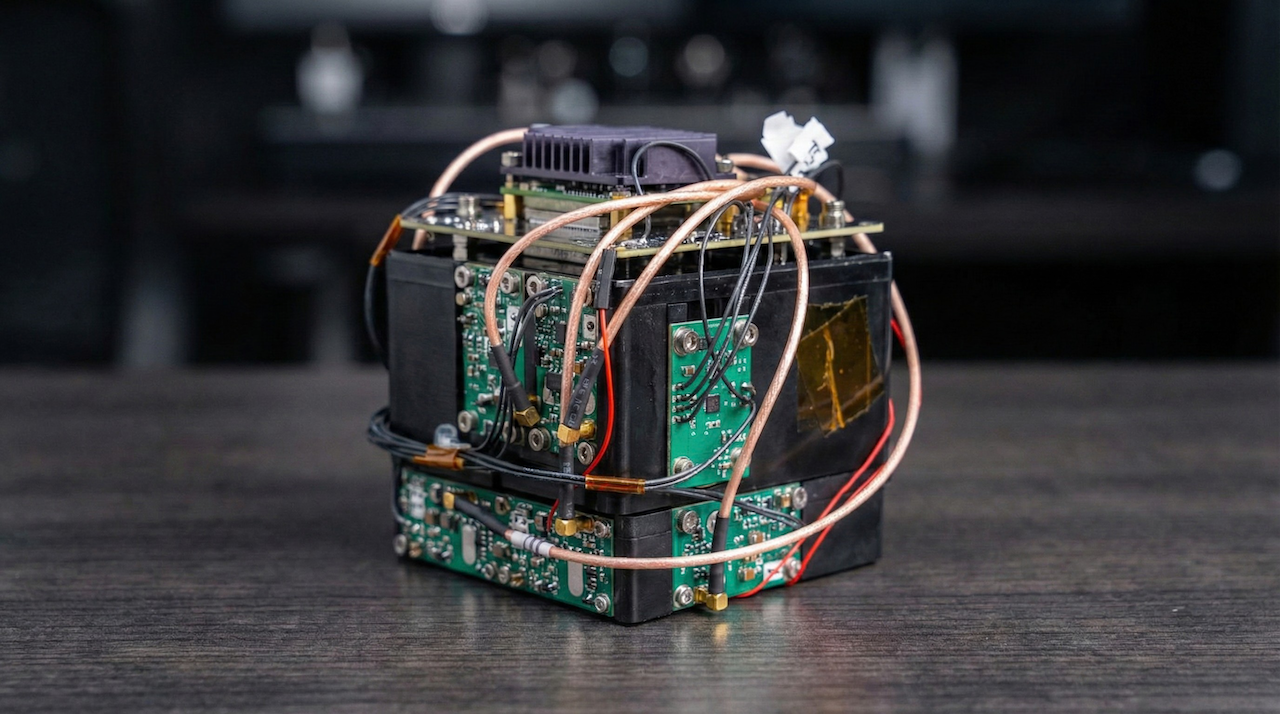
Insider Brief:A CubeSat no larger than a shoebox entered low Earth orbit aboard SpaceX’s March 30th Transporter-16 mission, carrying a compact quantum communication system built by a commercial startup out of Turkey and the Netherlands.The payload, developed by Qubitrium, is designed to test the foundational capability of whether entangled photons can be reliably generated and measured in space using fully integrated, miniaturized hardware.This deployment is one small step for space-based quantum systems, on the journey to becoming one giant leap for quantum communication.Inside the satellite is Qubitrium’s QubitCore system, a CubeSat-compatible payload that integrates an entangled photon source, optical receiving modules, and time-tagging electronics into a single, self-contained unit.The architecture is built to implement the BBM92 quantum key distribution protocol, which is an entanglement-based method for generating encryption keys that, in principle, cannot be intercepted without detection. But this particular mission is not yet about delivering secure communications; this is no small journey. This payload is intended to validate that the system functions in orbit as intended.Quantum communication has already been demonstrated in space, most notably through state-backed missions. But those efforts have largely remained within the domain of government-funded research programs. This launch, instead, represents an attempt to package that capability into a repeatable, commercial form factor that can be deployed, tested, and iterated on as infrastructure versus experiment.The technical challenge is not in generating the entangled photons alone, something that has been achieved in controlled environments for decades. Rather, the challenge is doing so within the constraints of a CubeSat which has limited power, constrained volume, and exposure to radiation, vibration, and thermal cycling.QubitCore operates within those constraints. Roughly 10 centimeters per side and weighing about a kilogram, the payload consumes just a few watts of power while performing photon generation, detection, and correlation measurements onboard.Over the coming months, the system will transmit data back to Earth, allowing engineers to assess performance in real conditions. The focus will be less on whether the system works at all, and more on how it behaves over time, including how detectors degrade, how electronics respond to radiation, and whether entanglement correlations remain stable. This type of data cannot be simulated.Qubitrium’s long-term vision extends beyond this single mission. It is positioning its hardware as a modular platform that other organizations can use, such as research groups developing quantum memories, companies designing optical ground stations, or teams exploring new communication protocols. Instead of building entire satellite systems from scratch, these groups could integrate pre-engineered payloads and focus on their specific layer of the stack.The broader implication here is the potential for an emergence of a supply chain for quantum technologies in space, one where components are standardized, validated, and reused across missions. That model has precedent in other areas of the space industry, where modularization has reduced costs and accelerated iteration cycles.Quantum communication has not yet reached that stage, but this deployment suggests it may be moving in that direction. For Dr. Kadir Durak, Founder & CEO of Qubitrium, this is less about a single mission and more about lowering the barrier to entry across the field. “At Qubitrium, we believe progress in quantum technologies should not start from zero every time. Our role is to provide a foundation, so researchers and innovators can build higher, move faster, and focus on what truly advances the field, and eventually we reach the ultimate goal of a global quantum internet as species. ” said Durak.Reaching orbit is no trivial milestone for hardware like this. The CubeSat survived its most treacherous part of the mission within a volatile and unforgiving threshold. The payload endured launch vibrations, extreme forces, and the uncertainty of leaving Earth’s atmosphere, where any number of failure modes can render a system obsolete.Now, it sits in orbit, suspended in a kind of engineered stillness, moving at thousands of miles per hour, yet finally in an environment stable enough to begin its real work.If the system performs as expected, the next phase is a second-generation payload equipped with an optical telescope to enable downlink communication between satellite and ground. That would allow for practical demonstrations of quantum key distribution from orbit, even if the satellite itself remains a “trusted node” in the network.Beyond that lies a more difficult challenge, which includes integrating quantum memory into space-based systems, to effectively remove the need to trust the satellite altogether. But that technology remains unresolved.This mission does not solve quantum communication. But it does reduce one layer of uncertainty.By demonstrating that a fully integrated, commercially developed quantum payload can operate in orbit, the question of whether space-based quantum systems are possible iterates upon itself to become a question of how they will be built, scaled, and accessed.From isolated demonstration to repeatable deployment, this is where the early stages of infrastructure are born. And in quantum communication, it has always been the infrastructure that is hardest to build.Share this article:Keep track of everything going on in the Quantum Technology Market.In one place.
Tags
Source Information
Discussion
0 professional contributions
Sign in to join this professional discussion.
Be the first to add a constructive contribution.