
Quantum influencers gather to celebrate London’s role in quantum tech
Summarize this article with:


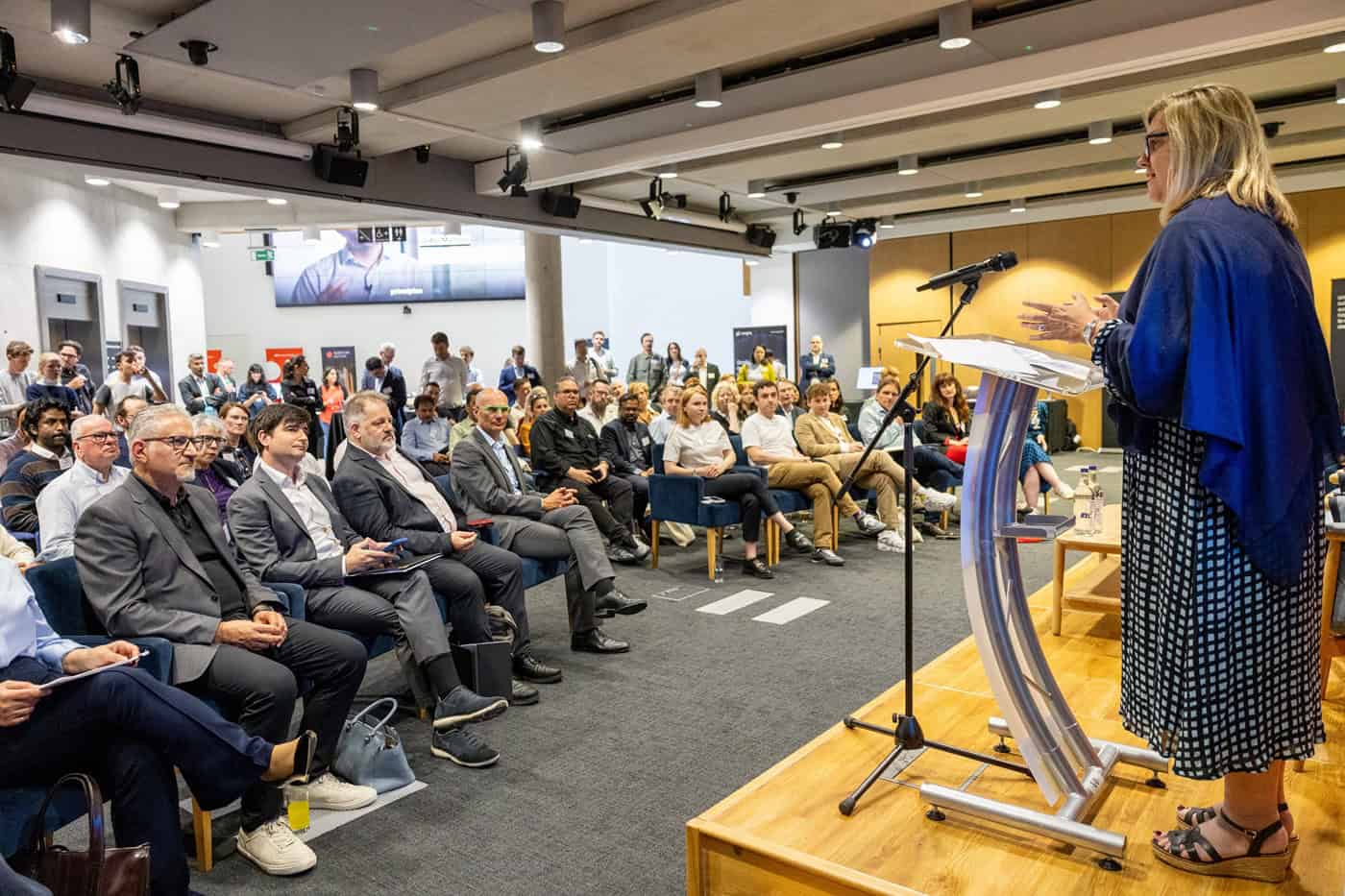
Matin Durrani joins an event at the Institute of Physics celebrating the first anniversary of the founding of the London Quantum Cluster Capital connections Janet Coyle from London and Partners addressing delegates at meeting at the Institute of Physics to mark the first anniversary of the London Quantum Cluster. (Courtesy: Carmen Vilano) “There are two types of people when it comes to quantum”, joked Howard Dawber, deputy mayor of London for business and growth at a meeting at the Institute of Physics last night to celebrate the first anniversary of the London Quantum Cluster. “There are those who understand quantum mechanics. There are those who don’t. And there are those who are in superposition of understanding and not understanding until they are observed.” It was a light-hearted remark that matched the mood of what was essentially an evening of boosterism for quantum technology in London ahead of London Tech Week next week. As chair of London and Partners – the growth agency for London – Dawber told the gathering of more than 100 “quantum influencers” that the organisation was “100% behind the London Quantum Cluster”. Founded in 2025 by University College London, King’s College London and Imperial College London with support from the Mayor of London and the UK government, the cluster seeks to establish the capital as a powerhouse of quantum tech. Georgia Siora from Warwick Economics and Development presented data to show that London is already doing well in the sector, being home to more than 160 quantum companies, with seven of the top 10 UK quantum firms based in the city. Small- and medium-sized quantum firms in the capital, she added, contribute an estimated £153m annually to the economy. Happy anniversary The London Quantum Cluster is now one year old. (Courtesy: Carmen Vilano) “Quantum and deep tech are at the heart of the capital’s 10-year growth plan”, added Janet Coyle, managing director of London and Partners. Geraint Rees, vice provost for research, innovation and global engagement at UCL, said his aim was “to make London the best place on the planet for serious quantum companies”. He pointed to UCL spin-out Quantum Motion, which has just won $160m of venture-capital funding, as an example of the kind of firm making a name in the city. The evening ended with a panel debate chaired by Jess Wade from Imperial College London, featuring Maria Maragkou from Nu Quantum as well as Richard Murray, founder of ORCA Computing, who drew a distinction between universities being all about expanding the frontiers of knowledge, whereas for start-ups “the aim is to win”. Also on the panel was physicist Alejandro Montblanch – head of quantum communication and networking at banking group HSBC – who made it clear that what he wanted to know was: “How can your quanutm company help HSBC make more money”. A welcome note of caution came from London-based venture-capital investor Eloisa Angeles, who pointed out that while the UK has a good track record of government-funded research, the UK is weak at “follow through”, with the government not focused on procurement and not having the end customer of the research in sight. For more about the commercial impact of quantum economy, check out this feature by Philip Ball. Want to read more? Registration is free, quick and easy Note: The verification e-mail to complete your account registration should arrive immediately. However, in some cases it takes longer. Don't forget to check your spam folder. If you haven't received the e-mail in 24 hours, please contact customerservices@ioppublishing.org. E-mail Address Register Physics World Careers Providing valuable careers advice and a comprehensive employer directory Environment and energy Feature What physicists can do to support the green economy Scientific enterprise News Physicist John Hill takes the helm at Brookhaven National Laboratory Quantum sensors Research update Molecular spin sensor takes the temperature of cancer cells