
The Quantum Economy Will Be Built on Glass
Understand this faster with AI


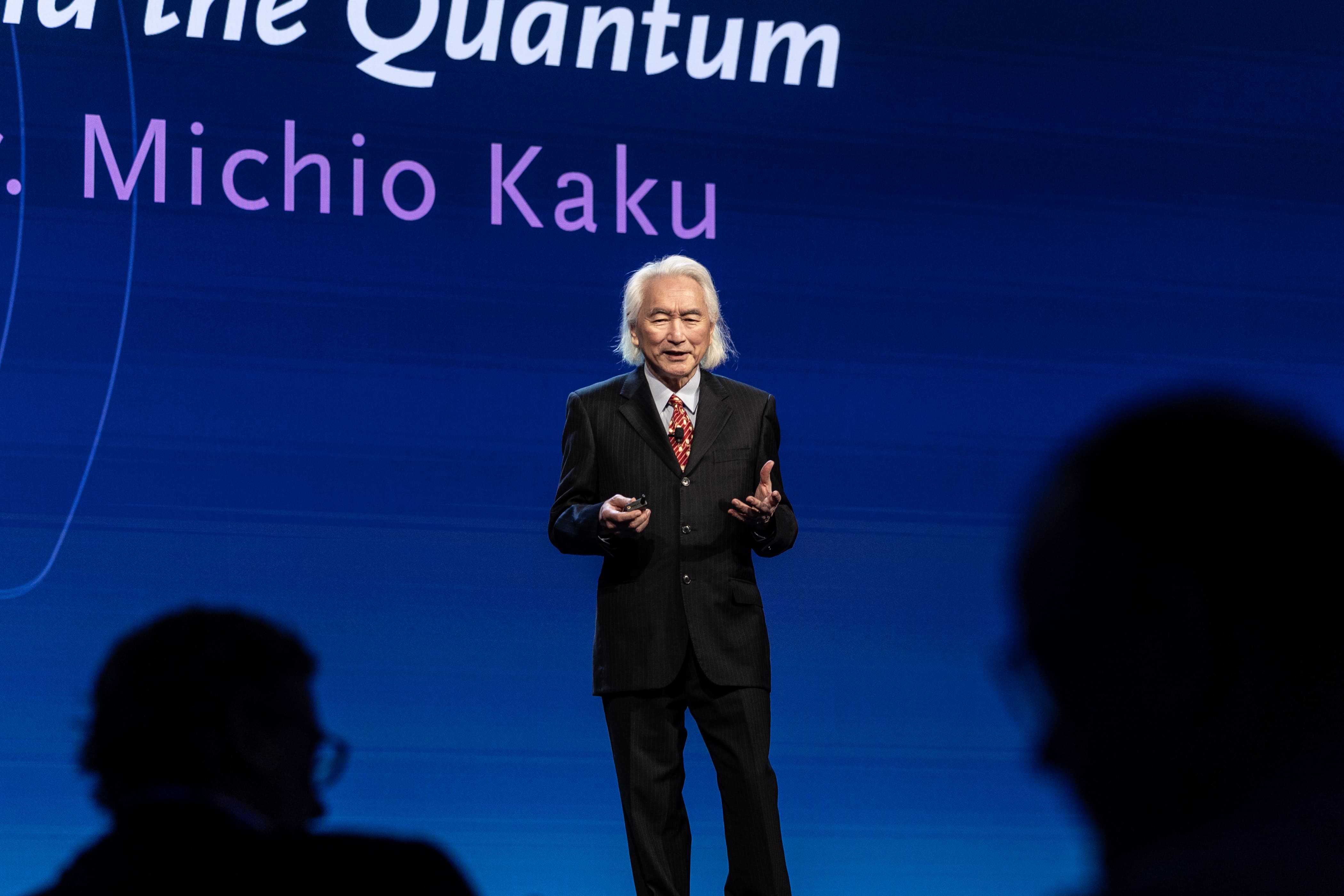
Photo credits: Fiber Broadband AssociationBy Matt CimagliaThis week in Orlando, Michio Kaku stood in front of a few thousand fiber broadband executives and told them their industry is the nervous system of the next economy. He meant it more literally than most of the audience registered.The setting was Fiber Connect 2026, the Fiber Broadband Association’s 25th anniversary conference, and the morning was the inaugural session of the AI & Emerging Technology Infrastructure Summit, a new program the FBA built specifically to put fiber at the center of the quantum and AI conversation. Booking Kaku for the keynote was a statement of intent. The conference exists because the people who build the country’s optical networks understand that what runs on those networks is about to change, and that the conversation needed a venue.I was there to talk about the quantum node economy. The conversation that morning kept returning to a point the broader market has not absorbed. Quantum technology is going to matter, and not in the narrow sense of computing. Quantum sensing is already in your MRI machine, your GPS, and the ATM you used yesterday. Quantum networking is the connective tissue that turns sensors and computers into an economy. Free-space and satellite links will carry some of that traffic. Fiber will carry most of it.I have been following quantum technology since 2017, first as someone trying to understand it, and now as the founder of a fund that builds positions in the infrastructure underneath it. Over those years I have heard quantum described as five to ten years away in roughly the same phrasing, every year. The phrase has become a running joke in the field. What changed recently is that the timeline started to compress.Kaku opened by walking the audience through four waves of innovation. Steam, electricity, digital computers, artificial intelligence. Then he pointed at a fifth. “We can already see the fifth generation, the fifth wave of progress, will be at the quantum level,” he said. “We’re talking about quantum computers, computing not on transistors, but computing on atoms, the ultimate building blocks of the universe.” The framing mattered because of what he said next. Previous cycles took a century or more to mature. Steam took roughly a hundred years to come under real control. The transistor changed everything in a few decades. Artificial intelligence went, in his phrase, “from science fiction to something that’s now in children’s history books” in a handful of years. Each cycle compresses. The quantum cycle, he argued, will be the most compressed yet.The deeper argument he made, the one most of the room had not heard articulated quite that way, was that digital itself is an approximation. “Mother Nature is not digital,” he said. “Mother Nature is quantum.” He pointed out that the only place in the known universe where you find computation running on strings of zeros and ones is the surface of this planet, in machines we built. Plants do not compute that way. Photosynthesis does not. DNA does not. Quantum computers are not exotic in the cosmic sense. They are the first machines we have built that approach the substrate the rest of the universe already uses.He made the case for fiber the same way. Copper versus glass is not a contest. Glass wins on carrying capacity, on power consumption, on maintenance, on weight, on interference. “Fiber optics is the glue,” he said. “It’s the nervous system that’ll permeate every aspect of society.” He returned to the human-body analogy more than once. Brain to nervous system to muscle. Mainframe to fiber to robot. He ended that section of the talk with a phrase that stuck with me. “Fiber optics will eventually marry with quantum computers. We will have quantum fiber optics.”He was also careful about hype, which I appreciated. “Real problems that are solved by quantum computers are still not here yet,” he said. “We see the promise, but we have a long ways to go still. We’re looking at a technology in its infancy.” Newspaper claims that a quantum computer solved a problem a digital computer would need a million years to handle, he said bluntly, are mostly about “imaginary problems cooked up by mathematicians.” The promise is real. The press has gotten ahead of the engineering.The fireside chat with Ryan Harring, IonQ’s Director of Partnerships and Alliances, sharpened the security implications. Harring asked what a sufficiently scaled quantum computer means for digital infrastructure. Kaku did not soften it. “A quantum computer in principle, on paper anyway, can break any digital code, which includes your bank account, which includes the Fed, which includes currency.” He pressed further. “The whole fabric of capitalism is digital. In principle, a quantum computer can break through that and perhaps even collapse the nature of commerce itself.” Harring asked the natural follow-up about post-quantum cryptography work coming out of NIST and the major labs. Kaku said he is not yet convinced. “I have yet to see an algorithm that allows you to stop a quantum computer from breaking into a digital computer.”Harring then named something the industry has danced around for years. “Adversarial nations are doing this thing called harvest now, decrypt later, in hopes that quantum computers will eventually get stronger and powerful enough so they can then take and start breaking the codes against that personal data.” Encrypted traffic is being collected today against the bet that it will be readable tomorrow.Kaku closed his portion with the workforce question, and his answer is one fiber operators should sit with. Robots, he said, are good at repetitive tasks. They cannot fix a broken pipe, because every broken pipe is different. They cannot put a roof on a building. They cannot identify a child in a classroom who is struggling for reasons that have nothing to do with the math. “Robots are programmed to do one thing well over and over again.” The quantum economy will create more skilled jobs than it eliminates, and most of them will be hands-on. He ended with a story about Einstein’s chauffeur, who had memorized the professor’s lecture so well he could deliver it himself. The room laughed. The joke lands because the chauffeur understood the script but not the science. The fiber industry, twenty years from now, will be in the opposite position. It will have built the infrastructure for an economy whose underlying physics it does not need to fully understand. That is how most infrastructure works.My session followed. Kelsey Ziser of InformationWeek moderated, and her opening question was how to define the quantum node economy. The frame I gave her was geographic. Fifty years ago, Silicon Valley happened because a particular set of universities, defense contracts, and venture firms clustered in one place. The quantum economy is not clustering that way. New York, Maryland, Florida, Tennessee, New Mexico, and Arizona are each developing their own concentration of quantum activity in parallel, because the fiber is already in the ground. Distributed by default. The fiber decides which regions get to participate.Ziser asked where the industry is underestimating the moment. My honest answer is that I worry about the hype cycle more than the technology. AI had a chat-GPT moment that pulled in a wave of capital with no patience for the underlying work. Quantum cannot afford that pattern, because the underlying work is harder, the timelines are longer, and the security implications mean a misallocation now compounds into a vulnerability later. The responsible posture is to think about quantum as an asset class rather than a single bet. Fund three companies, and if two fail, the trained workforce moves to the third. The capital is recovered as expertise.On security, I picked up the thread Harring opened with Kaku. The Enigma machine is the right historical analogy. The Nazis were sending encrypted traffic over wires they assumed were secure. Alan Turing built a computer that broke the encryption, and the Allies did not announce it. They used the information. If a hostile state develops the capability to break public-key cryptography first, we should not expect a press release. As I said from the stage, “Are they really going to tell us? Are they going to raise a flag or post something on social media saying, guess what guys, we gotcha? No, they’re going to use that information to their advantage. So the quicker we can start having these dialogues and securing our networks, the quicker we’re going to be able to thwart off any kind of enemies on gaining that data.”The clearest live example of fiber-first quantum economics is Chattanooga. EPB’s municipal quantum fiber network, is the reason Chattanooga now has a working quantum computer connected to a working metropolitan network and a working pipeline of businesses moving in to use both. It is not a university project. It is a commercial deployment. Florida is on a similar track. Florida LambdaRail, IonQ, and a coalition of network and research partners are working together now to convert the state’s research and education backbone into a quantum-safe statewide network. The first phase covers about 100 miles. The full state is the eventual footprint. The deal moved because the state’s leadership, including Florida Commerce, the legislature in Tallahassee, and the founding partners of the Florida Quantum initiative, decided that quantum infrastructure is economic development.
Florida Atlantic University is installing a D-Wave Advantage 2 system later this year, which will give Palm Beach County businesses direct access for logistics and optimization work.The bottleneck in every one of these regions is not the physics. The physics has some of the most creative people I have ever met working on it. The bottleneck is everyone around the physics, which is exactly the workforce gap Kaku flagged from the stage. The technicians laying the fiber. The welders building the racks. The HVAC operators keeping the rooms cold at three in the morning when the physicists come back to run their equations.
Palm Beach State College launches the first college level quantum certification in Florida this July. Arizona’s Department of Education is discussing a K-12 quantum program. These are the unglamorous pieces of work that decide whether a region hosts the next economy or only watches it pass through.For fiber operators, the implication is concrete. Your dark fiber is the most strategically valuable asset on your balance sheet, and most of the market has not finished thinking through why. The networks that prepare now for quantum traffic, node placement, hardware-layer security, partnerships with quantum hardware companies and universities, will be the ones the next decade gets built on top of.The infrastructure decision is the economic decision. It always has been.Share this article:Keep track of everything going on in the Quantum Technology Market.In one place.
Source Information
Discussion
0 professional contributions
Sign in to join this professional discussion.
Be the first to add a constructive contribution.