
Qruise Collaborates with Goethe University on NV Center Systems
Summarize this article with:


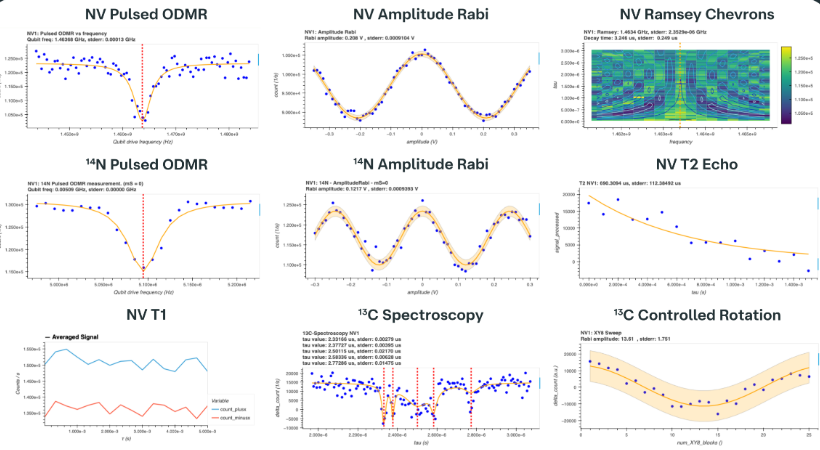
Qruise expanded its work on NV center quantum systems through a collaboration with Goethe University Frankfurt. The partnership focuses on improving bring-up, calibration, and control of NV center-based quantum devices. The effort aims to streamline quantum system initialization and accelerate development workflows for quantum hardware. PRESS RELEASE — Saarbrücken and Frankfurt, Germany | Monday March 23rd, 2026 – Following its ambition to become completely hardware agnostic, Qruise is working with XeedQ and the Modular Supercomputing and Quantum Computing (MSQC) group at Goethe University Frankfurt to enable reliable operation of nitrogen-vacancy (NV) centre quantum systems. As part of this, Qruise has demonstrated automated bring-up, simulation, and optimal control of a 5-qubit XeedQ QPU. This significantly reduces the effort required to bring the system into operation. NV centres in diamond offer several advantages over other qubit platforms, such as long coherence times, room-temperature operation, and direct optical control and readout. XeedQ has harnessed these properties to build XQ1, a 5-qubit portable QPU that enables hands-on use without cryogenic systems or complex microwave wiring. This directly supports their mission to provide accessible quantum computers for research and education. Qruise has integrated its automated bring-up software, QruiseOS, with ‘Baby Diamond’, the XQ1 at MSQC, which is driven by a Quantum Machines OPX. The integration provides an extensive library of bring-up experiments, from basic ODMR (optically detected magnetic resonance) and Rabi experiments to gate calibration and tomography routines. This yielded single-qubit gate fidelities reaching beyond 99.8%. Users can submit arbitrary circuit jobs via JupyterLab, and the QruiseOS Dashboard actively manages workflow execution and provides access to all current and past experimental results. In the coming months, MSQC and Qruise will continue to collaborate to obtain similarly high fidelities for entangling gates, using both direct and indirect driving. The QruiseOS Experiment Database allows users to easily navigate data from all experiments, grouped by experiment type and ordered chronologically, with built-in plot visualisation. Building on the bring-up results yielded by QruiseOS, Qruise utilised its simulation software, QruiseML, to build a differentiable digital twin of the entire system. This digital twin models all aspects of Baby Diamond and its control stack, from high-level system behaviour down to individual qubits, their couplings, and relevant imperfections. This was used to optimise control pulses for single-qubit gates that are robust to variations in the Rabi frequency. The pulses were validated on the hardware and the simulated results show a good fit with the experimental data. “This QPU stack is really fantastic in that system parameters are very close to specification values and these parameters demonstrate true long term stability, making it possible to create very accurate digital twins”, noted Anurag, chief product officer at Qruise. “We plan to expand the digital twin simulations to also aid the bring-up of entangling gates in the coming months.” QruiseML uses experimental data to build a digital twin of the entire system, including quantum hardware and control electronics. It optimises the control pulse amplitude (top left) and phase (bottom left) to make the X gate more robust to fluctuations in pulse frequency (detuning, δ/Ω) and amplitude (β). This is reflected in the colourmaps on the right, where it can be seen that the simulation closely matches the experiment and there is less variation in the final population (and in turn the fidelity) for the optimised pulses.
Dr Manpreet Singh Jattana, deputy group leader at MSQC added, “Developers of quantum algorithms benefit greatly from access to quantum hardware to test novel ideas. It is crucial that the quantum hardware performs noise-free quantum gate operations. An important step in this direction is the optimal control of the pulses that perform these gate operations.” Qruise and MSQC look forward to continuing to collaborate closely to advance the reliability and performance of NV centre quantum systems.
Mohib Ur Rehman LinkedIn Mohib has been tech-savvy since his teens, always tearing things apart to see how they worked. His curiosity for cybersecurity and privacy evolved from tinkering with code and hardware to writing about the hidden layers of digital life. Now, he brings that same analytical curiosity to quantum technologies, exploring how they will shape the next frontier of computing. Share this article: