
Physicists Solve Major Challenge in Quantum Synchronization
Summarize this article with:


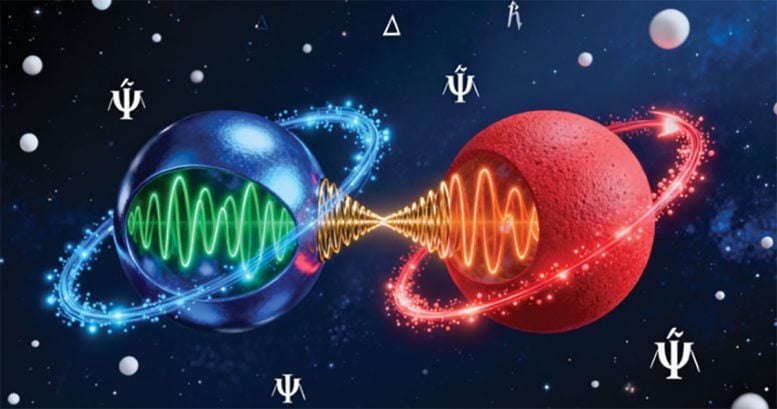
Physics Physicists Solve Major Challenge in Quantum SynchronizationBy RIKENMay 11, 20263 Mins Read Facebook Twitter Pinterest Telegram LinkedIn WhatsApp Email Reddit Share Facebook Twitter LinkedIn Pinterest Telegram Email Reddit An artistic representation of nonreciprocal quantum synchronization. RIKEN researchers have proposed a novel approach for the nonreciprocal quantum synchronization of phonons that is resilient against imperfections and noise. Credit: 2026 RIKEN Center for Quantum ComputingA theoretical study shows how nonreciprocal quantum synchronization could be achieved in real-world systems.Three theoretical physicists at RIKEN have proposed a new way to achieve one-way quantum synchronization in phonons. The method is designed to remain stable even when real-world obstacles, including fabrication flaws and environmental noise, would normally disrupt delicate quantum effects.Many technologies rely on components that work like one-way routes, letting particles or signals move easily in one direction while strongly limiting movement in the opposite direction. These nonreciprocal components are already important in microwave and optical systems, where they help guide signals and reduce unwanted reflections.“Nonreciprocal components enable signals to travel along desired paths, whereas they are strongly attenuated in the opposite direction,” notes Franco Nori of the RIKEN Center for Quantum Computing (RQC). “This ability finds applications ranging from signal processing to invisible cloaking.”One-way behavior reaches quantum systemsA major goal for physicists is to create nonreciprocal quantum synchronization in the laboratory. In this effect, two quantum systems synchronize in one direction, but the same synchronized behavior does not occur in reverse.Turning that idea into a practical system has been difficult. Earlier proposed approaches faced several limitations that would make them hard to use under real experimental conditions.“Practical quantum technologies face critical challenges from random fabrication imperfections and environmental noise,” notes Adam Miranowicz, also of RQC. “These factors profoundly suppress—or even completely destroy—quantum resources in conventional approaches.”Franco Nori (first row, second from the right), Adam Miranowicz (first row, first on the left), Deng-Gao Lai (second row, first on the left), and their team, as well as many visiting researchers, at the RIKEN Center for Quantum Computing. Credit: 2026 RIKENA sturdier route to synchronizationIn a theoretical study, Nori, Miranowicz, and Deng-Gao Lai have now proposed a way to produce nonreciprocal quantum synchronization in phonons, the sound-related particles that carry vibrations. Their approach is designed to avoid the practical weaknesses that affected earlier schemes.“This development establishes a new foundation for generating fragile-to-robust nonreciprocal quantum resources with future practical applicability,” says Nori.The proposed method combines two separate quantum effects that work together. It causes phonons to synchronize when light or a magnetic field is applied from one direction, but prevents the same synchronization when the input comes from the opposite direction.The strength of the effect surprised the three physicists. “We were thrilled to discover that quantum synchronization persists even in the presence of substantial imperfections and noise,” says Lai. “Previously, this was thought to be impossible without employing complex protection schemes.”Toward sturdier quantum devicesNori, Miranowicz, and Lai say the work could help create more practical quantum technologies and plan to continue developing the idea.“By enabling robust nonreciprocal quantum synchronization, our research paves the way for realizing more reliable quantum processors and protected quantum resources,” comments Lai. “We’re now planning to explore applications in quantum networking and error-resilient quantum information processing.”Reference: “Nonreciprocal quantum synchronization” by Deng-Gao Lai, Adam Miranowicz, and Franco Nori, 26 September 2025, Nature Communications. DOI: 10.1038/s41467-025-63408-zNever miss a breakthrough: Join the SciTechDaily newsletter.Follow us on Google and Google News.Materials Science Nanotechnology Quantum Computing Quantum Physics RIKEN Share.
Facebook Twitter Pinterest LinkedIn Email Reddit Related Articles Amazing Twist: “Magic” Angle Graphene and the Creation of Unexpected Topological Quantum States Mysterious New State of Matter – Quantum Spin Liquids – Could Enable Next-Generation Quantum Computing After Decades of Trying, Physicists Observe Kondo Cloud Quantum Phenomenon for the First Time Key Insight Enables Measuring Electron Spin Qubit Without Demolishing It New Research Provides Clearest Evidence Yet of Majorana Particle Scientists Reveal Blueprint for How to Construct a Large Scale Quantum Computer Scientists Develop a Light-Driven Three-Dimensional Plasmonic Nanosystem Quantum Process Significantly Boosts the Energy That Can Be Harnessed from Sunlight Researchers Demonstrate the Scalability of Quantum Dot Architectures