
OTI Lumionics Establishes New Computational Chemistry Benchmark Using Nvidia Blackwell GPU
Summarize this article with:


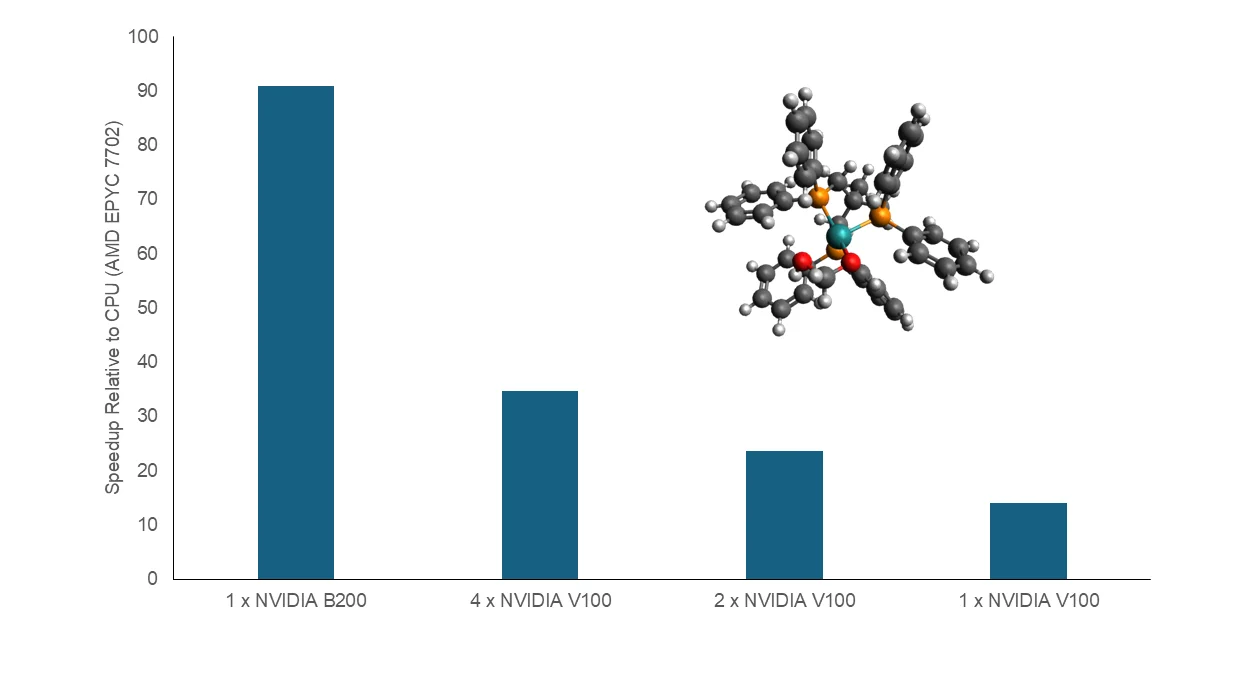
Insider Brief OTI Lumionics has run its Iterative Qubit Coupled Cluster algorithm on NVIDIA accelerated computing to simulate a 112-qubit greenhouse gas emission capturing catalyst, completing ground state energy calculations in just over one hour on a single NVIDIA Blackwell GPU. The company achieved a 90x performance increase by migrating from CPU-intensive environments to GPU computing, reducing calculation steps from several days to approximately one hour and surpassing Density Matrix Renormalization Group methods. OTI Lumionics states that a theoretical quantum computer would require 28 to 200 hours for a single ground state calculation of the same system, positioning the quantum-inspired approach as a benchmark for what 100 to 120-qubit quantum computers must achieve. PRESS RELEASE — OTI Lumionics, a leader in advanced quantum simulations and solutions for next-generation materials discovery, announces a significant breakthrough in computational chemistry. The company has successfully run its Iterative Qubit Coupled Cluster (iQCC) algorithm using NVIDIA accelerated computing, achieving a new benchmark for what’s possible with material design simulations. This innovation enables the simulation of complex molecular systems with higher efficiency, speed and accuracy than ever before. Today, high-precision simulations of complex molecular systems often require extensive use of supercomputing clusters to achieve desired results. “By successfully translating the iQCC code to NVIDIA accelerated computing platform, we have increased its universality to simulate complex systems that were previously inaccurately modeled by lower-level tools,” said Mehdi Jenab, Senior Research Scientist at OTI Lumiomics. “We computed a single ground state energy variationally of a greenhouse gas emission capturing catalyst that needs 112 qubits, surpassing DMRG in just over an hour on a single NVIDIA Blackwell gaming processing unit (GPU), a result that dramatically expands the application of iQCC. When you consider that a theoretical quantum computer would likely require 28 to 200 hours for a single ground state calculation, this realization proves our quantum-inspired approach is the most viable path for complex chemistry, making geometry optimization feasible.” OTI Lumionics achieved a 90x performance increase by migrating these workloads from traditional central processing unit (CPU)-intensive environments to a single GPU. This innovation reduced individual calculation steps from several days to just ~one hour on a single NVIDIA Blackwell GPU. “This work sets a defined benchmark for what a quantum computer at the 100 to 120-qubit scale must achieve to outperform a quantum-inspired algorithm,” said Scott Genin, VP of Materials Discovery at OTI Lumionics. “Achieving low computational times for high-end variational quantum algorithms on the Blackwell GPUs means we are making accurate material structure simulation a practical reality today. This opens up multiple different options from accurate structure determination of complex catalysts to generating high-accuracy data sets for AI in materials discovery.” With these advances, industries reliant on materials discovery, like consumer electronics, automotive and next-generation OLED display manufacturers, can accelerate while eliminating the bottlenecks of traditional supercomputing. By proving that quantum-inspired approaches deliver exceptional performance, OTI Lumionics is enabling faster, more accurate material design through algorithmic efficiency. For more information on this research, the technical paper is available on arXiv. To learn more about OTI Lumionics’s advanced materials and simulation work, please visit www.otilumionics.com.
Mohib Ur Rehman LinkedIn Mohib has been tech-savvy since his teens, always tearing things apart to see how they worked. His curiosity for cybersecurity and privacy evolved from tinkering with code and hardware to writing about the hidden layers of digital life. Now, he brings that same analytical curiosity to quantum technologies, exploring how they will shape the next frontier of computing. Share this article: