
Molecular Qubit Achieves Single-Photon Quantum Control
Understand this faster with AI


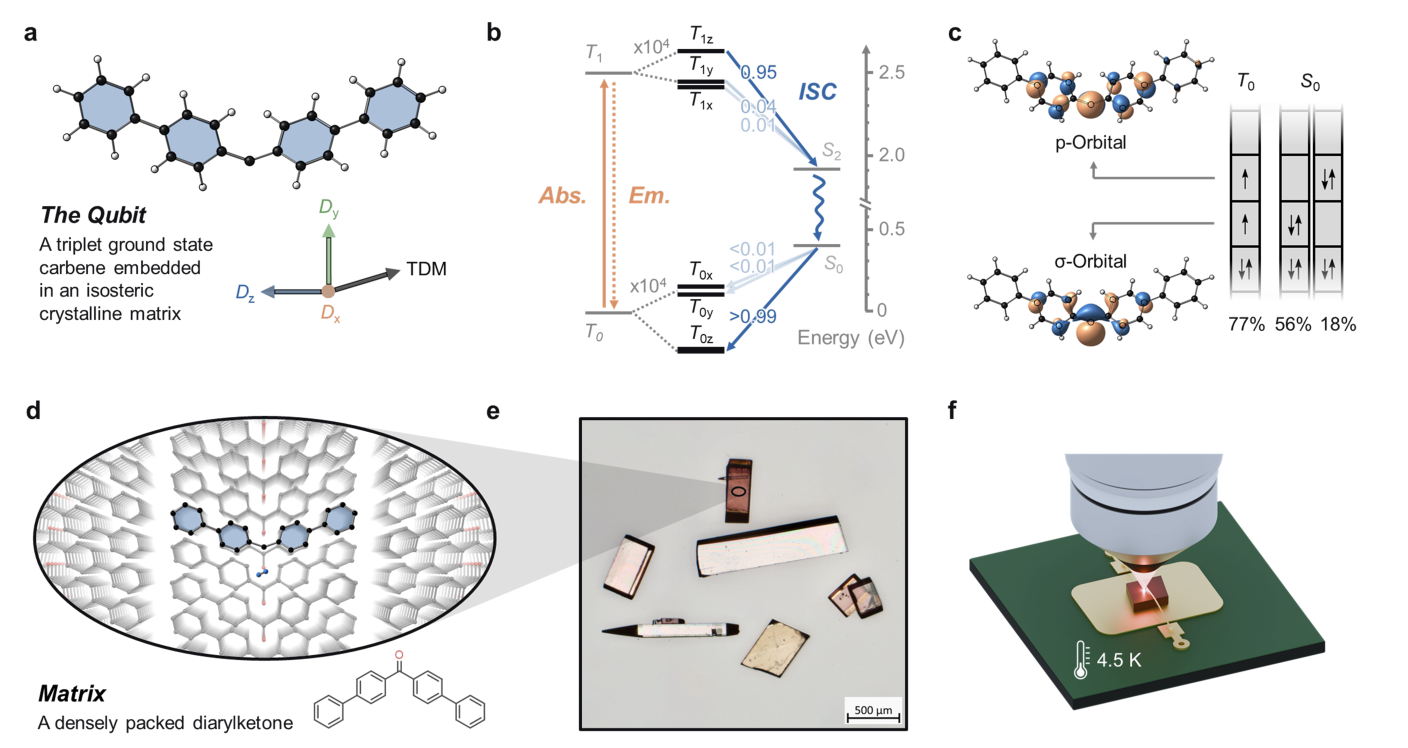
Insider BriefA team of researchers report a single organic molecule can now store, manipulate and read out quantum information one molecule at a time using light. They add that their work hints at a possible new quantum modality built from chemically engineered molecules rather than fabricated semiconductor defects.The study, published recently on arXiv by a team that included scientists from NVision Imaging Technologies and Ulm University, demonstrated coherent quantum control and optical readout of an individual organic molecule. The work marks one of the clearest signs yet that molecular quantum systems could evolve into a distinct branch of quantum hardware alongside superconducting, trapped-ion, neutral-atom and defect-based platforms.The findings arrive as NVision appears to be expanding beyond quantum sensing into quantum computing and healthcare-focused applications. The company recently raised $55 million in Series B funding and said it plans to combine quantum computing (PIQC) for drug design with its POLARIS quantum-enhanced MRI platform for therapy validation. NVision is also developing a photonic quantum computing platform based on organic molecular qubits integrated onto photonic chips.This study, itself, does not claim the creation of an entirely new quantum computing architecture. But the researchers argue that molecular systems may offer a rare combination of properties, including the tunability of synthetic chemistry, the optical networking advantages of photonic systems and the long-lived spin behavior associated with solid-state quantum defects. That combination has been difficult to achieve simultaneously.Optical spin-photon interfaces are considered a foundational requirement for quantum networking and distributed quantum computing because they allow quantum information to move between stationary qubits and traveling photons. Until now, the field has largely been dominated by inorganic defects such as nitrogen-vacancy centers in diamond.According to the study, molecular systems have historically struggled to combine “bright fluorescence, high spectral stability, and the persistent spin lifetimes inherent to ground-state systems.”The researchers attempted to solve that problem using a specially engineered carbene molecule embedded inside a carefully matched crystalline host matrix. The molecule contains two unpaired electrons, forming what is known as a triplet ground state. By embedding the molecule inside a rigid crystal structure, the team minimized vibrations and environmental disturbances that normally destabilize molecular quantum states.Think of this as a custom-made molecular apartment for the qubit, designed to keep the surrounding environment quiet enough for fragile quantum states to survive.The result is a system capable of stable optical emission and coherent quantum control at the level of a single molecule.Using cryogenic confocal microscopy, which allows scientists to cool materials close to absolute zero and use tightly focused lasers to observe single molecules individually, the researchers demonstrated single-photon emission, optically detected magnetic resonance and coherent spin manipulation on individual molecules.The paper reported optical line widths as narrow as 38 megahertz for single molecules and showed spectral stability lasting more than an hour with fluctuations of only a few megahertz. The key is these numbers reflect the promise of the system because quantum networking systems require highly stable photons that can reliably interfere with one another.The researchers also showed they could use microwave pulses to control and stabilize the molecule’s quantum state.The molecular qubit was able to maintain its quantum information for milliseconds at ultra-cold temperatures. That’s a significant improvement over earlier molecular quantum systems and long enough to perform more complex quantum operations.According to the study, those coherence times exceed previous molecular qubit results by more than an order of magnitude.The work also closes part of the gap between molecular systems and established inorganic defect platforms.“While the nitrogen-vacancy center remains an exceptional benchmark for solid-state spin lifetimes, our molecular platform already rivals the phonon-limited coherence of inversion-symmetric defects,” the researchers wrote.While not explicit in the study, the work offers some broader implications, including the platform’s construction.Most leading quantum computing architectures rely on top-down fabrication methods borrowed from semiconductor manufacturing. Molecular systems instead use bottom-up synthesis, allowing researchers to design qubits atom by atom through chemistry.That opens the possibility of engineering quantum systems with tunable optical transitions, customized spin properties and intentionally placed nuclear spins.The researchers say future versions of the platform could use carefully chosen atomic isotopes placed at specific positions inside the molecule, effectively creating tiny built-in quantum memory registers engineered through chemistry.They add that molecular systems may provide cleaner magnetic environments than defect-heavy solid-state materials such as diamond or silicon carbide.Unlike many inorganic systems, the molecular host crystal contains relatively few extraneous electron defects that can interfere with coherence.The platform could also integrate naturally with photonic hardware.Because the molecular systems can be processed into thin films, they may be compatible with photonic integrated circuits based on materials such as silicon nitride and lithium niobate. The researchers specifically identified on-chip photon routing and quantum repeater nodes as potential applications.That direction seelms to align closely with NVision’s broader commercial strategy.The company initially emerged in quantum sensing and imaging, particularly in ultra-low-field MRI technologies. Its POLARIS platform uses quantum-enhanced sensing methods to improve molecular imaging and therapy monitoring.The company is now attempting to connect that sensing expertise with quantum computing workflows aimed at pharmaceutical and biomedical applications.Under that strategy, quantum computing systems could potentially accelerate molecular simulation and drug candidate design, while the POLARIS imaging platform could validate therapeutic responses in biological systems.The study suggests molecular quantum hardware could eventually play a role in that stack.Still, as with most scientific advances in quantum, technical hurdles remain before molecular spin-photon systems become commercially viable quantum computers.The experiments required cryogenic temperatures and highly controlled optical setups. The researchers demonstrated control over isolated molecules, but not entanglement between multiple molecular qubits or scalable quantum processing architectures.Photon collection efficiency, nanophotonic integration and reproducible manufacturing also remain unresolved engineering challenges.The researchers, in fact, report that the work remains an early-stage platform demonstration rather than a complete computing system.However, if molecular spin-photon interfaces continue improving, they could eventually emerge not merely as another qubit variant, but as a chemically programmable quantum modality optimized for photonic networking, sensing and distributed quantum computing.“Ultimately, this work introduces a structurally precise and chemically tunable interface that promisesa scalable framework for the next generation of quantum technologies,” the team writes.The research team included researchers from NVision Imaging Technologies in Ulm, Germany, including Simon Roggors, Thomas Unden, Anna Aubele, Paul Mentzel, Gregor Bayer, Alon Salhov, Jochen Scharpf, Tim R. Eichhorn, Tobias A. Schaub, Matthias Pfender, Philipp Neumann and Ilai Schwartz. The work also included contributions from Ulm University’s Institute for Quantum Optics, including Roggors, Fedor Jelezko and Schaub, as well as Martin B. Plenio from Ulm University’s Institute of Theoretical Physics and the Center for Integrated Quantum Science and Technology. Additional collaborators included Alon Salhov and Alex Retzker from the Racah Institute of Physics at the Hebrew University of Jerusalem in Israel.For a deeper, more technical dive, please review the paper on arXiv. It’s important to note that arXiv is a pre-print server, which allows researchers to receive quick feedback on their work. However, it is not — nor is this article, itself — official peer-review publications. Peer-review is an important step in the scientific process to verify results.Share this article:Keep track of everything going on in the Quantum Technology Market.In one place.
Tags
Source Information
Discussion
0 professional contributions
Sign in to join this professional discussion.
Be the first to add a constructive contribution.