
Meta-design: language models generate novel quantum experiments
Understand this faster with AI


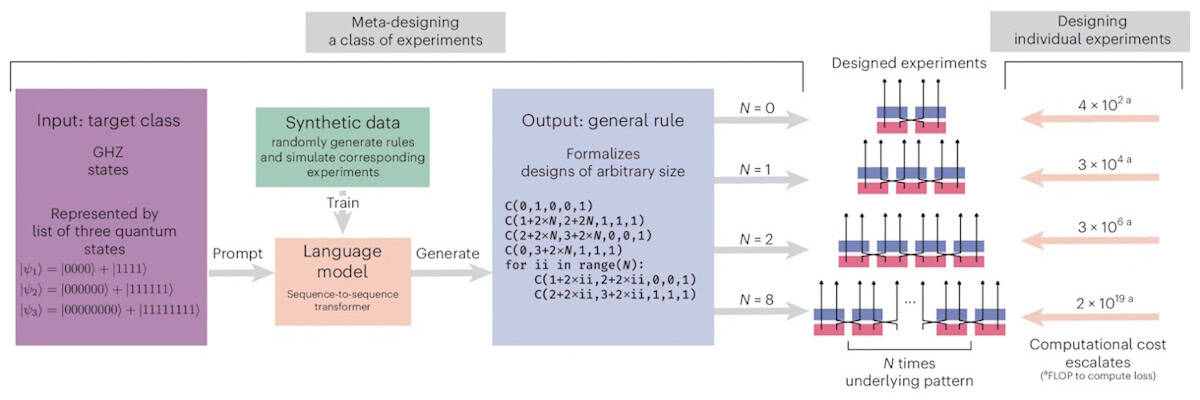
Designing quantum experiments Left: the AI takes the first three from a class of target quantum states and produces a Python program that generates the correct experimental setup for arbitrary system sizes. Right: manually designing an experiment is fast for small particle numbers, but the computational cost grows rapidly with system size. (Courtesy: CC BY 4.0/Nat Mach Intell 10.1038/s42256-025-01153-0) Earlier this year a group of researchers led by Sören Arlt of the University of Tübingen set out to stretch the limits of how far artificial intelligence (AI) can contribute to scientific discovery. In work published in Nature Machine Intelligence, they developed a language model capable of generating classes of blueprints for quantum optics setups that produce specific families of quantum states. Their model was able to design several experimental configurations that successfully generated desired, and in some cases previously unknown, constructions within the limits of its training. Beyond this immediate technical achievement, the implications of this approach are striking. In principle, a researcher could ask a system like this to propose experimental setups for a desired quantum state without spending months or years exploring possible configurations. Such capabilities could accelerate research in areas like quantum computing and quantum communication, where specially engineered quantum states serve as key resources. Although the system still has clear limitations – it cannot always guarantee that the produced state perfectly matches the target and it sometimes fails to find a solution – this study demonstrates that machine learning can already contribute meaningfully to scientific discovery, even in the design of physical experiments. Earlier attempts had already hinted that AI could assist in designing quantum experiments. In 2016, researchers from Mario Krenn‘s group (in which Arlt is a doctoral student) demonstrated that automated search methods could propose previously unknown quantum optics experiments capable of generating complex entangled states. Since then the field has grown rapidly, with tools such as PyTheus producing candidate experimental designs and revealing physical mechanisms that researchers had not previously recognised. This time, instead of searching directly for a single experimental setup, the researchers trained a transformer-based language model on a dataset linking target quantum states to experimental blueprints. Given a desired state, the model generates Python code describing how to build a corresponding experiment. Based on the same transformer architecture used in modern language models, the system translates a quantum state into a program that constructs it experimentally. This output can be interpreted directly by researchers, allowing them to run the proposed construction and understand the design rules that the model discovered. Evaluating the codes The fidelities of the best code produced for 14 of the 20 target classes. (Courtesy: CC BY 4.0/Nat Mach Intell 10.1038/s42256-025-01153-0) Using this approach, the researchers constructed 20 classes of quantum states of interest, among them well-known entangled states, such as GHZ, W and Bell states, some of which had no known experimental construction rules. Out of these, the system generated valid construction rules for six classes: four corresponded to already known solutions, while two corresponded to genuinely new construction rules for generating particular classes of entangled quantum states. Rather than discovering entirely new states, the system identified previously unknown ways of assembling optical components that produce states with the required entanglement structure.
The team verified these constructions computationally by simulating the resulting quantum states and comparing their fidelity with the target states. Although the experiments have not yet been carried out in the laboratory, the proposed setups provide experimentally testable blueprints. The practical implications of tools like this are already prompting debate. Some see them as accelerating scientific discovery by exploring vast experimental possibilities, while others raise concerns that increasing automation could sideline experimental intuition. The key advance over previous approaches lies in generalization: rather than producing a single design, the model generates a program capable of constructing experiments for an entire class of states. “Instead of designing a single experiment for one target, this approach generates a general program that produces valid experiments for a whole class of targets,” Arlt explains. The researchers chose to explore states that are physically relevant across different areas of quantum physics, allowing them to probe entanglement patterns relevant to quantum simulation, communication and computation. In this sense, the system expands the experimental toolbox available to physicists. In some cases, the system uncovered patterns that the researchers had not previously identified. “We discovered two construction rules that we did not know of before,” Arlt notes. In another case, it generated a different construction rule for a class of states that had already been solved, following a completely different experimental strategy. Rather than replacing physicists, the authors see AI changing how experiments are conceived. Instead of manually assembling setups, researchers may define the space of possible configurations and allow algorithms to explore it. As Arlt describes it: “instead of thinking about how do I put these components together so my experiment works, we think about what should the space of possible configurations look like so my computer can explore it efficiently”. Artificial intelligence predicts future directions in quantum science Read more Despite the use of machine learning, the system is relatively modest in scale, with roughly 100 million parameters. While this keeps the computational cost manageable, it also constrains the range of experimental sizes and resources that the model can handle. The model also does not verify the correctness of its own outputs, requiring explicit fidelity checks of the generated states. Looking ahead, the team hopes to extend this approach to other domains of physics and combine it with additional discovery methods. All in all, tools like this suggest a future in which computers assist not only with simulations, but also with proposing new experiments and uncovering patterns in physical systems. Rather than replacing physicists, such systems may increasingly act as collaborators, helping researchers explore experimental designs that would otherwise remain inaccessible. Want to read more? Registration is free, quick and easy Note: The verification e-mail to complete your account registration should arrive immediately. However, in some cases it takes longer. Don't forget to check your spam folder. If you haven't received the e-mail in 24 hours, please contact customerservices@ioppublishing.org. E-mail Address Register
Tags
Source Information
Discussion
0 professional contributions
Sign in to join this professional discussion.
Be the first to add a constructive contribution.