
Light-Matter Particles Could Revolutionize AI Computing
Understand this faster with AI


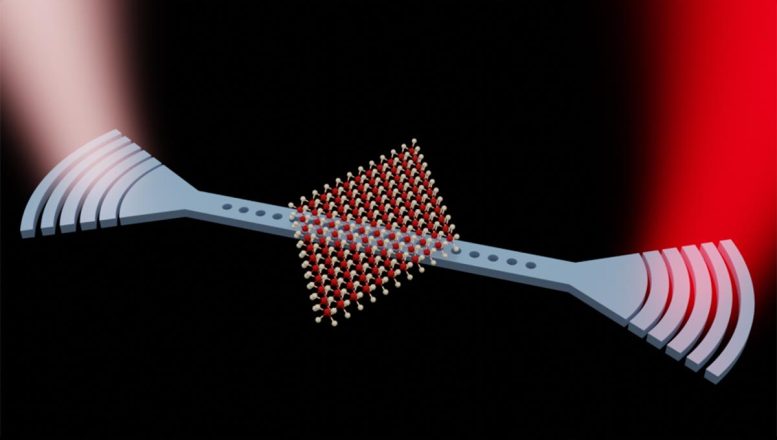
Technology Light-Matter Particles Could Revolutionize AI ComputingBy University of PennsylvaniaMay 20, 20264 Mins Read Facebook Twitter Pinterest Telegram LinkedIn WhatsApp Email Reddit Share Facebook Twitter LinkedIn Pinterest Telegram Email Reddit In this illustration, light is coupled into a nanoscale cavity and interacts with an atomically thin material, creating exciton-polaritons. These hybrid particles combine light’s speed with matter’s ability to interact, enabling optical signal switching. Credit: Zhi WangPenn scientists may have found a way to power future AI with exotic light-matter particles instead of electrons.Eighty years after the debut of ENIAC, the world’s first general-purpose electronic computer, researchers at the University of Pennsylvania are exploring a radically different future for computing. Instead of depending entirely on electrons, scientists are now looking to light itself to help power the next generation of artificial intelligence systems.ENIAC, developed by Penn researchers J. Presper Eckert and John Mauchly, launched the era of electronic computing by using electrons to perform complex calculations. Modern computers still rely on the same basic approach today. But as AI systems become larger and more demanding, traditional electronics are beginning to run into serious physical and energy limitations.Why AI Is Pushing Electronics to Their LimitsElectrons carry electrical charge, which creates problems as computer chips become more advanced. Moving electrons through materials generates heat and resistance, wasting energy and making systems harder to cool. Those challenges are growing as AI hardware must process and transfer enormous amounts of data.To address these issues, Penn physicists led by Bo Zhen in the School of Arts & Sciences are investigating whether photons, the particles that make up light, can take over some of the work now handled by electrons.“Because they are charge-neutral and have zero rest mass, photons can carry information quickly over long distances with minimal loss, dominating communications technology,” explains Li He, co-first author of a paper published in Physical Review Letters and a former postdoctoral researcher in the Zhen Lab. “But that neutrality means they barely interact with their environment, making them bad at the sort of signal-switching logic that computers depend on.”Light can move information extremely efficiently, but it normally lacks the strong interactions needed for computing operations such as switching and decision-making.Light-Matter Particles Enable All-Light ComputingTo solve that problem, Zhen’s team created special quasiparticles called exciton-polaritons. These unusual particles are formed by coupling photons with electrons inside an atomically thin semiconductor. The result is a hybrid light-matter particle that combines the speed of light with the stronger interactions typically associated with matter.This breakthrough could be particularly important for AI computing.Many photonic AI chips already use light to perform certain calculations rapidly and efficiently. However, when those systems need to carry out nonlinear activation steps, including decision-related operations, they often must convert optical signals back into electronic ones. Those repeated conversions reduce speed and increase power consumption, limiting the advantages of photonic computing.Using exciton-polaritons, the Penn team demonstrated all-light switching while consuming only about 4 quadrillionths of a joule of energy. That is an extraordinarily tiny amount of energy, far less than what is needed to briefly power a small LED light.Future AI Chips Could Run on LightIf the technology can be scaled successfully, it could allow future photonic chips to process light directly from cameras without constantly converting signals back and forth between light and electricity. Researchers say the approach could significantly reduce the energy demands of large AI systems and may eventually support basic quantum computing functions on chips.Reference: “Strongly Nonlinear Nanocavity Exciton Polaritons in Gate-Tunable Monolayer Semiconductors” by Zhi Wang, Bumho Kim, Bo Zhen and Li He, 8 April 2026, Physical Review Letters. DOI: 10.1103/gc15-qsvfBo Zhen is the Jin K.
Lee Presidential Associate Professor in the Department of Physics and Astronomy in the School of Arts & Sciences at the University of Pennsylvania.Li He was a postdoctoral researcher in the Zhen Lab in Penn Arts & Sciences. He is currently an assistant professor at Montana State University.Additional authors on the study include Zhi Wang and Bumho Kim from the University of Pennsylvania’s School of Arts & Sciences.The research was supported by the US Office of Naval Research (N00014-20-1-2325 and N00014-21-1-2703) and the Sloan Foundation.Never miss a breakthrough: Join the SciTechDaily newsletter.Follow us on Google and Google News.Artificial Intelligence Computer Electrical Engineering Photonics Quantum Computing University of Pennsylvania Share.
Facebook Twitter Pinterest LinkedIn Email Reddit Related Articles Light-Speed AI: MIT’s Ultrafast Photonic Processor Delivers Extreme Efficiency At the Speed of Light: Unveiling the Chip That’s Reimagining AI Processing Light Speed Ahead: 3D Photonic-Electronic Hardware Revolutionizes AI Next-Gen Superconducting Diode: Enhancing AI Performance and Quantum Computing Scalability Shifting Colors for On-Chip Photonics To Power Next Generation Quantum Computers and Networks Photonic Chip Breakthrough Opens a Path Toward Quantum Computing in Real-World Conditions AI Boosted by Parallel Convolutional Light-Based Processors Generating Photons for Communication Between Processors in a Quantum Computing System Scaling Up the Quantum Chip: MIT Engineers Connect Photonics With “Artificial Atoms”
Tags
Source Information
Discussion
0 professional contributions
Sign in to join this professional discussion.
Be the first to add a constructive contribution.