
A landmark first: Solving Differential Equations with Logical Neutral-Atom Qubits
Understand this faster with AI


Home – FTQC – A landmark first: Solving Differential Equations with Logical Neutral-Atom Qubits A landmark first: Solving Differential Equations with Logical Neutral-Atom Qubits FTQC Hardware +End-to-end application with logical qubits+From Building Blocks to Full Applications+Why This Application?+The Results: Logical Qubits Outperform Physical Ones+What’s Next+Stay Tuned Apr 10, 2026 +End-to-end application with logical qubits+From Building Blocks to Full Applications+Why This Application?+The Results: Logical Qubits Outperform Physical Ones+What’s Next+Stay Tuned Authors: Pascal Scholl, Adrien Signoles, Lucia Garbini End-to-end application with logical qubits For the first time, the Pasqal team solved differential equations using quantum kernels at the logical qubit level. In our latest work, we’ve implemented a complete end-to-end application using logical qubits moving beyond testing sub-routines to delivering an actual computational solution. This proof-of-concept used 2 logical qubits on Pasqal’s neutral atom quantum processor. Previously, this same processor demonstrated analog quantum computing capabilities, including applying machine learning to molecular toxicity prediction, and managing financial risk. Now, for the first time, that same hardware has demonstrated logical computations. validates a critical milestone: logical qubits can tackle real problems beyond theoretical building blocks.
From Building Blocks to Full Applications Fault-tolerant quantum computing (FTQC) relies on logical qubits that protect against noise: even though errors occur on the underlying physical qubits, the computation remains error-tolerant, delivering correct results. If you’re new to FTQC, our post on understanding fault-tolerant quantum computing breaks down how this approach works and why it’s essential for delivering the full value of quantum computing Until now, FTQC research has focused mostly on sub-routines of complete computations such as verifying that quantum information can be stored efficiently in logical qubits or preparing basic entangled states. These core building blocks are essential (as we explored in Part II of our FTQC series). Testing FTQC on a full, end-to-end application is the next critical step.
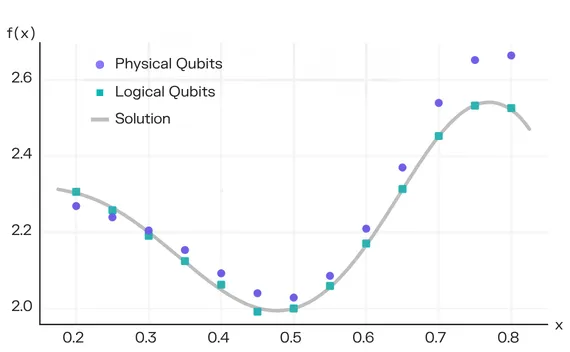
Why This Application? We chose differential equations for two key reasons: First, solving differential equations has potential for real industrial impact. Differential equations model phenomena across industries, from simulating airflow in aerospace and heat transfer in energy systems, to chemical reaction kinetics in pharmaceuticals and risk modelling in finance. These are computationally expensive problems that industries are actively trying to solve today. Quantum computers offer a promising alternative for example using quantum kernels, potentially solving them more efficiently as we scale. Second, the workflow is highly representative of true large-scale computations, such as Shor’s algorithm: the QPU serves as a critical resource within a larger, hybrid quantum-classical algorithm. By implementing this workflow, we could understand the operational constraints of manipulating logical qubits and identify the most important aspects of FTQC in practice. The Results: Logical Qubits Outperform Physical Ones We solved differential equations using both Physical qubits and Logical qubits. Then we compared performance. The outcome? Logical qubits performed better than physical ones. This validates the core promise: logical qubits reduce noise impact and deliver more accurate results. Fig. 1: Experimental results obtained on Pasqal R&D QPU “What surprised us during this project is that our logical qubits turned out to be naturally resistant to certain types of noise that typically make solving differential equations harder. As a result, we obtained better results than we had initially anticipated. This is exactly why running complete applications matters, you discover insights that sub-routine validation alone cannot reveal.” Pascal Scholl, FTQC – Hardware Technology Owner at Pasqal What’s Next This result is a first step on the road toward full-scale FTQC. Looking ahead, we will focus on: Improve hardware capabilities to compute with more logical qubits Develop higher-quality logical qubits Enable logical qubits that can detect and correct all types of errors during circuit execution Expand the class of applications we can tackle in FTQC Using two logical qubits, we demonstrated a critical milestone: logical qubits can detect most errors and outperform physical qubits on a real application. Building on this foundation, full error correction will unlock even more powerful FTQC applications. Thanks to the natural scalability and native implementation of quantum error correction schemes (all-to-all connectivity, parallel operations…) of the neutral atom platform, we expect the next steps in FTQC to be reached soon.
Stay Tuned This proof-of-concept demonstrates that logical qubits are beginning to address real-world problems. We’re moving beyond validating sub-routines to delivering actual computational solutions. The full scientific paper will be published soon on arXiv. Fault tolerant quantum computing is emerging, and it’s already solving differential equations.
Related Posts Nov 12, 2025 Quantum Computing and the New Era of Materials Discovery Oct 8, 2024 Quantum AI Explained: New Guide for Leaders Ready to Innovate Subscribe Close Subscribe for updates Stay informed with insights from Pasqal’s leading quantum experts. Subscribe now. "*" indicates required fields EmailThis field is for validation purposes and should be left unchanged.First Name*Last Name*Business Email* Country*Country *AlbaniaAlgeriaAmerican SamoaAndorraAngolaAnguillaAntarcticaAntigua and BarbudaArgentinaArmeniaArubaAustraliaAustriaAzerbaijanBahamasBahrainBangladeshBarbadosBelarusBelgiumBelizeBeninBermudaBhutanBoliviaBosnia and HerzegovinaBotswanaBrazilBritish Indian Ocean TerritoryBritish Virgin IslandsBruneiBulgariaBurkina FasoBurundiCanadaCambodiaCameroonCape VerdeCayman IslandsCentral African RepublicChadChileChinaChristmas IslandCocos (Keeling) IslandsColombiaComorosCongoCook IslandsCosta RicaCroatiaCubaCuraçaoCyprusCzech RepublicCôte d’IvoireDemocratic Republic of the CongoDenmarkDjiboutiDominicaDominican RepublicEcuadorEgyptEl SalvadorEquatorial GuineaEritreaEstoniaEthiopiaFalkland IslandsFaroe IslandsFijiFinlandFranceFrench GuianaFrench PolynesiaFrench Southern TerritoriesGabonGambiaGeorgiaGermanyGhanaGibraltarGreeceGreenlandGrenadaGuadeloupeGuamGuatemalaGuernseyGuineaGuinea-BissauGuyanaHaitiHondurasHungaryIcelandIndiaIndonesiaIranIraqIrelandIsle of ManIsraelItalyJamaicaJapanJerseyJordanKazakhstanKenyaKiribatiKuwaitKyrgyzstanLaosLatviaLebanonLesothoLiberiaLibyaLiechtensteinLithuaniaLuxembourgMacao S.A.R., ChinaMacedoniaMadagascarMalawiMalaysiaMaldivesMaliMaltaMarshall IslandsMartiniqueMauritaniaMauritiusMayotteMexicoMicronesiaMoldovaMonacoMongoliaMontenegroMontserratMoroccoMozambiqueMyanmarNamibiaNauruNepalNetherlandsNew CaledoniaNew ZealandNicaraguaNigerNigeriaNiueNorfolk IslandKorea, Democratic People's Republic ofNorthern Mariana IslandsNorwayOmanPakistanPalauPalestinian TerritoryPanamaPapua New GuineaParaguayPeruPhilippinesPitcairnPolandPortugalPuerto RicoQatarRomaniaRussiaRwandaRéunionSaint BarthélemySaint HelenaSaint Kitts and NevisSaint LuciaSaint Pierre and MiquelonSaint Vincent and the GrenadinesSamoaSan MarinoSao Tome and PrincipeSaudi ArabiaSenegalSerbiaSeychellesSierra LeoneSingaporeSlovakiaSloveniaSolomon IslandsSomaliaSouth AfricaKorea, Republic ofSouth SudanSpainSri LankaSudanSurinameSvalbard and Jan MayenSwazilandSwedenSwitzerlandSyriaTaiwanTajikistanTanzaniaThailandTimor-LesteTogoTokelauTongaTrinidad and TobagoTunisiaTurkeyTurkmenistanTurks and Caicos IslandsTuvaluU.S. Virgin IslandsUgandaUkraineUnited Arab EmiratesUnited KingdomUnited StatesUnited States Minor Outlying IslandsUruguayUzbekistanVanuatuVaticanVenezuelaViet NamWallis and FutunaWestern SaharaYemenZambiaZimbabweState*State *AlaskaAlabamaArkansasArizonaCaliforniaColoradoConnecticutDistrict of ColumbiaDelawareFloridaGeorgiaGuamHawaiiIowaIdahoIllinoisIndianaKansasKentuckyLouisianaMassachusettsMarylandMaineMichiganMinnesotaMissouriNorthern Mariana IslandsMississippiMontanaNorth CarolinaNorth DakotaNebraskaNew HampshireNew JerseyNew MexicoNevadaNew YorkOhioOklahomaOregonPennsylvaniaPuerto RicoRhode IslandSouth CarolinaSouth DakotaTennesseeTexasUtahVirginiaUS Virgin IslandsVermontWashingtonWisconsinWest VirginiaWyomingIndustry*Industry *AcademicsAerospaceBankingBusiness ServicesDefenseConstructionEnergyFinanceGovernmentsGrantsHealthcareHPC centerIndustrialsManufacturingMaterialsMobilityOil & GasOtherPharmaceuticalPublicRetailTechnologyTelecomTransportationUtilitiesSMS Consent Check Box-1 Yes, I would like to receive emails about Pasqal products, services, and events. I can unsubscribe at any time.SMS Consent Check Box-2* By submitting this form, you confirm your consent to Pasqal processing your personal data in accordance with the privacy policy and to receive this asset by e-mail.*CAPTCHA Submit Δ
Tags
Source Information
Discussion
0 professional contributions
Sign in to join this professional discussion.
Be the first to add a constructive contribution.