
HiLumi LHC: full-scale tests start
Summarize this article with:


Editor’s note: The following press release was posted by CERN on February 23, 2026.
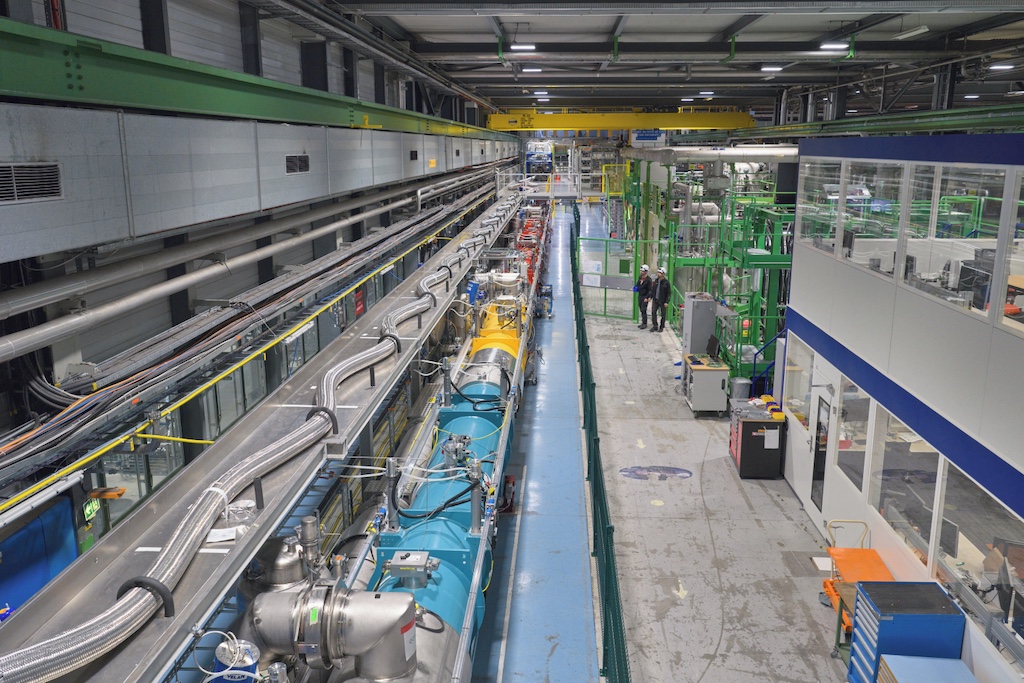
Fermi National Accelerator Laboratory developed and shipped five cryoassemblies containing niobium-tin magnets for use in the High-Luminosity Large Hadron Collider upgrade at CERN. The newly developed and tested magnets will focus the beam at the CMS and ATLAS interaction points, increasing the number of collisions for the experiments tenfold in the HiLumi era. Fermilab will deliver five additional cryoassemblies by mid-2027. The innovative magnet system is an important element in the major upgrade that will transform the Large Hadron Collider into the HiLumi LHC. Fermilab’s leadership and participation in the upgrade demonstrate the lab’s commitment to its ongoing collaboration with CERN and other Department of Energy national laboratories. View of the IT String magnet line. Credit: CERN CERN has reached a crucial milestone in the advancement of the High-Luminosity Large Hadron Collider (HiLumi LHC) project with the start of the cryogenic cooldown to 1.9 K (-271.3 °C) of its 95-metre-long test stand – a full-scale replica of the innovative equipment that will transform the LHC in the coming years. The test stand is designed to validate the novel magnet system (the inner triplet beam-focusing magnets) and its complex infrastructure, which is a key element in a major upgrade of the LHC that is set to enter operation in 2030. This summer will mark the start of a four-year-long intensive work period (Long Shutdown 3 – LS3) to transform the LHC into the HiLumi LHC—a groundbreaking accelerator that will usher in a new era for high-energy physics. The HiLumi LHC will increase by a factor of ten the number of particle collisions (called “luminosity”), vastly increasing the volume of physics data available for researchers. This leap forward will allow physicists to explore the behaviour of the Higgs boson and other elementary particles with unprecedented precision and to uncover rare new phenomena that might reveal themselves. “I don’t think it is possible to overstate the importance and excitement of the High-Luminosity LHC, which is the largest project undertaken by CERN for the past 20 years,” explains Mark Thomson, CERN Director-General. “Coupled with advanced new data tools and upgraded detectors, it will allow us to understand for the first time how the Higgs boson interacts with itself – a key measurement that will shed light on the first instants and possible fate of the Universe. The HiLumi LHC will also explore uncharted territory and could reveal something completely new and unexpected. That’s the whole point of exploring the unknown: you don’t know what’s out there.” Many of the technologies developed for the HiLumi LHC – such as superconducting crab cavities that tilt the particle beams before they collide, crystal collimators designed to remove errant particles, and high-temperature superconducting electrical transfer lines to power the HiLumi magnets as efficiently as possible – have never been used in a proton accelerator before. Among these new key technologies, the inner triplet beam-focusing magnets are made of a superconducting compound based on niobium and tin (Nb3Sn), enabling magnetic fields higher than those achieved with the current LHC niobium–titanium (NbTi) magnets. These new magnets will be deployed on both sides of the ATLAS and CMS experiments, alongside new cryogenic, powering, protection and alignment systems, and will operate at a temperature of 1.9 K (-271.3 °C), just like the LHC magnets. To ensure seamless integration, CERN has built, in an above-ground test hall, a full-scale test stand called the Inner Triplet String (IT String), which mirrors the underground configuration. “All the systems have already been tested individually. The goal of the IT String is to validate their integration and their collective performance under operational conditions,” explains Oliver Brüning, CERN Director for Accelerators and Technology. “The connection and operation of all the equipment in the IT String give us a chance to optimise our procedures before the actual installation in the tunnel, so that we will be prepared and ready for an efficient and smooth installation.” The large LHC experiments ATLAS and CMS will also undergo a major upgrade to enable them to harness the full scientific potential of the HiLumi LHC collisions – work that is being carried out in close coordination with hundreds of institutes worldwide. Additionally, the entire accelerator complex and associated experiments will benefit from improvements, solidifying CERN’s leadership in high-energy physics. The HiLumi LHC project is led by CERN with the support of an international collaboration of almost 50 institutes in more than 20 countries – the vast majority located in Europe. In addition to the funding provided by CERN Member States and Associate Member States, the project received special contributions from Italy, Spain, Sweden, the United Kingdom, Serbia and Pakistan, and from several non-Member States such as the United States, Japan, Canada and China. The cooldown of the HiLumi LHC test string, which is achieved using a sophisticated liquid- helium refrigeration and distribution system, is expected to take several weeks to complete. Recommended reading View all news Fermilab technology debuts in supercollider dress rehearsal at CERN August 14, 2025 HL-LHC Accelerator Upgrade ProjectFermilab feature Several components developed, assembled and tested by the HL-LHC Accelerator Upgrade Project, a consortium of U.S. national laboratories and institutions, including Lawrence Berkeley National Laboratory, Brookhaven National Laboratory and Fermi National Accelerator Laboratory, take center stage as engineers at CERN build and test a section of the High-Luminosity Large Hadron Collider, a major upgrade to the world’s most powerful supercollider. Sowjanya Gollapinni elected co-spokesperson for DUNE collaboration April 2, 2025 collaborationDUNEleadershipPress release Sowjanya Gollapinni has been elected as the new co-spokesperson for the Deep Underground Neutrino Experiment, succeeding Mary Bishai. Gollapinni is a senior scientist and the Neutrino Group Leader at Los Alamos National Laboratory and has been involved with DUNE since 2015. Now, she will co-lead the project to its next stages of development. Fermilab leads project to develop novel quantum sensor March 24, 2025 collaborationquantum sensorqubitsPress release Fermilab is finalizing a partnership with Diraq and several universities for the Quandarum project. The project team intends to combine extreme environment electronics and silicon spin qubits to develop a quantum sensor that could profoundly impact the field of high-energy physics.