
Grapefruit-Sized Quantum Sensor Mapped Earth’s Magnetic Field From Space
Summarize this article with:


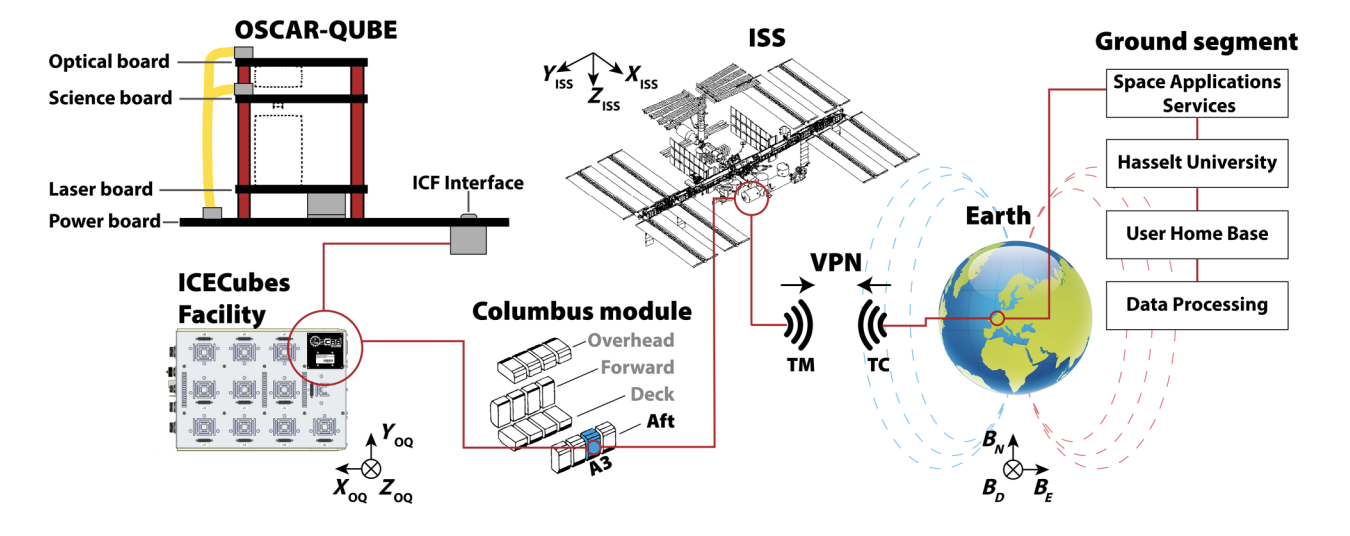
Insider BriefA quantum device — about the size of a grapefruit, or, if you’re not a fan of that particular fruit, about the size of a shoe box — using flawed diamonds successfully measured Earth’s magnetic field from the International Space Station over 10 months, demonstrating that compact quantum sensors can survive and function in the harsh environment of low Earth orbit.The findings, published recently in Physical Review Applied, mark a significant step toward a new generation of space-based instruments that could one day replace the bulky, expensive satellites now used to chart Earth’s geomagnetic field. The research was led by more than a dozen researchers at Hasselt University and the research institute imec in Belgium.At the heart of the device is a piece of diamond no larger than a lentil. It is not a gem-quality stone. It is riddled with a specific type of atomic defect called a nitrogen-vacancy center, in which one carbon atom in the diamond’s rigid crystal lattice is missing and a neighboring carbon atom is replaced by a nitrogen atom. They may not be great for jewelry, but those paired imperfections — vacancy plus nitrogen — act like miniature antennas tuned to magnetic fields.When researchers shine a laser and microwaves at a diamond containing these defects, the impurities absorb energy and re-emit light. The brightness of that emitted light shifts depending on the strength and direction of any magnetic field present. By measuring those shifts precisely, scientists can calculate the magnetic field at the sensor’s location to high accuracy. The technique is called optically detected magnetic resonance.The approach exploits the rules of quantum mechanics rather than the classical electronics used in conventional magnetometers. The researchers report that quantum sensors can achieve greater sensitivity while consuming less power and fitting in a smaller package than their traditional counterparts.The instrument, called OSCAR-QUBE — a quintessential academic acronym that’s short for Optical Sensors Based on CARbon materials, QUantum BElgium — was conceived, designed and built by a team of master’s and doctoral students from Hasselt University as part of the European Space Agency’s Orbit Your Thesis program. That program gives university students the chance to fly their own experiments aboard the ISS.The team had roughly one year to take the project from concept to flight hardware. The finished device fits inside a 1U CubeSat form factor, meaning its outer shell measures 10 centimeters on each side. It weighs 420 grams, about the same as a can of soup, and draws just 5 watts of power, comparable to a dim nightlight.According to the study, the device launched to the ISS aboard a SpaceX cargo resupply mission in August 2021 and was installed inside the station’s ICE Cubes commercial facility, a rack-mounted platform designed to host small scientific experiments. Data collection ran from late 2021 through 2022.Ten Months of Data in Low Earth OrbitThe team reports the device operated consistently throughout the 10-month measurement campaign without significant performance degradation. From its orbit roughly 400 kilometers above Earth at an inclination of 51.6 degrees, the sensor swept over a wide swath of Earth’s surface, recording magnetic field strength at each pass.The researchers then compared their measurements against the World Magnetic Model, an internationally maintained reference map of Earth’s geomagnetic field produced jointly by the U.S. National Oceanic and Atmospheric Administration and the British Geological Survey. According to the study, OSCAR-QUBE’s readings showed good agreement with the reference model, validating that a quantum diamond sensor can produce scientifically useful geomagnetic data from orbit.The sensor achieved a resolution of better than 300 nanotesla per square root of hertz — a standard unit for describing how precisely a magnetic sensor can detect change. Earth’s total magnetic field strength hovers around 25,000 to 65,000 nanotesla depending on location, meaning the instrument was sensitive enough to resolve meaningful spatial variation across the globe.The geomagnetic field is far more than a compass direction. It encodes information about the churning motion of molten iron in Earth’s outer core, the magnetic properties of rocks in the crust, the buffeting effects of solar wind and space weather at the upper atmosphere, and even the subtle pull of ocean tides. Researchers who study the field in detail can probe Earth’s interior structure, forecast geomagnetic storms that can disrupt power grids and satellites, and track the slow drift and occasional reversal of the magnetic poles over geologic time.Space-based measurements are especially valuable because they sample the field globally and continuously, free from the interference of local geology or electrical infrastructure that complicates ground-based observations. Current dedicated geomagnetic satellite missions, such as the European Space Agency’s Swarm constellation, rely on instruments that require larger and more power-hungry platforms.The OSCAR-QUBE result suggests that quantum sensors could shrink the hardware requirements for such missions substantially, potentially enabling constellations of small, inexpensive satellites to provide denser coverage of the geomagnetic field than is practical today. Because the nitrogen-vacancy centers in the diamond are oriented along four different directions within the crystal lattice, the sensor can measure not just the overall strength of the magnetic field but also its direction — a capability known as vector magnetometry that makes the data richer and more useful for modeling Earth’s interior dynamics.The study notes a few limitations and acknowledges that OSCAR-QUBE did not outperform the most advanced conventional magnetometers now flying in space. A central problem was its location inside the space station, which is itself a large source of stray magnetic fields generated by its power systems, motors, and other equipment. That electromagnetic clutter placed a floor on how precisely OSCAR-QUBE could resolve the geomagnetic signal, the researchers write.The device’s sensitivity was also constrained by the compact optical design required to fit within the 1U CubeSat envelope. Laboratory-based diamond quantum magnetometers operating in controlled conditions have demonstrated sensitivities several orders of magnitude better than what OSCAR-QUBE achieved in orbit, according to published benchmarks in the field.The researchers report the mission was primarily as a proof of concept — a demonstration that the technology could survive launch vibrations, radiation exposure, and the thermal cycling of repeated passes between sunlight and Earth’s shadow in low Earth orbit, and still return useful data over an extended period. That the device continued to function reliably for 10 months and its readings tracked the known geomagnetic field is meaningful progress for a first-generation space deployment of the technology, according to the study.A follow-on mission is planned with upgraded quantum hardware. Critically, the next instrument is designed to operate outside the space station rather than inside it, eliminating the station’s own magnetic interference as a noise source. External deployment would also place the sensor in a more stable thermal environment and give it an unobstructed view of Earth’s field.The researchers also report that nitrogen-vacancy diamond sensors offer a wide dynamic range — meaning they can measure both very weak and relatively strong magnetic fields without saturating — which makes them attractive for applications beyond geomagnetic mapping. These include attitude control systems for spacecraft, mineral prospecting from orbit, subsurface exploration on the moon and navigation in GPS-denied environments such as underground passageways or underwater, where magnetic field maps can substitute for satellite positioning.The OSCAR-QUBE project earned its student team the Hans von Muldau Award at the 2021 International Astronautical Congress, a competition among student space projects held that year in Dubai.The research team included Dries Hendrikx, Sam Bammens, Musa Aydogan, Siemen Achten, Jeffrey Gorissen, Sebastiaan Vanspauwen, Siemen Vandervoort, Teoman Köseoglu, Jens Mannaerts, Stijn Jacobs, and Daphne Box of Hasselt University; as well as Yarne Beerden, Boo Carmans, Remy Vandebosch, Milos Nesladek, and Jaroslav Hruby of both Hasselt University and imec.Share this article:Keep track of everything going on in the Quantum Technology Market.In one place.