
Getting the Most from Your Quantum Measurements: Adaptive Shot Allocation on Amazon Braket
Summarize this article with:


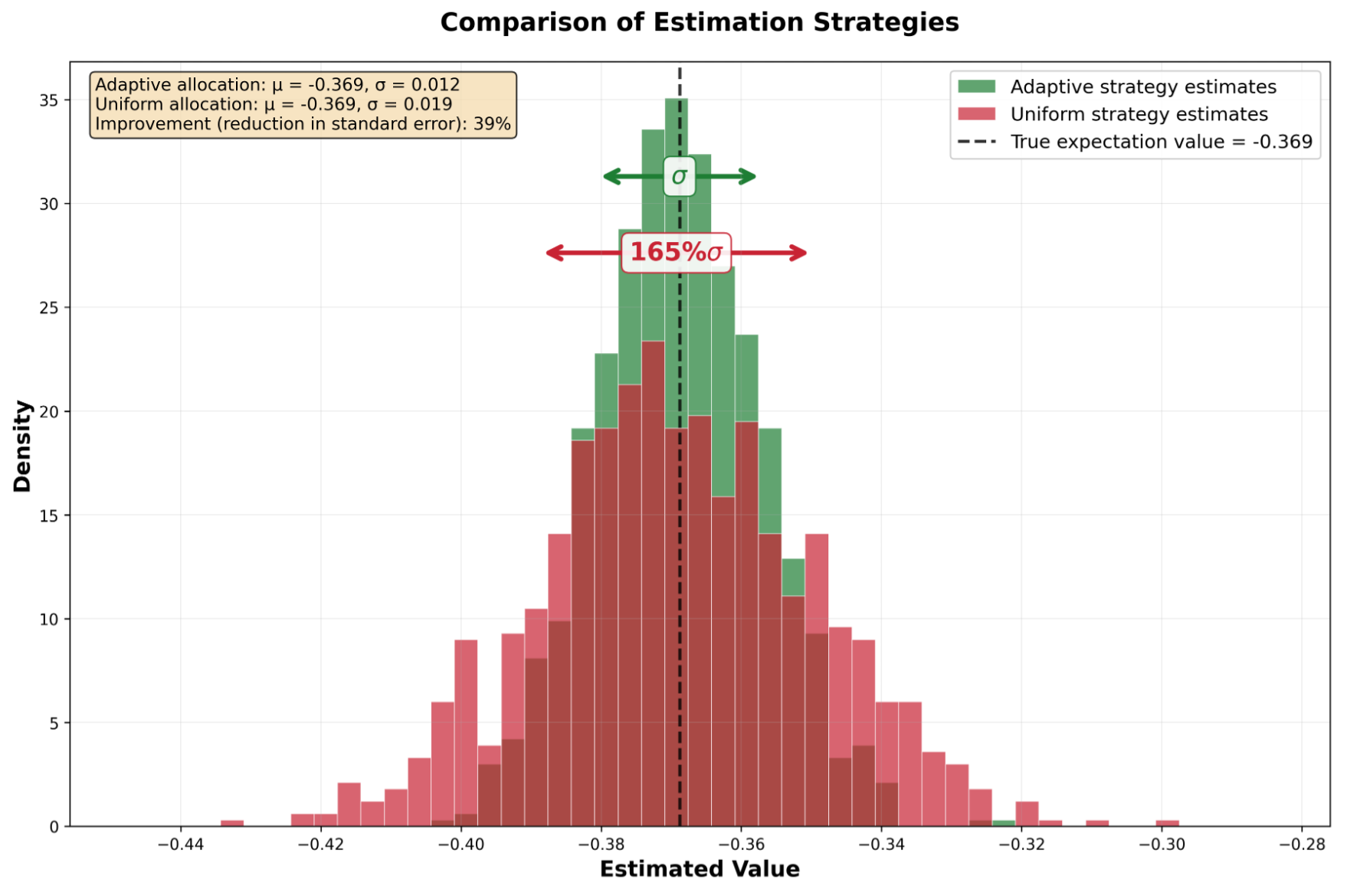
With current noisy quantum hardware, every quantum circuit evaluation is precious. Variational quantum algorithms like the Variational Quantum Eigensolver (VQE) require repeated estimation of expectation values of quantum observables—each requiring multiple shots, or measurements of quantum states. On today’s hardware, these shots represent a finite resource that needs to be managed carefully. Efficient shot allocation therefore improves algorithm performance and reduces quantum runtime.This post explores how shot allocation techniques can reduce errors in quantum expectation value estimation, without increasing the total shot cost. To help users understand and experiment with these advanced strategies, we released an educational implementation of an adaptive shot allocation algorithm in the Amazon Braket Algorithms Library, based on the paper “Adaptive Estimation of Quantum Observables” (Shlosberg et al., 2023).As a starting point, we published two new interactive notebooks in the Braket Algorithms Library:Iterative estimation of expectation values is a common pattern in near-term quantum algorithms. In VQE, for example, the energy of a molecular Hamiltonian is computed as the weighted sum of expectation values of Pauli terms. Each term requires estimation from repeated measurements and with limited quantum runtime available, how we allocate these measurements—or shots—impacts the estimator error.A naive approach assigns the same number of shots to each term. But this ignores key differences in variance and contribution of each term to the result. Terms with larger weights or higher variance contribute more to the overall estimation error and should receive more of the measurement budget.Tailoring shot allocation to the structure of the observable, achieves lower estimation error for the same total number of shots. In a representative example using a 26-term Hamiltonian of a small molecule, the adaptive allocation strategy reduced the estimation error by approximately 40% compared to the uniform allocation strategy, where each term received the same number of shots.Figure 1: Overlapped histograms of estimation values for the uniform and adaptive shot allocation on a representative example.Shot reallocation techniques—especially adaptive ones—reduce the estimation error without increasing cost in terms of total shot count. However, this improvement comes with an important tradeoff: increased classical runtime.In contrast to static allocation strategies that submit a single circuit with the full shot budget, adaptive approaches typically submit multiple rounds of circuits, each using only a fraction of the total budget. This iterative behavior enables the algorithm to update its allocation based on intermediate results—but also increases total runtime due to repeated circuit submissions and classical post-processing.Understanding this tradeoff helps decide when and how to apply adaptive strategies in real-world workflows.To help researchers and developers understand these advanced techniques, we implemented a simplified version of the adaptive algorithm proposed in Shlosberg et al., 2023. The implementation is available in braket.experimental.algorithms.adaptive_shot_allocation.This module is part of the braket.experimental namespace and is designed primarily for educational and exploratory purposes. It demonstrates the key principles behind adaptive shot allocation, including:Though not optimized for production use, this example is fully functional and serves as a starting point for building more advanced or customized versions. It also provides insight into how iterative allocation strategies are implemented on Braket.Find a comprehensive walkthrough in the adaptive shot allocation notebook, which details how to integrate the algorithm with Braket observables and simulators.To explore these concepts, we created two companion notebooks:This tutorial walks through:This notebook includes:As quantum algorithms continue to evolve, optimizing classical resources like shot allocation remains a key strategy for getting the most out of quantum hardware today and in the future. Whether you develop VQE workflows, benchmarking allocation strategies, or are exploring quantum measurement theory, this implementation and its accompanying notebooks, available on the Braket Algorithms Library on GitHub, will help you get started.Charunethran Panchalam Govindarajan is a Sr.
Product Marketing Manager at AWS, focused on High-Performance Computing and Quantum Technologies. He has worked across a broad range of technology domains, with a core interest in intersection of R&D and product development. Charunethran holds a Master's degree in Electrical Engineering from Stanford University. Outside of work, he enjoys sketching and philosophical conversations.Dimitar Trenev is an Applied Scientist at Amazon Braket, with a Ph.D. in Mathematics. He previously worked at ExxonMobil, exploring quantum computing applications in energy. Originally from Bulgaria, Dimitar enjoys good food, traveling with his family, and has recently rediscovered his passion for ping-pong.James Whitfield is an Amazon Visiting Academic working on quantum education. James has spent over a decade working at the intersection of quantum chemistry and quantum computing. James has a PhD in Chemical Physics from Harvard University and is currently an Associate Professor at Dartmouth College in the Department of Physics and Astronomy. In his free time, he enjoys creating, learning, and spending time with loved one.Yi-Ting (Tim) Chen is a scientist at Amazon Braket. He works on quantum verification, programming experience, and compilers. His past research focused on applying atom manipulation to study atomic physics and condensed matter physics, and on simulating quantum systems. He studied at Stanford University where he received his PhD in Applied Physics, and at National Taiwan University where he received his BS in Physics.