
Fermilab’s accomplishments highlight discovery and innovation in 2025
Summarize this article with:


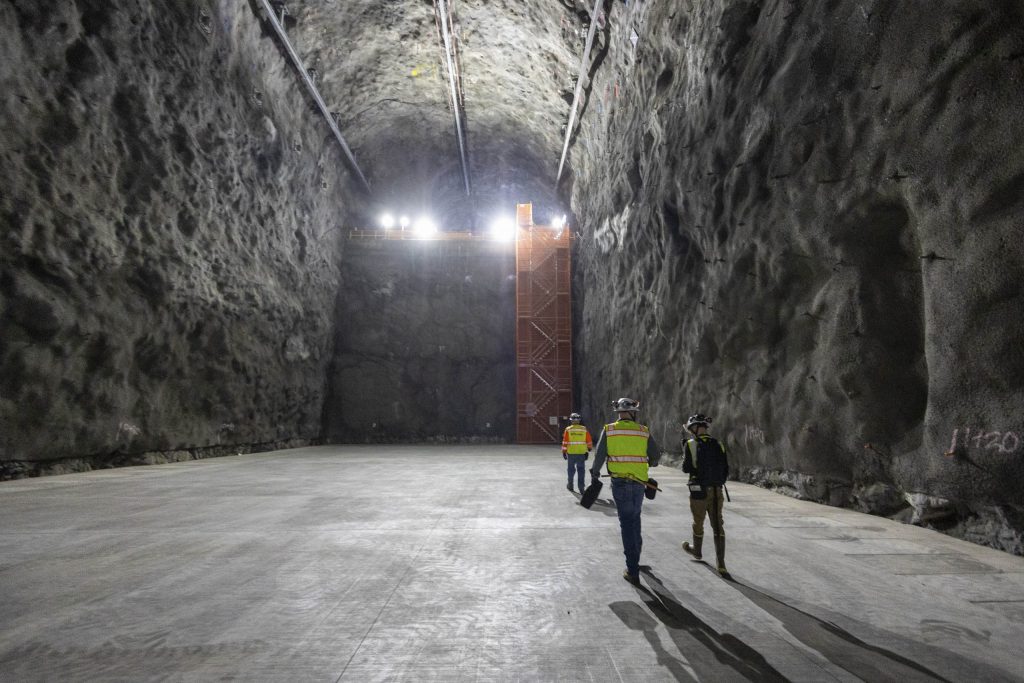
The U.S. Department of Energy’s Fermi National Accelerator Laboratory is not only one of the world’s premier particle physics and accelerator research facilities but also a key innovation hub for DOE in its goals of advancing cutting-edge fields that include quantum information science and artificial intelligence. Over the course of this year, Fermilab’s dedicated team of scientists, engineers, technicians and operations staff advanced the lab’s scientific mission through impactful new results, exciting collaborations and progress on essential projects that support its future as the neutrino research capital of the world. Building the neutrino capital of the world Fermilab is the host laboratory for the Deep Underground Neutrino Experiment, the largest neutrino experiment ever undertaken. The DUNE collaboration has grown to more than 1,500 collaborators from more than 35 countries and seeks to answer some of the biggest questions about our universe by studying elusive particles called neutrinos. The DUNE far detectors will be installed in the Long-Baseline Neutrino Facility a mile underground in new, massive caverns recently excavated in Lead, South Dakota, at the Sanford Underground Research Facility. With excavation finished, 2025 work centered on outfitting the underground research space with essential infrastructure such as power and utilities. This year, more than 3,000 tons of steel for DUNE’s far detectors arrived in South Dakota. An in-kind contribution from CERN, the steel will form the structures for the experiment’s cryostat modules that will house the far detectors, each measuring 216 feet long, 62 feet wide and 60 feet high. In April 2025, people walk through an LBNF/DUNE research space at the Sanford Underground Research Facility in Lead, South Dakota. Located nearly a mile below ground, this area will house a massive particle detector filled with liquid argon. Credit: Destyn Humann, Fermilab The powerful neutrino beam for DUNE will be generated by a new 215-meter-long linear particle accelerator, which is currently being built at Fermilab by the Proton Improvement Plan-II project. Construction at the PIP-II site made important progress, and in January 2025, an essential piece of equipment, the PIP-II coldbox, arrived at Fermilab after a two-month voyage from France. It is now installed in the Cryogenic Plant Building on the PIP-II site in Batavia. In October, the PIP-II collaboration received authorization for use and possession of the High-Bay Building, part of the in-progress Linac Complex. This allows the collaboration to begin installing accelerator components and support equipment, first focusing on components previously installed in the PIP-II Injector Test Facility. Soon, they will take on management of the linac tunnel, which will allow them to continue installing technical components like the cryogenic transfer line, radiofrequency waveguides and related infrastructure. Construction continues on the PIP-II site at Fermilab, reaching important milestones. Credit: Ryan Postel, Fermilab Producing exciting new results on the Intensity Frontier In 2025, Fermilab researchers presented impactful new science results, and their work was published in more than 540 scientific papers in highly respected journals. As a vivid example of Fermilab’s scientific leadership, this year brought the long-awaited third and final measurement of the muon magnetic anomaly by the Fermilab Muon g-2 collaboration. Released in June, the result agrees with their published results from 2021 and 2023 but with a much better precision of 127 parts per billion, making it the world’s most precise measurement of the muon magnetic anomaly. While there are still disagreements about the predicted value among theorists, this experimental measurement is a tremendous achievement of precision. It also marks an end to the Muon g-2 experiment’s main analysis — though scientists will perform more analyses with the data, including measuring a property of the muon called the electric dipole moment and testing a fundamental property of physical laws known as charge, parity and time-reversal symmetry. The Muon g-2 collaboration presented their third and final measurement results of the muon magnetic on June 3, 2025, at Fermilab. Credit: Ryan Postel, Fermilab Along with the Muon g-2 results, Fermilab advanced a variety of particle physics research initiatives this year. Fermilab’s Short-Baseline Neutrino Program consists of three liquid-argon time projection chamber experiments — SBND, MicroBooNE and ICARUS — that use the Booster Neutrino Beam to study neutrino oscillation. SBND, the Short-Baseline Near Detector, now beginning its second year of operation, sees about 7,000 neutrinos per day — the largest sample of neutrino interactions in liquid argon in the world. The collaboration presented some of their initial data this year, and they aim to publish their first cross-section measurement in 2026. MicroBooNE has been working to find evidence for a fourth neutrino — the sterile neutrino, which could explain anomalous behavior observed by prior experiments. Shortly after celebrating the 10th anniversary of its start of operations, MicroBooNE published a new result in Nature on Dec. 3 that ruled out the possibility of a single sterile neutrino with 95% certainty. This achievement may compel physicists to look elsewhere to solve one of the neutrinos’ many mysteries. The far detector for the SBN Program, ICARUS, celebrated five continuous years of data collection. Over the past year, the collaboration published and produced various analyses about physics beyond the Standard Model, dark matter candidates, neutrino cross-sections, the performance of the detector, and more. All three detectors contribute to the development of particle detection technology for DUNE, and in 2025, the Booster Neutrino Beam itself achieved record-breaking beam delivery. Elsewhere on the Fermilab site and beyond, the NuMI Off-axis νe Appearance experiment, or NOvA, is a long-baseline neutrino experiment studying a phenomenon called neutrino oscillation. In October, the NOvA collaboration published joint results with Japan’s T2K collaboration in Nature. This initial analysis provides some of the most precise neutrino-oscillation measurements in the field, adding to physicists’ knowledge about the particles and paving the way for DUNE and other future and current neutrino experiments. The first Mu2e tracker module is successfully moved from the production clean room to the Mu2e experiment hall. Credit: Ryan Postel In November, researchers at Fermilab moved the final subdetector for the Mu2e experiment into the experiment hall, marking a major step forward for the collaboration. Once completed, Mu2e will search for a rare muon conversion that may unlock evidence of physics beyond the Standard Model. Advancing the Energy Frontier on an international scale As the host institution for U.S. scientists working on the CMS experiment at the CERN international particle physics laboratory, Fermilab had the opportunity to contribute to another record-breaking year for CERN’s Large Hadron Collider, the most powerful particle accelerator in the world. This year, CMS recorded a total integrated luminosity — the number of particles colliding in an area at a time — of nearly 500 inverse femtobarns, far surpassing expectations. Fermilab’s CMS team was essential to enabling the recording of this data. The CMS collaboration produced an updated suite of the most precise measurement of the Higgs boson’s properties and new limits on its self-coupling. The LHC is undergoing a major upgrade to become the High-Luminosity Large Hadron Collider. Several components for this are being developed, assembled and tested by the HL-LHC Accelerator Upgrade Project, a consortium of U.S. national laboratories and institutions that includes Brookhaven National Laboratory, Lawrence Berkeley National Laboratory and Fermilab. Among the components are four quadrupole accelerator magnets that Fermilab shipped to CERN earlier this year. These quadrupoles weigh 25 tons each and contain everything needed to focus the proton beams that will pass through their cores. Making strides toward solving mysteries of the universe Fermilab has eyes on the skies with DESI, the Dark Energy Spectroscopic Instrument, an international experiment managed by Lawrence Berkeley National Laboratory. Fermilab contributed key components to DESI, aiding in the exploration of the far reaches of the universe. In 2025, the DESI collaboration published new results and released the largest 3D map of the universe yet. The results found that combining the DESI data with other experiments shows signs that the impact of dark energy may be weakening over time — and the model of how the universe works may need an update. DESI observes the sky from the Mayall Telescope in Arizona, shown here beneath the bright band of the Milky Way galaxy. Credit: NOIRLab/NSF/AURA/R.T. Sparks Meanwhile, in October, data from the Fermilab-led Dark Energy Survey found that the current model of the universe is still the best description of what we observe. The new results were from a study led by University of Chicago scientists in which they cataloged the universe by mapping huge clusters of galaxies. The DES collaboration expects to announce updated cosmology results early in 2026. Recently, Fermilab scientists finished installing the dark-matter experiment SuperCDMS at SNOLAB, a 6,000-square-yard underground space in an active nickel mine in Sudbury, Canada. Hosted by SLAC National Laboratory, SuperCDMS has more than 100 members from 25 institutions in North America, Europe and Asia. After they finish this current period of cooling and testing, the collaboration aims to start collecting data in early 2026. Fermilab also completed construction of its laser laboratory for the world’s largest vertical atom interferometer, called MAGIS-100. With the goal of discovering new physics, the research space will house state-of-the-art lasers for a quantum sensing device capable of seeing the tiniest signals emanating from the farthest reaches of the universe. Leading the way in quantum and AI research Fermilab is the home of the Superconducting Quantum Materials and Systems Center, one of five research centers DOE funds as part of a national initiative to develop and deploy the world’s most powerful quantum computers and sensors. In November, DOE renewed SQMS funding for another five years — a momentous achievement for the center and for Fermilab. SQMS made important research contributions in its fifth year. These achievements included groundbreaking demonstrations of superconducting coupled systems with impressively longer lifetimes that open the path to more powerful qudit-based quantum computers; advancing the understanding of defects and disorder that lead to variations in the performance of quantum devices; new approaches for quantum arithmetic that could facilitate the use of quantum computers in medicine; and new methods for experimental modeling that result in improved limits on the question of quantum mechanics behaving nonlinearly. In December, Fermilab and SQMS hosted Exploring the Quantum Universe – a Fermilab Quantum Symposium. The event attracted over 600 attendees representing more than 100 different organizations. The two-day event brought together leaders from across the global quantum community to reflect on recent progress and outline next steps for the field. Since 2020, SQMS researchers have produced 306 publications and 10 patent applications. SQMS now has 43 collaborating institutions, including new industrial partners.
Professor Jun Ye of the University of Colorado Boulder delivers the keynote talk for “Exploring the Quantum Universe — A Fermilab Quantum Symposium” in December. Held in Fermilab’s Ramsey Auditorium, the talk focused on scaling up quantum systems for clock and fundamental physics. Credit: JJ Starr, Fermilab Fermilab is involved in more quantum research beyond SQMS. At Fermilab’s NEXUS laboratory — the Northwestern Experimental Underground Site — researchers measured correlated charge noise in superconducting qubits underground for the first time. Their results, published in Nature in November, will inform future dark matter detection research and provide invaluable insights into how to optimize quantum sensors by reducing background noise. To harness the power of artificial intelligence and ensure that AI advances are incorporated efficiently, Fermilab inaugurated the AI Coordination Office. This cross‑laboratory team serves as the central hub for strategic planning, mapping AI opportunities to scientific and operational priorities while aligning them with DOE’s objectives. It also aims to bring state-of-the-art tools to Fermilab staff and tailor them for high-energy physics‑specific use cases. In November, DOE announced the Genesis Mission, an initiative that links the national laboratories with industry and academia to harness frontier AI and quantum science. Fermilab is primed to play an important role, both as a creator of cutting‑edge AI methods and as a steward of the high‑energy physics mission. And Fermilab is already leveraging artificial intelligence to drive greater efficiency and productivity across both scientific research and day-to-day operations. Fermilab delivered a number of high‑impact AI achievements, including tools and techniques for intelligent sensing, AI-ready datasets for particle collision data, AI tools for accelerator operations, new ML-accelerated models to speed up simulations of CMS and accelerator systems, and more. In 2025, the lab continued participation in the Tachyon Project, which will model the entire distributed infrastructure required to transmit and analyze data from DUNE to the computing facilities at Fermilab and Argonne National Laboratory in near real-time. The goal is to develop end-to-end models, using artificial intelligence and machine learning techniques, of the data paths used by current neutrino experiments and apply those models to develop data paths and workflows for DUNE. Making breakthroughs in emerging technologies In November, DOE announced a partnership between Fermilab and the company Qblox, under which Qblox will coordinate manufacturing, distribution and support for the Quantum Instrumentation Control Kit, or QICK, to advance U.S. quantum research and workforce development. Originally developed at Fermilab, QICK is an open-source platform for managing quantum readouts and controls. It plays a critical role in synchronizing quantum processors and sensors, making it a foundational technology for the growing quantum ecosystem. Also in November, Fermilab installed a major piece of a new facility called MAGNet Environment Simulator, or MAGNES, that can support efforts to harness fusion energy. MAGNES will test superconducting cables that could be used for a future fusion reactor, which, when cooled to extremely low temperatures, lose all electrical resistance and can carry very high currents essential for generating powerful magnetic fields. The facility’s fundamental magnet research will produce valuable insights into the electromagnetic and mechanical properties of superconducting magnets, advancing government, international and private fusion energy projects alike. Scientists expect MAGNES to become operational within the next few years. The MAGNES cryomodule is installed at the High Field Vertical Magnetic Test Facility. Credit: Ryan Postel, Fermilab Honoring Fermilab’s past, inspiring the future Fermilab closed out 2025 with a ceremony to officially name the Integrated Engineering Research Center in honor of the late Dr. Helen Edwards, a legendary physicist at Fermilab who oversaw construction of the Tevatron particle accelerator. The newly-named Helen Edwards Engineering Research Center is an 80,000-square-foot, multistory laboratory and office building adjacent to Fermilab’s iconic Wilson Hall. The new space is a collaborative laboratory where engineers, scientists and technicians tackle the technical challenges of particle physics and pioneer groundbreaking technologies. Fermilab’s achievements reflect the lab’s enduring commitment to discovery, technological innovation and service to the scientific community. From advancing next-generation accelerators and quantum technologies to delivering groundbreaking physics results and pioneering AI and machine learning research, Fermilab continues to push the boundaries of knowledge and strengthen the foundation for the discoveries of tomorrow.
Fermi National Accelerator Laboratory is America’s premier national laboratory for particle physics and accelerator research.
Fermi Forward Discovery Group manages Fermilab for the U.S. Department of Energy Office of Science. Visit Fermilab’s website at www.fnal.gov and follow us on social media. Recommended reading View all news MicroBooNE celebrates tenth anniversary at Fermilab December 12, 2025 liquid argonMicroBooNEneutrinosparticle physicsFermilab feature The experiment demonstrated the power of liquid-argon time projection chamber technology for neutrino research, and to date, the collaboration has published more than 80 scientific papers, helping lay the foundation for Fermilab’s neutrino research program. Fermilab teams up with Proficio to develop water treatment system targeting PFAS December 9, 2025 accelerator applicationsemerging technologiesIARCPFASPress release Fermilab and a Chicagoland firm Proficio Consultancy are teaming up to develop a specialized water treatment system that uses beams of electrons to destroy harmful chemicals in water. Fermilab celebrates new era of quantum innovation with ‘Exploring the Quantum Universe’ December 4, 2025 emerging technologiesquantumSQMSFermilab feature Fermilab is hosting a national symposium that brings together experts from across the quantum information science community. The event comes as the United States expands its leadership in quantum technology and underscores Fermilab’s increasing emphasis on QIS research.