
Fermilab-led study advances development of sophisticated quantum sensors to track high-energy particles and detect dark matter
Summarize this article with:


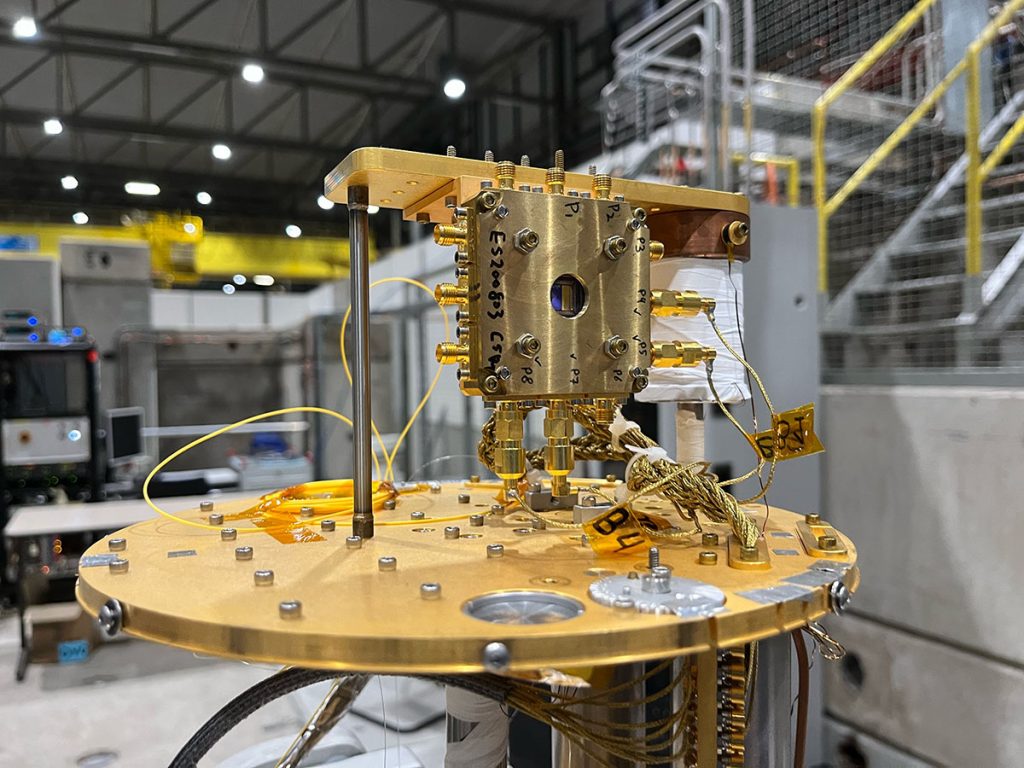
Scientists at the U.S. Department of Energy’s Fermi National Accelerator Laboratory and several collaborating institutions are using a new type of quantum sensor called a superconducting microwire single-photon detector — or SMSPD — to improve particle detection efficiency and timing, characteristics essential for future accelerator-based experiments and dark matter detection experiments. The research is led by Fermilab, and collaborators include Caltech, NASA’s Jet Propulsion Laboratory and the University of Geneva. This study builds on previous research conducted at Fermilab, which determined SMSPD sensors could efficiently detect individual high-energy charged particles like protons, electrons and pions. A superconducting microwire single-photon detector, or SMSPD, under study. Scientists are investigating the use of these devices in future particle accelerators. Building on work conducted at Fermilab, this study took place at CERN’s test beam facility. Credit: Christina Wang, Fermilab The new study, conducted at CERN, takes the development of these high-efficiency sensors one step further by demonstrating improved particle detection efficiency and time resolution using sensors made from a thicker tungsten silicide film than that used previously. The thicker the wire, the better its ability to absorb energy from charged high-energy particles. “This research is significant because it shows improvement from our initial measurements using SMSPDs for charged particle detection,” said Cristián Peña, a scientist at Fermilab who led the study. “In addition, for the first time, we used SMSPDs to measure the detection efficiency of muons, potentially expanding their use for new avenues of exploration,” said Peña. An international collaboration is investigating the feasibility of using muons in a future high-energy muon collider. Because of their unique properties and behaviors, scientists use these particles — 200 times heavier than electrons — to explore fundamental forces and particles. Future particle physics experiments will require more powerful, more intense colliders that produce millions of events per second. Within these events, detectors must be able to detect and track individual particles in both space and time with increasing precision. SMSPD sensors show great potential for this. A research team led by Fermilab conducted a study to test the ability of superconducting microwire single photon detectors to efficiently detect high-energy particles at CERN’s accelerator test beam. Their research represents a significant step forward in determining SMSPD suitability for use in next-generation detectors. Pictured in the front row, from left to right, are Cristián Peña, Thomas Sievert, Manish Sahu, Alex Albert, Elise Sledge, Adi Bornheim, Christina Wang and Artur Apresyan. In the back row, from left to right, are Shuoxing Wu, Towsif Taher, Guillermo Reales Gutierrez and Boris Korzh. Credit: Cristián Peña, Fermilab Compared to superconducting nanowire single photon detectors, or SNSPDs, the larger active area afforded by SMSPDs enables greater opportunity to track charged particles. This makes them ideal, not only for future accelerator-based experiments but for also seeking dark matter, and exploration of this new technology continues at a rapid pace. In a separate study recently published in the Journal of Instrumentation, some of the same scientists involved in the research above conducted the first detailed temperature-dependent study of an SMSPD sensor array to use in low-background dark matter detection experiments. “We are continuing to make strides in developing these sensors with greater precision and greater efficiency to meet the needs of next-generation particle accelerators,” said Si Xie, a scientist at Fermilab and joint appointee at Caltech. “We still have a lot of work to do, but this research shows we are progressing very well. We are excited to continue studying and improving these devices so they can help facilitate new physics discoveries.” Fermi National Accelerator Laboratory is America’s premier national laboratory for particle physics and accelerator research.
Fermi Forward Discovery Group manages Fermilab for the U.S. Department of Energy Office of Science. Visit Fermilab’s website at www.fnal.gov and follow us on social media. Recommended reading View all news DOE national quantum research centers reach breakthrough towards building scalable quantum computers February 26, 2026 emerging technologiesionsmicroelectronicsquantumquantum electronicsqubitsPress release A partnership between the Quantum Science Center and the Quantum Systems Accelerator, two U.S. Department of Energy national quantum information science research centers, has enabled a breakthrough by Fermilab and MIT Lincoln Laboratory. Researchers used cryoelectronics to control ion traps, a key step toward realizing scalable quantum computers. Fermilab completes laser lab construction for world’s largest vertical atom interferometer January 7, 2026 emerging technologieslaserMAGIS-100quantumFermilab feature Construction of a laser laboratory that will house state-of-the-art lasers necessary to run the experiment’s 100-meter atom interferometer is complete. This is an important step in building a quantum sensing device capable of seeing tiniest of signals emanating from the farthest reaches of the universe to discover new physics phenomena. SQMS Center team from Fermilab and NYU Langone advance in NIH Quantum Computing Challenge January 6, 2026 partnershipquantumquantum computingSQMSFermilab feature Magnetic resonance imaging, commonly known as MRI, is a cornerstone of modern medical diagnostics. Now, a collaboration from Fermilab and NYU Langone Health, both partners in the Superconducting Quantum Materials and Systems Center, takes this technology a step further with Quantitative MRI.