
Clearest Black Hole Collision Ever Recorded Puts Einstein to the Test
Understand this faster with AI


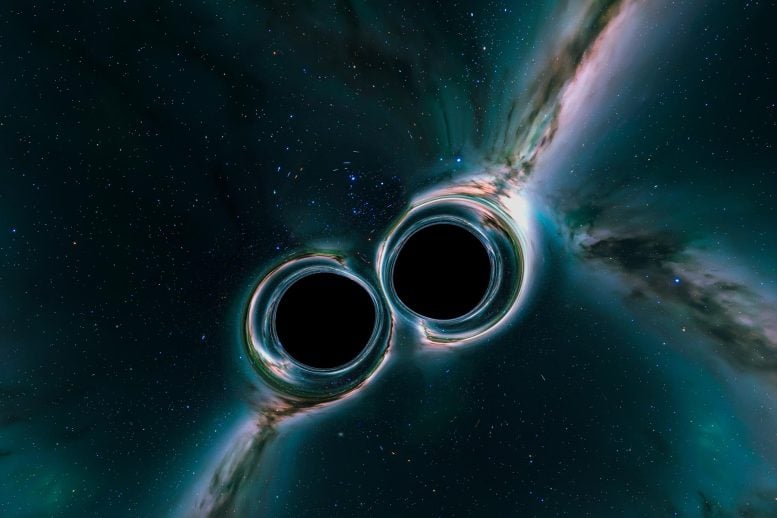
JunggooLee on February 5, 2026 11:42 am BC Memo 2602060403_Source 1. Reinterpretation [] Source 1. https://scitechdaily.com/clearest-black-hole-collision-ever-recorded-puts-einstein-to-the-test/ 1. _The clearest image of a black hole collision ever recorded puts Einstein’s theory to the test. _The record-breaking gravitational waves generated by the merger of two black holes have provided scientists with the most detailed opportunity to test Einstein’s theory of gravity. _The most powerful black hole collision ever observed has given Einstein another victory and raised hopes that the next collision might overturn the laws of gravity. _For scientists tracking gravitational waves from deep space, GW250114 is a very special event. This is the most precise gravitational wave signal ever detected from a pair of merging black holes, providing researchers with a rare opportunity to closely examine Albert Einstein’s theory of gravity, or general relativity. 1-1. “What’s remarkable is that this event is nearly identical to the first gravitational wave event, GW150914, observed 10 years ago. It’s much clearer because the detectors have improved significantly in the past decade,” said Keef Mittman, a professor of physics at Cornell University and a NASA Hubble Postdoctoral Fellow. This discovery was a global collaboration. -a2. [Gravitational waves from the collision of two black holes quake spacetime. Einstein’s discovery serves as a new standard for gravity. *(Albert Einstein’s General Theory of Relativity (1915) Einstein explained that gravity is not simply a force, but a geometric phenomenon caused by mass warping spacetime. This theory suggested that in the presence of a strong mass, spacetime could be so distorted that even light could not escape. 2. Schwarzschild’s Mathematical Solution (1916) German physicist Karl Schwarzschild solved Einstein’s equations of general relativity and mathematically demonstrated how a spherical mass distorts the surrounding spacetime. He mathematically demonstrated that when a mass is compressed below a certain size (the Schwarzschild radius), a region is formed within it where the escape velocity exceeds the speed of light, meaning nothing can escape.) —Black holes are celestial bodies first predicted through mathematical gravitational collapse calculations based on general relativity, which addresses the distortion of spacetime. Is this tremor limited to the theory of relativity and Schwarzschild’s mathematical solution? My mathematical thinking is that it isn’t. Oh, my. 0441. —qvixer implies a collision of two or more galaxy systems with eqpms.dark_energy. 0415. This theory is the most optimal point for detecting gravitational waves. 】 1-2. Mittman is one of the authors of a research paper titled “Black Hole Spectroscopy and Verification of General Relativity Using GW250114,” published in Physical Review Letters on January 29. The research was conducted by the LIGO Scientific Collaboration, in collaboration with the Virgo Collaboration in Italy and the KAGRA Collaboration in Japan. Scientists at Cornell University have been deeply involved in the LIGO-VIRGO-KAGRA project since its inception in the early 1990s. 1-3. The gravitational wave, dubbed GW250114, was generated when two black holes collided, generating ripples across spacetime. This signal reached the Laser Interferometer Gravitational-Wave Observatory (LIGO) in the United States on January 14, 2025. 2. Gravitational waves are named based on the date they are detected, and the LIGO-VIRGO-KAGRA team officially announced the event in September 2025. According to the researchers’ analysis, the signal is consistent with the predictions of general relativity. At the same time, scientists believe that future black hole mergers may exhibit unique behavior, providing an opportunity to explore the fundamental laws that govern the universe. 2-1. Listening to the Black Holes’ Ringing When two black holes merge, the newly formed black hole vibrates like a bell. Mittman explained that these vibrations produce a distinct tone, defined by two measurements: vibration frequency and decay time. Scientists can estimate the mass and spin of a black hole by detecting a single tone. Detecting two or more tones allows multiple independent measurements of the same property, as predicted by general relativity. 2-2. “If two measurements agree, you’ve essentially verified general relativity,” said Mitman. “But if you measure two signals whose mass and spin combinations don’t match, you can investigate how far they deviate from general relativity’s predictions.” In the case of GW250114, the signal was strong enough that researchers were able to measure two distinct tones and determine the range of the third. All of these measurements were consistent with Einstein’s theory. 3. Why do physicists pay attention to deviations? What would it mean if the tones didn’t match? “If that were the case, then as physicists, we would have had to do a lot of research to explain what was happening and what the true theory of gravity of our universe is,” said Mittman. He and his colleagues believe that gravitational waves observed in the future may not completely follow general relativity, which could provide answers to unanswered questions. 3-1. Many physicists already doubt that general relativity is the definitive explanation of gravity. As Mittman points out, the theory fails to explain gravitational phenomena associated with dark energy and dark matter, and it faces limitations when scientists try to reconcile it with the laws that describe the quantum realm. -a1.【 There is a general theory that gravitational waves originate from black hole collisions (qqcell). This is defined as qqcell.nqvixer.eqpms. 0443. If the gravitational waves have different tones, the traces of the black hole collisions become more complex. Structural collisions are caused by the different vixer structures of the objects or by the sequential overlapping of other traces on top of the traces that suggest the scale of the collision in space and time. —In this case, the black hole indicates a different gravitational wave tone at another qqcell location. 0347. 0400. —The problem is that it’s entirely possible for more than two objects to collide or merge. —sample2.eqpms hints at this. These all occur in the qpeoms.Decomposition.unit of msbase.msoss. Hmm. 0351. —Of course, the gravitational wave tone changes at any time. This situation wouldn’t be consistent with the theory of relativity. Hehe. 0354. 】 _”For our theory of gravity to be consistent with quantum mechanics, there must be a way to resolve this paradox,” said Mitman. “In that context, we expect some deviation from Einstein’s classical prediction, and we may see traces of quantum gravity appear in the gravitational wave signal.” _”Our hope is that one day we will be able to observe these deviations, which will help us figure out what the true theory of quantum gravity might be.
Tags
Source Information
Discussion
0 professional contributions
Sign in to join this professional discussion.
Be the first to add a constructive contribution.