
Building up the quantum workforce: an undergraduate route into industry
Summarize this article with:


Frédéric Sarazin, director of quantum at the Colorado School of Mines in the US, talks to Tushna Commissariat about the industry demands and workforce needs of the quantum sector, and why he helped to establish the first quantum systems engineering bachelor’s degree in the US Training ground PhD students working with associate professor of physics Meenakshi Singh (left) on the dilution refrigerator in one of the quantum labs on the Colorado School of Mines campus. The quantum labs will also be used by students on the new bachelor’s degree in quantum systems engineering at Mines. (Photo by Tim Meyer. © 2024 Colorado School of Mines) Quantum technologies are undoubtedly going to have a large impact on our world, potentially revolutionizing everything from healthcare and the environment, boosting the economy and helping with large-scale optimization challenges. But for them to deliver on these many promises, it will be vital for many countries to train and build a quantum-ready workforce. There are four pillars to the quantum sector – quantum computing; quantum simulation; quantum communication; and quantum sensing and metrology. But in each case there is a lack of trained individuals who can take on jobs across the board. Indeed, statistics in both the UK and the US suggest there is only one qualified worker for every three quantum jobs. With governments continuing to invest lots of money into national quantum programmes; a growing number of new quantum start-ups being launched; and ever more multi-national firms zoning in on quantum, the shortage of those with the right skills to work across the sector is expanding.
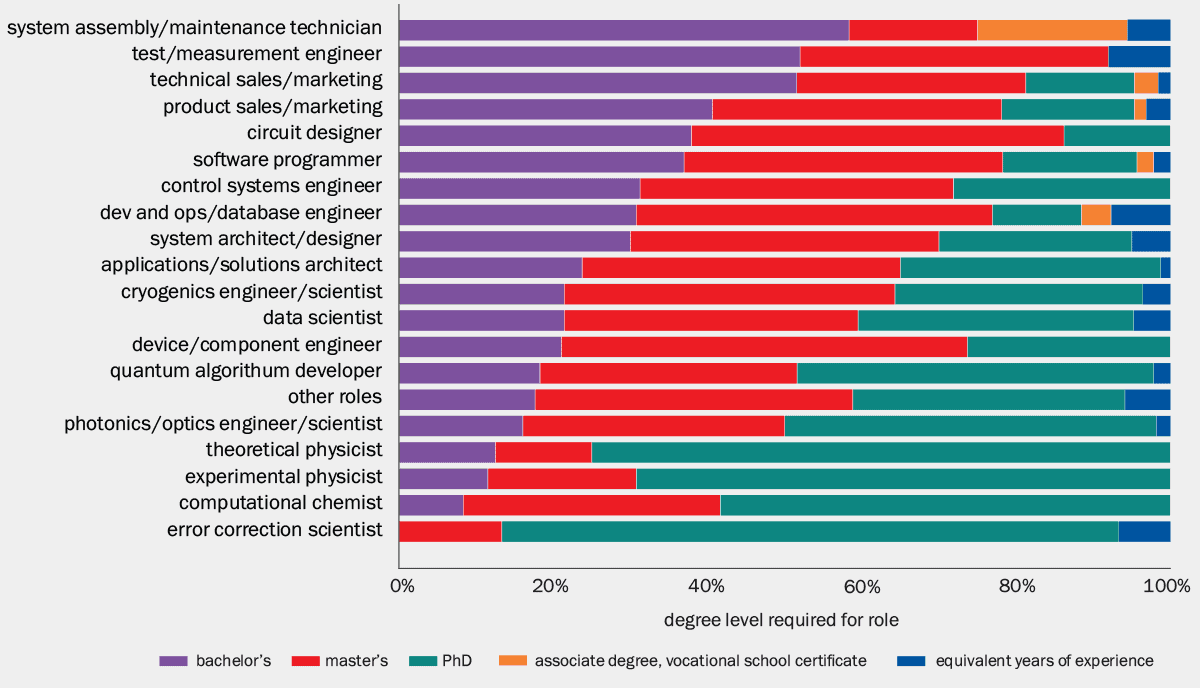
The Colorado School of Mines in the US is now trying to remedy this situation by launching the country’s first bachelor-level quantum systems engineering degree programme, due to start this autumn. An undergraduate degree specializing in quantum and systems engineering might, at first glance, seem odd. But 2021–2023 data from the Chicago Quantum Exchange show that 55% of quantum tech jobs only require a BSc or two-year associate degree. For instance, roles that ask for just a BSc include systems assembly and maintenance, measurement engineers, technical sales and marketing. “Industry demand especially values engineers with a systems-level understanding of quantum devices, and there is also a need for quantum technicians who can build and maintain quantum hardware,” says Frédéric Sarazin, director of the quantum programme at Colorado School of Mines. As the first standalone bachelor’s degree in quantum systems engineering in the US, the programme is designed specifically to supply industry-ready graduates. True requirements Distribution of degrees needed for different job roles in the quantum industry. (CC BY 4.0 IEEE Transactions on Education 65 592) The main focus for Sarazin and colleagues was to bring into the programme key aspects of systems engineering – which involves understanding and overseeing all aspects of a complex system, from its inception through to practical production, and even managing the final product. The goal: to help companies get their products and technologies out of the lab and into the marketplace. Rather than focusing on isolated components, systems engineers are trained to understand how complex technologies behave as integrated entities. “A quantum computer, for example, is more than just its qubits,” says Sarazin. “It’s cryogenics, optics, electronics, control software, signal processing and the user interface, all interacting with each other.” Companies are keen to hire people who can understand and help develop their quantum product as an end-to-end system, bridging the gap between the physics and engineering aspects, as well as making sure the end product is robust, scalable and manufacturable. The physics may be what Sarazin calls the “secret sauce” – but turning it into a device that is reliable, manufacturable and maintainable is an engineering problem “with a quantum flavour to it”. “What companies want is people who understand the product as a system, from beginning to end,” Sarazin explains. Quantum hotspot Colorado, in America’s mid-west, is a quantum innovation hotspot, with quantum companies employing more than 3000 people across the state. To develop the new programme, Sarazin and colleagues carried out an extensive consultation process with companies, institutions and organizations that all look to hire quantum engineers, to get a clear idea of the skills that students should have at the end of their course. They also collaborated with Elevate Quantum – a consortium of 120 organizations advancing quantum workforce development and commercialization in Colorado, New Mexico and Wyoming – to design an interdisciplinary course that will integrate physics, electrical and mechanical engineering, computer science and engineering design. While the students will learn plenty of foundational quantum physics, they won’t cover the full curriculum of a traditional physics degree. “You’d be talking about a six-year degree if we covered everything,” says Sarazin. Certain advanced topics, such as quantum error correction, remain overwhelmingly in the domain of PhD-level jobs and so are deliberately excluded. The lab is meant to be a signature experience. It’s where students start interacting with industry in a meaningful way A key feature of this degree will be hands-on practical engineering experience in the lab. Plans are under way to build a dedicated quantum device laboratory for the students, allowing companies to bring in their tech and partner with the on-campus facilities. “The lab is meant to be a signature experience,” says Sarazin. “It’s where students start interacting with industry in a meaningful way.” That connection is reinforced through internships and a year-long design project in the final year, with project topics supplied directly by quantum companies. “The junior-to-senior year is when internships really matter,” explains Sarazin. “That’s often what leads directly to a job.” Future prospects Although the programme is firmly industry-focused and aims to get graduates straight into the job market, students can progress to the Colorado School of Mines’ existing master’s programme in quantum engineering, launched in 2020. “At the bachelor’s level, you’re building breadth,” says Sarazin. “If students want to specialize further, they absolutely can.” Many of the skills that the students will develop – from electronics and embedded systems to control software and algorithms – are highly transferable too. “Looking beyond the quantum sector, our systems engineering students will have acquired a set of skills that is highly applicable in other industries,” says Sarazin. The first cohort will likely be around 15–20 students this year. Looking ahead, Sarazin has a clear benchmark for success: “a near-100% placement in industry at the end of the degree – that’s what we’re aiming for”. Beyond that, success will mean continuously refining the programme in response to industry feedback. “This isn’t static,” Sarazin says. “If companies tell us something needs adjusting, we want to respond.” For students still hesitant to take the leap into a specialized BSc or the quantum sector, Sarazin’s message is clear: quantum careers are here to stay and the direct path into the industry is starting earlier than ever before. Want to read more? Registration is free, quick and easy Note: The verification e-mail to complete your account registration should arrive immediately. However, in some cases it takes longer. Don't forget to check your spam folder. If you haven't received the e-mail in 24 hours, please contact customerservices@ioppublishing.org. E-mail Address Register