
Anna Grassellino appointed to DOE Office of Science Advisory Committee
Summarize this article with:


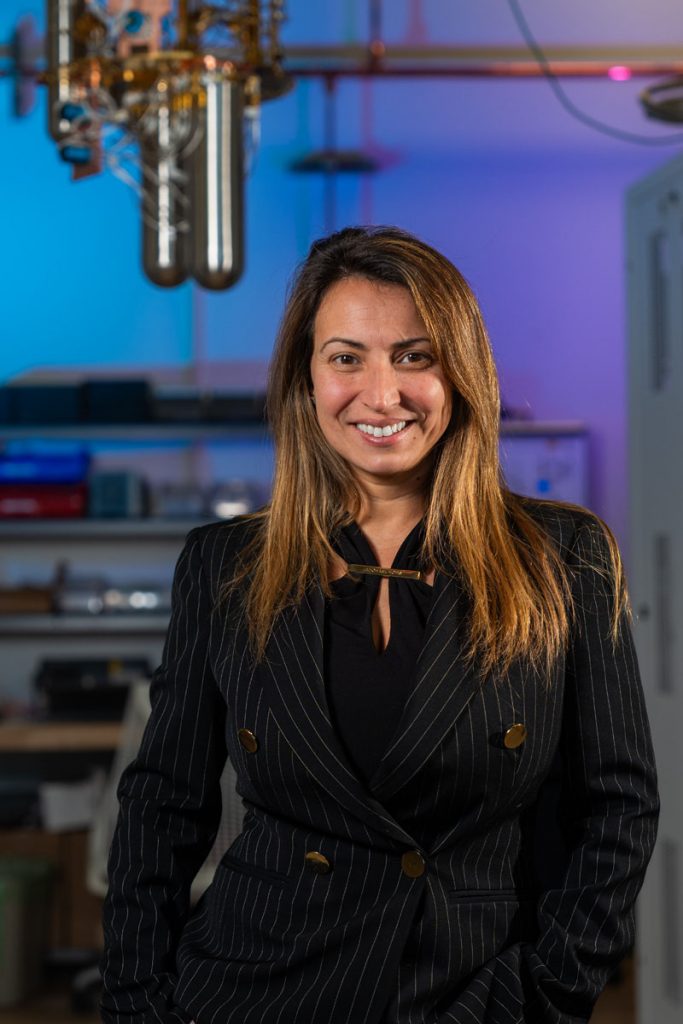
Anna Grassellino, chief technology officer and associate laboratory director for the Technology Directorate at Fermi National Accelerator Laboratory, has been appointed to the U.S. Department of Energy’s Office of Science Advisory Committee, known as SCAC — a federal advisory body that provides independent advice on scientific priorities and strategies. Grassellino will also serve as chair of the SCAC quantum subcommittee. In that role, she will help guide national efforts toward DOE’s 2028 goal for error-corrected quantum computers capable of addressing major scientific challenges. The subcommittee is also charged with exploring partnership opportunities and leveraging resources across the broad U.S. quantum ecosystem. These can include unique capabilities at national labs, innovations emerging in the private sector and resources across other federal agencies. SCAC provides guidance to the DOE Office of Science on major scientific and technical issues, including emerging opportunities and cross-cutting initiatives. The quantum subcommittee will assess the current state of quantum information science and identify the key steps needed to advance the field at the national level. “Anna brings a combination of scientific excellence, technical vision and leadership in large-scale quantum initiatives,” Fermilab Director Norbert Holtkamp said. “We congratulate Anna on this very important appointment and will fully support the committees and her work.” Anna Grassellino is chief technology officer and associate laboratory director for the Technology Directorate at Fermilab. Credit: Ryan Postel, Fermilab Grassellino is an internationally recognized physicist and director of the DOE’s Superconducting Quantum Materials and Systems Center, a national quantum information science research center led by Fermilab. Her work has advanced superconducting technologies for both accelerators and quantum systems, including innovations that have enabled record performance and new capabilities in superconducting devices. “I am honored to serve on SCAC and to chair the quantum subcommittee,” Grassellino said. “This is an important opportunity to help define a clear path forward for quantum information science and to accelerate progress toward fault-tolerant quantum computing.” Fermi National Accelerator Laboratory is America’s national laboratory for particle physics and accelerator research.
Fermi Forward Discovery Group manages Fermilab for the U.S. Department of Energy Office of Science. Visit Fermilab’s website at www.fnal.gov and follow us on social media.
The Superconducting Quantum Materials and Systems Center is one of the five U.S. Department of Energy National Quantum Information Science Research Centers. Led by Fermi National Accelerator Laboratory, SQMS is a collaboration of more than 40 partner institutions — national labs, academia and industry — working together to bring transformational advances in the field of quantum information science. The center leverages Fermilab’s expertise in building complex particle accelerators to engineer multiqubit quantum processor platforms based on state-of-the-art qubits and superconducting technologies. Working hand in hand with embedded industry partners, SQMS will build a quantum computer and new quantum sensors at Fermilab, which will open unprecedented computational opportunities. For more information, please visit sqmscenter.fnal.gov. Recommended reading View all news Fermilab’s new director clarifies mission and achieves progress in first 100 days April 24, 2026 AIDUNEGenesis MissonHL-LHC Accelerator Upgrade ProjectLBNFMAGIS-100quantumSQMSFermilab feature With a sharp focus on Fermilab’s core scientific mission, Norbert Holtkamp is establishing clear priorities and a disciplined strategy that align the laboratory with the nation’s most ambitious research goals. His leadership is positioning Fermilab for long‑term success. Yao Lu receives Early Career Award to harness quantum entanglement for dark matter search April 23, 2026 dark matterquantumSQMSFermilab feature Supported by a DOE Early Career Award, a Fermilab scientist is building a scalable superconducting cavity array to detect faint signals from mysterious dark photons with unprecedented speed and sensitivity. New electronically tunable quantum detector speeds up search for dark matter April 6, 2026 dark matteremerging technologiesquantumFermilab feature Scientists designed a state-of-the-art detector to electronically tune itself, enabling scientists to search broader frequency ranges for evidence of weak signals produced by dark photons — possible dark matter particles — much faster and more precisely than ever before.