
2 AI Stocks to Buy and 1 to Avoid
Summarize this article with:


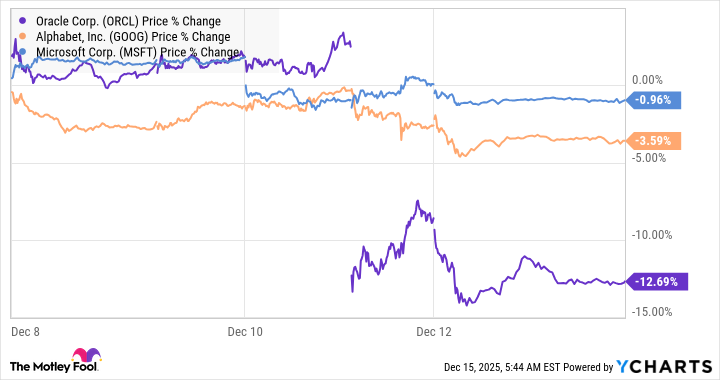
By Lee Samaha – Dec 17, 2025 at 8:49AM ESTKey PointsOracle's rising debt costs and CDS spreads signal increased risk.Microsoft and Alphabet remain financially stronger AI investments.Oracle's $300B OpenAI deal raises concerns about future profitability.These 10 Stocks Could Mint the Next Wave of Millionaires ›NASDAQ: GOOGLAlphabetMarket Cap$3.7TToday's Changeangle-down(-0.49%) $1.52Current Price$306.70Price as of December 16, 2025 at 3:59 PM ETTwo hyperscalers remain highly favored in the bond markets, and it's not hard to see why.There will always be winners and losers in any growth market, and recently, the markets have decided that Oracle (ORCL +1.97%) is at risk of being the latter. As you will see shortly, it's not necessarily a view that the markets are taking over its fellow hyperscalers, such as Alphabet (GOOG 0.51%) and (GOOGL 0.49%), and Microsoft (MSFT +0.45%). Equity markets and bond markets A quick look at the stock price chart shows Oracle's recent decline. ORCL data by YCharts That's only part of the story, however, as investors also need to keep an eye on the bond market. It's a particularly important point as hyperscalers are issuing debt (borrowing money) to support massive investment in AI infrastructure. As you can see below, it's an investment that has led to significant cash outflows at Oracle, whereas other hyperscalers, such as Microsoft and Alphabet, continue to generate substantial free cash flow, even after making substantial increases in capital spending. ORCL Free Cash Flow data by YCharts What the bond markets are saying As noted earlier, the bond markets, particularly bond yields and credit default swaps (CDS), are relevant. A higher bond yield reflects the greater risk implied in holding the bond to maturity. Therefore, you can compare bonds with similar maturities and assess the market's perception of risk, with a higher yield to maturity indicating a higher level of risk.Advertisement Image source: Getty Images. CDS are a form of insurance against the default risk of a bond. CDS are priced in terms of spreads, whereby a spread represents the annual payment that a buyer must make to guarantee the bond is paid out by the seller. It's priced in terms of basis points, whereby 100 basis points equals 1%. In other words, a $1,000 bond with a spread of, say, 200 basis points, means a CDS buyer needs to pay $20 a year to ensure the bond is paid out (interest payments and principal). A higher CDS spread indicates a higher risk of default. Starting with bond yield to maturity, here's a look at three bonds maturing in roughly five years' time. Clearly, the bond market is requiring a significantly higher yield to lend money to Oracle than to Alphabet and Microsoft over similar periods.
Company Maturity Date Yield to Maturity Alphabet Nov 2030 4.10% Microsoft Sep 2030 3.75% Oracle Sep 2030 5.10% Data source: tradingview.com Credit default swap spreads are soaring for Oracle Additionally, the bond market is growing increasingly concerned about the risk of default on Oracle's debt. The table below shows that CDS spreads for Oracle have increased significantly recently, while remaining consistent for Alphabet and Microsoft over the past year. 5 Year Credit Default Swap Spread 12 Months Ago 9 Months Ago 6 Months Ago 3 Months Ago Current Alphabet 50 basis points 45 basis points 40 basis points 50 basis points 45 basis points Microsoft 45 basis points 40 basis points 35 basis points 45 basis points 40 basis points Oracle 50 basis points 45 basis points 40 basis points 55 basis points 139 basis points Data source: multiple sources, including Bloomberg and S&P Global Market Intelligence What it means for investors Reading between the lines of the data, the market is starting to question Oracle's business strategy, particularly the $300 billion deal made with OpenAI, whereby Oracle will build data centers to support OpenAI's growth. The problems with the deal are that Oracle's recent results revealed its costs and capital commitments are higher than the market expected. There are question marks around OpenAI's financial future, given expectations of $143 billion in cash burn between 2024 and 2029. These concerns are significant, and matters will get more difficult if Oracle's borrowing costs continue to rise. All of which makes Oracle a stock to avoid if you want to invest in AI hyperscalers. Image source: Getty Images. Microsoft and Alphabet In comparison, Microsoft and Alphabet have already demonstrated their ability to build profitable cloud computing businesses with Azure and Google Cloud. Moreover, they have much stronger financial positions than Oracle, and the bond market's optimism reflects that. They are both investing to support their existing and successful cloud computing businesses. All told, if you believe in the AI revolution, then Microsoft and Alphabet are better ways to invest than Oracle.About the AuthorLee Samaha is a contributing Stock Market Analyst at The Motley Fool covering industrials, electricals, energy, materials, transportation, and infrastructure stocks. Prior to The Motley Fool, Lee was a Civil Engineer and Investment Manager. He holds a Bachelor of Civil and Structural Engineering from Southampton University and a Certificate in Investment Management from Chartered Institute for Securities & Investment. Lee first cut his investing teeth on The Motley Fool bulletin boards (commonly referred to as the “Fool Boards,”) and he’s infinitely grateful to all of the investors he learned from in this powerful investing community.TMFSaintGermainX@LeeSamahaRead NextDec 17, 2025 •By Keithen DruryIs Alphabet a Top Artificial Intelligence Stock to Buy for 2026?Dec 16, 2025 •By Daniel SparksAI Infrastructure: 1 Cloud Stock Poised for Explosive GrowthDec 16, 2025 •By Keithen DruryHere Are 3 Genius Nasdaq Stocks to Load Up on Before 2026Dec 16, 2025 •By Trevor Jennewine2 Artificial Intelligence (AI) Stocks to Buy Before They Soar to $5 Trillion in 2026, According to Wall StreetDec 16, 2025 •By Sean Williams3 Artificial Intelligence (AI) Stocks Billionaires Can't Stop Buying Ahead of 2026Dec 15, 2025 •By Neil PatelShould You Invest $1,000 in Alphabet Right Now?