
Fed Chair Powell Credits Automation and AI For This Exciting Boom in the Economy He "Never Thought" Was Possible
Summarize this article with:


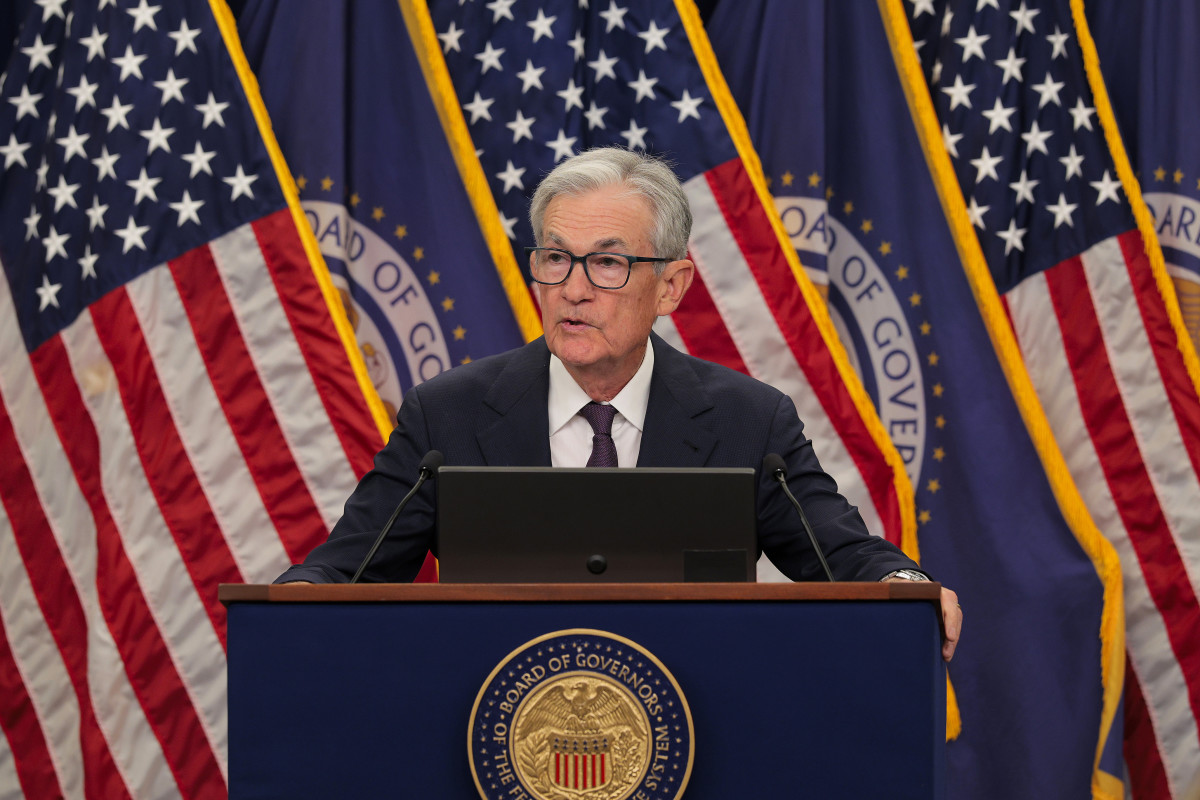
After announcing a widely expected quarter-point rate cut on Wednesday, many traders expected Fed Chairman Jerome Powell to strike a hawkish tone in the absence of economic data created by the government's recent shutdown -- offering caution about the trajectory of future cuts, as well as risks to the labor market and inflation.He offered the traditional rhetoric about persistent concerns, but with a surprising stroke of optimism. Despite the Fed stressing about a "shrinkin" labor market -- which it blames on lower immigration and a soon-to-be-declining working age population -- the Fed Board actually bolstered its expectations for the U.S. economy next year.The Fed's Summary of Economic Projections upgraded Real GDP Growth for 2026, now seeing the U.S. economy growing 2.3%, versus the 1.8% it expected at its September meeting. It also sees 2025 growth finishing at 1.7%, versus 1.6%. In addition, policymakers see PCE Inflation coming in lower to end 2025, plus declining further in 2026. It now sees year-end PCE at 2.9%, while 2026 rates are expected to decline to 2.4%. The Fed also kept its expectations for unemployment anchored. It sees unemployment peaking at 4.5% this year, before declining to 4.4% next year.At the press conference following the bank's decision, Chairman Powell credited a specific ingredient in the improved outlook: productivity. Economists measure a number of different forms of productivity as total outputs divided by total inputs. In its simplest form, labor productivity is real GDP divided by total hours worked in the economy. And in recent years, Powell says that there has been strength in the U.S. economy's productivity measures.In fact, the outgoing leader of the Fed said that he "never thought" he would see a situation where productivity growth was consistently over 2%, even as the job market shrinks. Powell says the Fed projects that the U.S. economy might be losing 40,000 more jobs per month than stated in the establishment report from the Bureau of Labor Statistics, an 'overreporting' that could mean the job market is already shrinking. Still, with productivity holding up, the U.S. economy might be able to sustain its already-envious economic growth -- at least with respect to the rest of the industrialized world -- even with less workers. AI + Automation = Productivitymaxxing?Powell cites strong productivity as a primary ingredient in the Fed's more robust forecast for 2026 -- as well as still-strong consumer spending and business investment -- which comes despite a "clear" softening in labor demand. His comments had an immediate impact on markets.As for why productivity might be so strong, Powell singled out greater business automation as likely contenders for the "structural" increase in productivity. AI was also namechecked."You can see the prospects for [higher] productivity," he says. Although, he does add that it could have implications for the labor market, especially if automation or AI disrupts certain jobs. However, when asked about how AI could be affecting the job market, Powell says that it's, "not a big part of the story... yet." He adds that -- despite prominent headlines about big companies conducting layoffs -- there has not been a significant surge in unemployment claims. Instead, the U.S. economy has remained in a "low hire and fire" environment. The dichotomy of higher productivity in the face of a shrinking job market gave markets a bullish injection on Wednesday. The Russell 2000 index jumped nearly 2%, the Dow added more than 1%, and the S&P 500 and Nasdaq finished the day on a strong note.How Does This Affect Rates?Although Powell's comments were more dovish than expected, many traders would consider this meeting's commentary to be hawkish. After three quarter-point cuts, Powell and many members of the Fed Board estimate that policy is now in the "plausible range of neutral."They don't see many more cuts ahead. The median rate for year-end 2026 is 3.4%, which would mean just one cut from today's new 3.50% to 3.75% rate. Traders are pricing in closer to two cuts, expecting that President Donald Trump's candidate for Fed Chair will be more amenable to cutting rates, putting aside the more academic conversation around r*.However, Powell did add that higher productivity could mean that the neutral rate could end up being higher in the long term -- that would be necessary if productivity proved to be so strong that it actually caused the economy to overheat.That isn't considered to be a risk right now, nor does a higher neutral rate necessarily mean that rates would be raised. In fact, Powell has said that nobody on the Fed Board thinks rates should be higher. (Among dissenters on the board at this meeting, two voted to hold rates at current levels; only one voted for a half a percentage point cut.)Instead, higher productivity could create an envious situation for the U.S. economy, one where the labor market could continue to shrink, but where economic growth continues to rise.